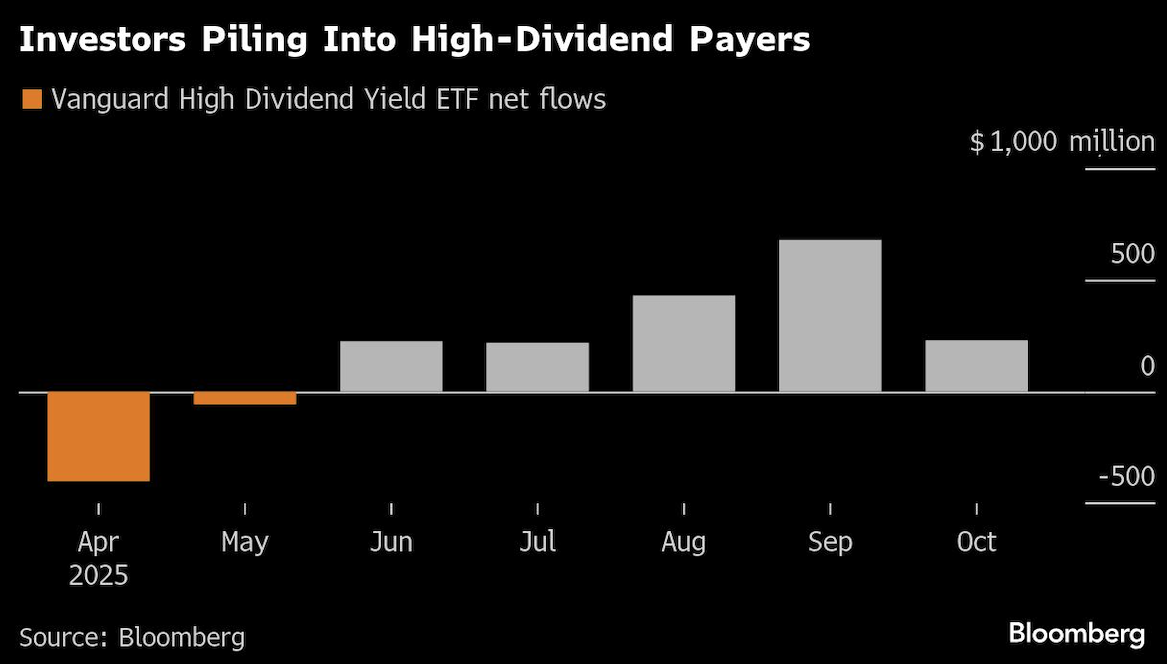
Rotation From Tech Leads Investors to Dividend-Paying Stocks
For most of the past three years, Big Tech had something to offer no matter the market environment: soaring profits in boom times, rock-solid balance sheets in times of stress.
But that latter profile has taken a hit in recent weeks, as the likes of Oracle Corp., Amazon.com Inc. and Meta Platforms Inc. tap the credit market for billions to fund artificial intelligence projects.
The result is the first sustained selloff for the group since April, with the Nasdaq 100 leading the broader market lower as investors ditch tech winners in favor of more defensive stocks. One of the beneficiaries: companies with juicy dividend payments.
That group, which includes old-economy stalwarts like Exxon Mobil Corp., JPMorgan Chase & Co. and Procter & Gamble Co., is often coveted when riskier stocks start to look expensive. They also tend to be calmer in times of turbulence. The Cboe Volatility Index jumped above 24 Tuesday, surpassing its long-term average of 19.
“It’s common for investors to favor dividend-paying stocks when overall market valuations look stretched. These stocks often trade at lower valuations, and the steady cash flows can help cushion volatility,” said Christopher Cain, Bloomberg Intelligence’s US quantitative equity strategist.
Bloomberg’s Magnificent 7 index has lost 7.6% since it peaked on Oct. 29, as investors grow concerned about the AI trade. The Vanguard High Dividend Yield ETF is down just 1.3% in the same time period.
The divergence is continuing a trend where tech is taking on its more traditional role as a growth sector, while defensive plays such as health-care, utilites and makers of household necessities come into favor.
Correlation between the Mag 7 and defensive sectors has fallen to 80%, according to 22V Research, underscoring the shift in risk appetite.
“The underlying theme is a rotation into industries that return a lot of cash,” the firm said. 22V’s long-short Cash Return factor — which tracks dividends and buybacks — is up 1.4% in the past week and 2% in the month, while broader indexes are down across the board. The dividend yield factor was the second-best performer on a weekly basis among the 12 tracked by Bloomberg Intelligence.