Inflation is the number-one public concern in Japan. But one section of the economy is proving to be invulnerable to rising prices: pop idols, YouTubers and cartoon characters.
The term oshikatsu has been on the lips of everyone from executives to the Bank of Japan in recent months. Lacking a good direct translation, the word means supporting your favorite idol, character, or artist. You can think of it as being like a dedicated Swiftie buying Taylor Swift’s merchandise and traveling long-distance to concerts — except that passion can be applied to almost anyone, real or fictional.
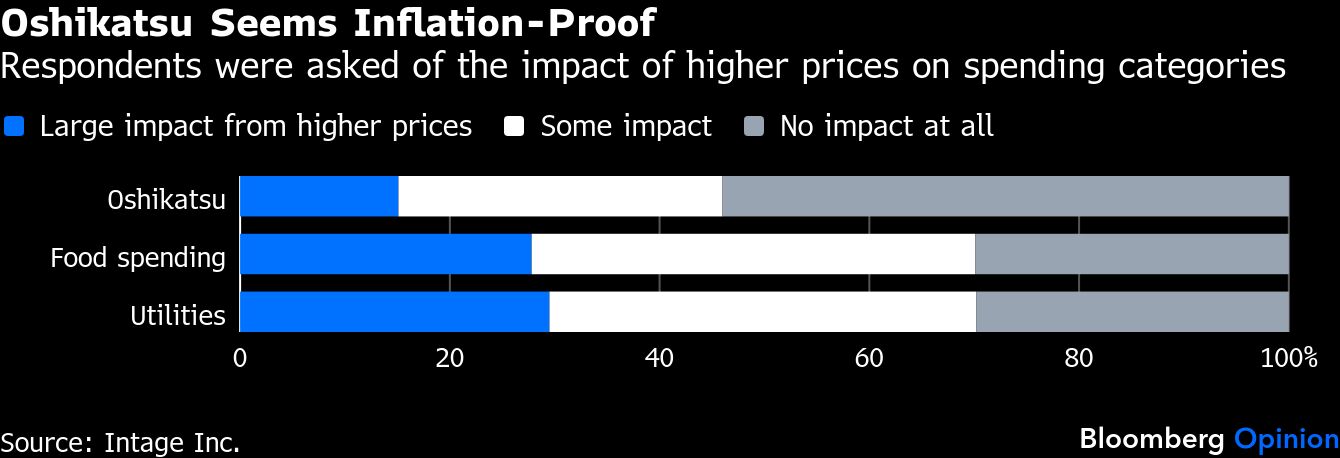
Sanrio Co. Chief Executive Officer Tomokuni Tsuji recently told the Nikkei that while consumers once used only disposable income on oshikatsu and entertainment, it’s now become a separate spending category — one unaffected by rising prices. One survey found that a majority of respondents said inflation or the weak yen had no impact whatsoever on their spending in the category, unlike others.

A market where raising prices don’t affect demand? That’s a capitalist’s dream. It’s one that industry research estimates at 3.5 trillion yen ($22.4 billion). About 10% of the Japanese population engages inoshikatsu — but importantly, more than 50% are those crucial arbiters of cool: teenage girls. That has even the central bank on notice: Since last year, it has highlighted the activity in its quarterly Sakura Report on regional economies, with one branch noting that “even as prices are being raised, merchandise sales are performing well, supported by strong oshikatsu demand.”
But perhaps you’re having a hard time understanding what it actually entails. Oshikatsu is written 推し活, with your oshi (推し) your favorite — i.e. if you’re a fan of BTS, that might be V; if you’re a fan of Manchester United like your long-suffering author, your oshi might be Portuguese midfielder Bruno Fernandes. But it doesn’t even have to be a real person — it can be an anime character, a virtual YouTuber or even a long-dead historical figure.
Katsu (活) means “activity” and can be appended to almost any noun, such as shuukatsu, “work activity” i.e. looking for a job typically as a college student. Put them together and you’ve got activities for your favorite, doing things to support the one you stan (that’s Gen Z slang for excessively enthusiastic fans).
The term grew out of the otaku nerd culture surrounding idol groups such as AKB48 in the late 2000s, with fans buying multiple copies of the same CD to improve their favorite’s chances in annual votes to choose which members got the spotlight. But that carries with it a certain air of unhealthy obsession.
Natsuho Tada, founder and chief executive officer of Oshicoco, a company that supports and analyzes fan culture, explains that during the pandemic the word came to describe something more mainstream and socially acceptable, as people started spending on collectibles and turning to virtual communities. It also involves a certain level of altruism and evangelizing — the key point is that you’re doing it for the sake of your oshi and to help promote them, not yourself (she herself stans Thai actors.)
Indeed, there can also be a vicarious, almost parasocial aspect, projecting one’s own ambitions onto your idol. “Everybody wants to be Shohei Ohtani, but you can’t just become like him,” Tada says. “But you can entrust your dreams to him and by supporting him, feel as if you’re sharing in those things you wanted to do but couldn’t.”
Spending can take many forms: not just buying branded goods but also owning the same things as your favorite — think of how the Labubu trend grew after Lisa from the K-pop band Blackpink was spotted sporting the doll. Fans are also willing to travel, whether to see a performance, or visit real-life locations where anime or games are set. That’s one reason the BOJ is interested: An activity that’s not only immune to inflation but also boosts regional economies is like the Holy Grail for the Japanese economy. Areas that can nimbly jump on this trend will benefit.
Despite the usual complaints that Gen Z have no money, Tada explains that they’re swapping the exorbitant expenses of past generations, like cars and fancy watches, for experiences. That’s in line with youth trends seen elsewhere, with a focus on collectibles, heavily influenced by the growth of Instagram and Tiktok and the formative experiences of isolation during Covid.
But it’s not just Gen Z — indeed, companies are now targeting older generations, who have more money to spend. And as I researched the topic, I started to wonder if perhaps we are all doing oshikatsu too. When I pay over the odds to watch my favorite boxer Naoya Inoue or buy his merch, is that not the same thing? The only reason I’ve ever been to Yokosuka, a city overlooking Tokyo Bay that houses a US naval base, was because it’s the location of the classic video game Shenmue. Perhaps we can go even more abstract: Tada agreed when I put it to her that my visits to far-flung craft beer breweries, and telling other people about them, could also count.
Perhaps, then, we’re all doing oshikatsu. After all, while inflation might be the biggest worry, some things just aren’t optional.
A message from Advisor Perspectives and VettaFi: Discover something new! Click here to register for our upcoming webcasts.
Bloomberg News provided this article. For more articles like this please visit
bloomberg.com.
Read more articles by Gearoid Reidy