The world’s biggest listed utility’s claim to owning the future is baked into its name. Investors have long taken NextEra Energy Inc. at its word, too. But the future is being rewritten rapidly by bigger forces, namely political whiplash and the artificial intelligence boom. NextEra’s latest investor day, accompanied by a slew of deals, represents an attempt to catch up and, in doing so, offered confirmation of how much tomorrow has changed.
For a while, before Big Tech lit a spark under utilities in general, NextEra was itself the closest this humdrum sector had to a tech darling. That rested on three things: An unassailable position as the biggest utility in a large, growing, utility-friendly state, Florida; a deserved reputation for efficiency; and the biggest renewables development business in the US. The latter, especially, was turbocharged by the election of former President Joe Biden and the subsequent passage of the green-friendly Inflation Reduction Act. NextEra’s earnings grew at about 10% per annum, on average, over the past decade, more than double the regulated utility sector’s performance. What’s not to like?

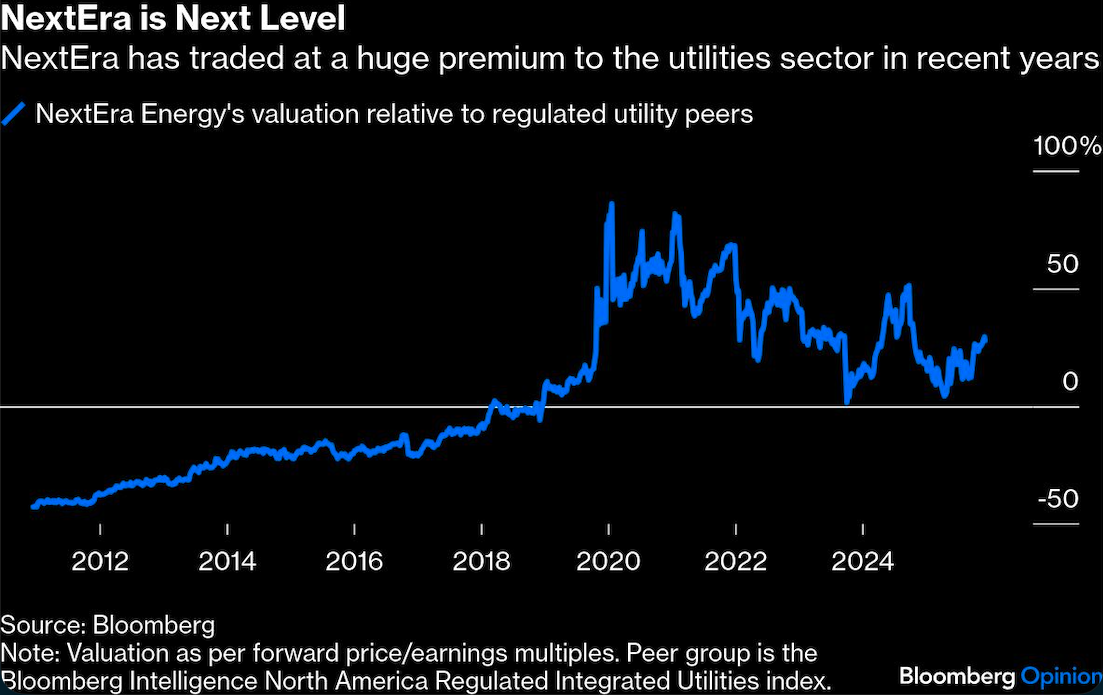
The bursting of the green bubble, and concurrent collapse in the fortunes of a NextEra yieldco, cut into the advantage it has enjoyed. Then President Donald Trump got elected and the IRA got obliterated. Earlier this year, the premium had all but evaporated. It has recovered somewhat since, but the question hanging over NextEra remained: How would a growth story centered on a green grid transformation continue once tax credits for renewables rolled off?
Besides facing that headwind, the hype around AI and its power needs has allowed NextEra’s peers to close the gap. The listed merchant generation sector, once on the edge of extinction, has boomed as fears of shortages pushed up power plant valuations and led hyperscalers to sign above-market power purchase agreements. Utilities, meanwhile, are touting gigawatts of datacenter hookup requests and promising big growth off the back of that. The median electric utility is forecast to grow its ‘rate base’ — the assets on which it earns a regulated return — by 9.8% a year between 2024 and 2029, according to Sector and Sovereign Research, above NextEra’s 7.8%.
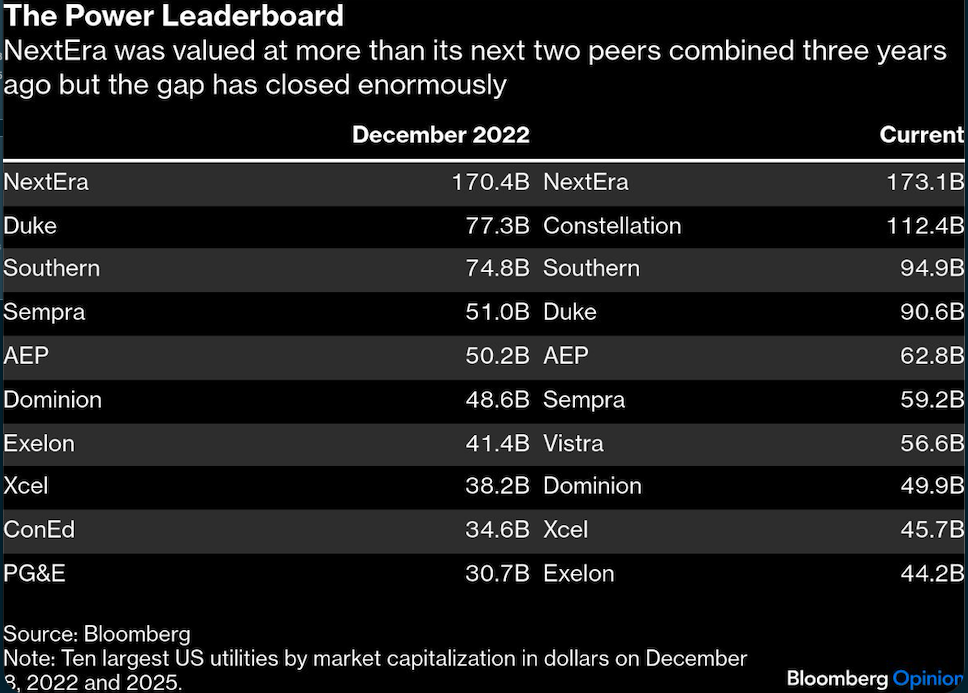
One way to look at all this is to consider what has happened with the leaderboard of US listed utilities over the past three years. NextEra remains on top, but its market cap is essentially unchanged while others, notably Constellation Energy Corp. — whose stock has behaved more like an AI developer’s — have raced up the rankings.
On Monday, NextEra essentially reapplied for the number one position. The key issue it had to address was the loss of federal production tax credits on wind and solar projects after 2030, threatening a big source of growth. Hence, while companies don’t usually offer 10-year earnings guidance, NextEra felt compelled to in this case, expecting “8%+” per year through 2032, then targeting the same to 2035. That’s a bit less than the pace of the past decade, obviously. But it comes off a much higher base and still implies earnings more than doubling from here.
The underlying foundation has changed markedly, however.
Whereas NextEra’s investor conference presentation in 2022 focused on being “an industry-leading clean energy company,” it now touts itself as “America’s quintessential, all-forms-of-energy company.” NextEra hasn’t given up on clean technology. It reckons wind and solar power remain cheaper to build than gas-fired generation per unit of electricity, even with tax credits gone, and expects to build up to 56 gigawatts of them through 2032. Rather, it recognizes the outlook for those gets cloudy after the end of this decade under the current political settlement, while the sun is rising on a new narrative: AI.
Hyperscalers are, in theory, committed to cleaner energy, but in practice, they are more committed to speed. NextEra is well-suited to that. Renewables and batteries — the latter retaining federal tax credits — can be deployed relatively quickly to serve datacenters’ upfront needs. The latter’s willingness to pay over the odds for electricity may also mitigate the loss of tax credits if they prove willing to sign premium-price purchase agreements for renewable projects rolling off prior contracts. NextEra may also pick up existing projects on the cheap as smaller developers hit a wall in a post-subsidy environment.
Natural gas is the other energy source of choice for datacenters, however. Here, backlogs on, and surging prices for, turbines are a bottleneck. NextEra can tout its existing experience in the sector, especially in Florida, as well as a partnership agreed earlier this year with leading turbine manufacturer GE Vernova Inc. NextEra announced it was buying a gas retailer on Monday as well as plans to develop gas plants that capture carbon emissions alongside Exxon Mobil Corp., something the latter has been pushing for a couple of years.
There is even a nuclear angle, with NextEra due to restart a plant in Iowa shut down in 2020 in order to feed Alphabet Inc.’s datacenters as well as giving the obligatory nod to small modular reactors somewhere down the road.
Besides aligning itself more closely with the political zeitgeist, NextEra’s new ‘all of the above’ mantra speaks to the ongoing fusion between tech and power amid the AI boom.
Hyperscalers ideally want partners who don’t just provide electricity but also take away the headache and delay of dealing with the byzantine, politically sensitive and decidedly not-move-fast-and-break-things world of energy supply. The emergence of the concept of giant datacenter hubs with their own onsite generation, access to grid hookups (eventually) and water and digital connections — the 21st century equivalent of a turnkey business park — is the clearest sign of this. Look at Fermi Inc., the profitless Rick Perry-backed SPAC developing one such site in Texas and valued already at almost $10 billion.
NextEra has a base case of 15 gigawatts of hubs by 2035, with its upside case double that. Whether it can deliver, and how real the AI power bonanza proves, are still to be seen. The pivot by the biggest of Big Power is undeniable.
A message from Advisor Perspectives and VettaFi: Discover something new! Click here to register for our upcoming webcasts.
Bloomberg News provided this article. For more articles like this please visit
bloomberg.com.
Read more articles by Liam Denning