Bitcoin’s 30% slide from its all-time high is creating conditions financial advisers say are likely driving more tax-loss harvesting in digital assets than in previous years.
While the world’s largest cryptocurrency by market value is down 5% year-to-date, the equity benchmark S&P 500 has gained roughly 18% in the same time period. This divergence gives investors holding both assets a clear incentive: sell underwater cryptocurrency positions to offset their stock gains before Dec. 31, especially those who bought the digital asset near its October peak.
“Tax-loss harvesting in crypto is being treated as part of the overall tax strategy - especially in a year of strong equity market performance - rather than as a standalone tactic,” said Tom Geoghegan, a certified financial planner and founder of Beacon Hill Private Wealth in Summit, New Jersey.
In the practice of tax-loss harvesting, an investor sells an asset at a loss, and then uses that loss to reduce their taxable income. Initially, losses offset any capital gains dollar-for-dollar. If losses exceed gains, up to $3,000 can be deducted from ordinary income each year, with any additional losses carried forward to future tax years. The result of this? A lower tax bill.
This strategy can be simpler with cryptocurrency than stocks. The IRS wash-sale rule requires equity investors to wait 31 days before repurchasing a stock sold at a loss. If the investor buys back sooner, the IRS prohibits the tax deduction. Spot cryptocurrency, which the IRS classifies as property rather than securities, does not face this restriction. Cryptocurrency ETFs, which are considered securities, are treated differently.
“You can sell that Bitcoin, buy it on that same day, and it doesn’t trigger that limitation,” said Robert Persichitte, a certified public accountant and certified financial planner at Delagify Financial outside of Denver.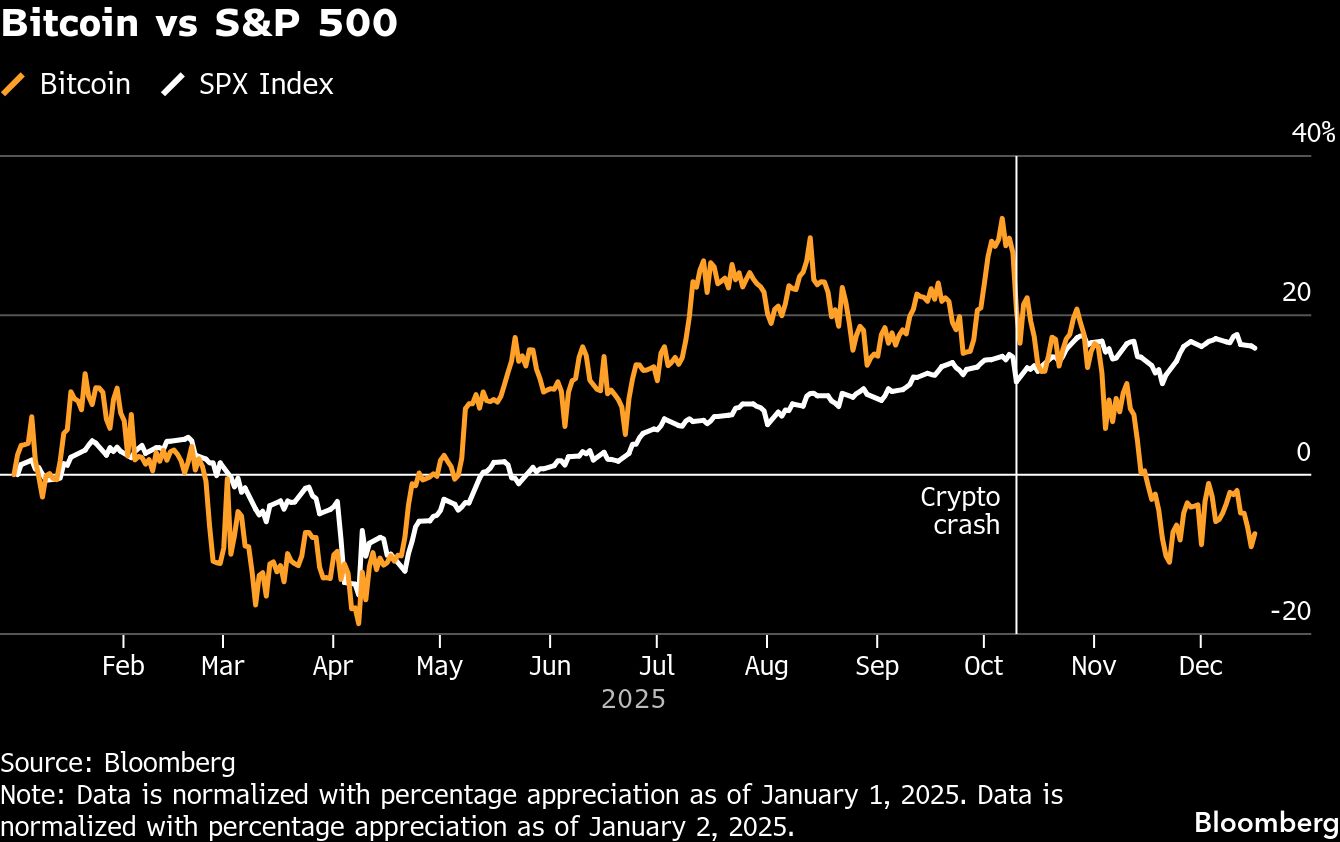
The timing of Bitcoin’s price decline this year matters. Investors who bought near its peak now have losses to harvest, and this year’s volatility amplifies the opportunity, said Will Cong, a finance professor at Cornell University’s Samuel Curtis Johnson School of Management.











