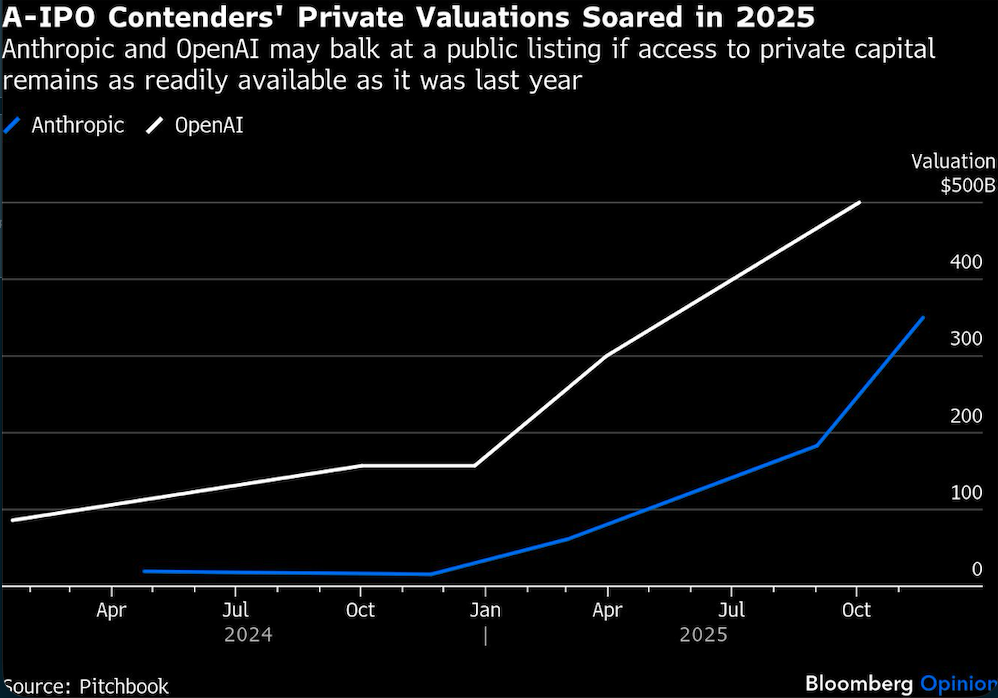
They’re calling them the “hectocorns,” apparently: artificial intelligence startups valued at $100 billion or more. I’m old enough to remember when being a “unicorn,” worth a measly $1 billion, was a milestone to be intensely proud of. Simpler times.
In 2026, AI hectacorns might go public. That process, historians would tell you, was a harbinger for the dot-com bust as hopeless balance sheets were ignored in favor of overhyped promises that eventually collapsed. Will the A-IPOs prove to be a similar come-to-Jesus moment? It’s one theme I’ll be watching closely in 2026, but it’s certainly not the only one.
The A-IPOs are coming (maybe)
I was feeling a little sheepish earlier this year when, three months after my piece warning that CoreWeave Inc.’s IPO would air AI’s “dirty laundry” financials, the company’s stock had quadrupled its $40 IPO share price.
But then, as the demands of quarterly earnings reports kicked in, investors became nervous about its debt load and delays in building data centers. Short sellers lurked. As one of the relatively few pure-play AI stocks, CoreWeave feels every bump on the the AI boom road. Its stock is now down about 53% from that steamy summer peak.
Whether other AI companies considering going public should take much from CoreWeave’s experience is a complex question. Two contenders, Anthropic and OpenAI, are synonymous with the AI boom and would therefore feel the brunt of the market’s optimism or pessimism on any given day. But, unlike CoreWeave, they exist in a different part of the AI “stack” — they are not a pick or shovel but the theoretical gold.

Preparations are being made for some huge listings, though whether they will take place in 2026 isn’t clear. Anthropic, the FT reported in early December, has consulted IPO lawyers ahead of a potential listing. It is securing a private funding round, the newspaper said, that would value it at somewhere between $300 billion and $350 billion. OpenAI, meanwhile, is said to be lining up a new funding round that could propel its valuation to $750 billion.
Both companies are clearly still confident they can raise money privately. This makes a listing, with all the scrutiny of required disclosures and quarterly earnings calls, a not-altogether-appealing option. “Am I excited to be a public company CEO? Zero percent,” Chief Executive Officer Sam Altman remarked on recent podcast. “Am I excited for OpenAI to be a public company? In some ways I am, and in some ways I think it would be really annoying.”
And yet there may be additional riches to be had by being the first to pull the trigger. And riches are what matters in the scramble to stay ahead.
Apple’s Crunch Time
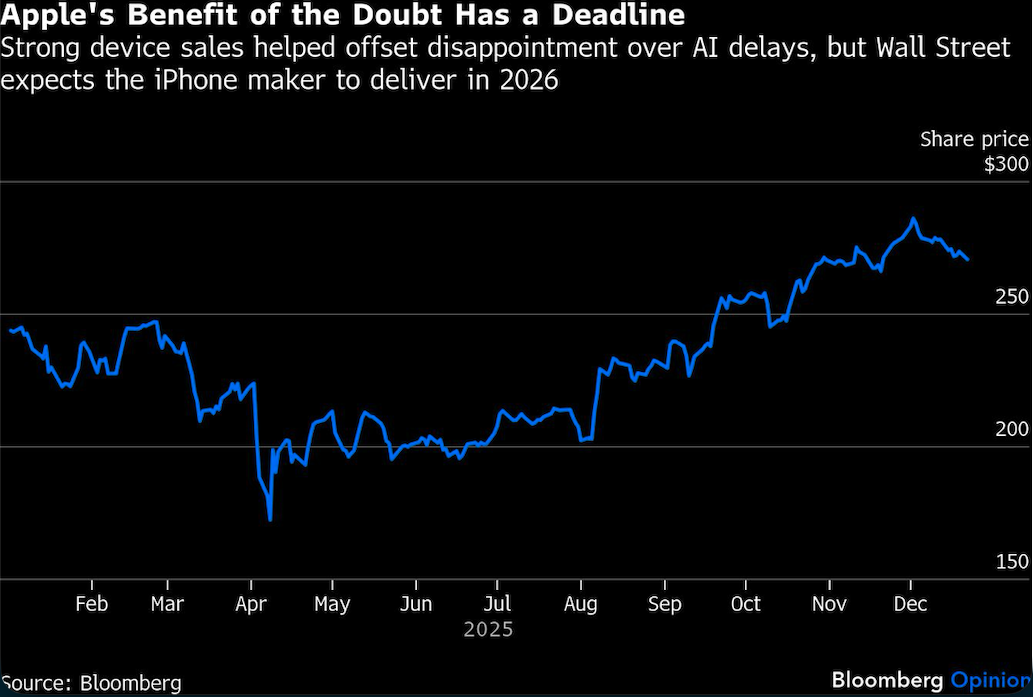
Apple Inc. got off lightly in 2025. It whiffed on the rollout of its AI features, delaying most of them and now likely turning to Google to help make a smarter Siri digital assistant. The Vision Pro headset, while never destined to be a mainstream product, has nonetheless underperformed.
Still, old iFaithful pulled through: A new crop of iPhones propelled sales of the device up 4.18% at the end of Apple’s fiscal year in September compared with 0.3% a year earlier. The company then predicted a strong holiday quarter.
More recent headlines speak to the tough year ahead, however. A number of prominent departures, several of them to Meta Platforms Inc., has complicated succession planning for Tim Cook, who is the subject of speculation that he will step down as CEO this year.
Investors willing to give Apple the benefit of the doubt on AI are expecting the company to have fixed its problems with such aplomb that it spurs a boost to the next iteration of the iPhone. Anticipated among the offerings is a folding iPhone at an eye-popping price point.
Without huge AI ambitions of its own — Apple isn’t investing anything like the amounts being spent by its other Big Tech rivals — it has to double down on what it has always done best: hardware. Wall Street will expect to be rewarded for its patience.
The People Versus Data Centers
From 2023 up until June 2025, according to a tally from research group Data Center Watch, $162 billion in data center projects has either been canceled or delayed following community resistance. Some 61% of that amount, $98 billion, was in the second quarter of 2025 alone.
The intensity has only ramped up since and threatens to be a significant flashpoint in 2026 as politicians look to the midterms and wonder whether support of a data center project will mean losing an election. Just ask the residents of Warrenton, Virginia, where all of the town council members who supported an Amazon data center were voted out.
Financing for large projects, such as Oracle’s planned facility in Michigan, has been disrupted in part because of concerns about the local political climate, Bloomberg has reported. Allie Greenfield, executive director of real estate firm Cushman & Wakefield’s Global Data Center Advisory Group, cited “community impact and nimbyism” as a possible constraint to data center expansion in the months and years ahead. Every day I get Google Alerts from local news outlets across the country describing raucous public hearings, in some cases leading to arrests. Sometimes Big Tech wins; sometimes it doesn’t.
How that balance plays out in the new year could be a flashpoint. David Sacks, the White House AI czar, maintained in a recent tweet that the Trump administration’s recent efforts to prevent states from writing their own AI-related laws did not have the goal of forcing “communities to host data centers they don’t want.”
We’ll see how that pledge holds up as groups become more organized and learn from the playbooks finding success across the US — threatening to slow the deployment of the necessary GPUs to train and run the latest models.
A message from Advisor Perspectives and VettaFi: Discover something new! Click here to register for our upcoming webcasts.
Bloomberg News provided this article. For more articles like this please visit
bloomberg.com.
Read more articles by Dave Lee