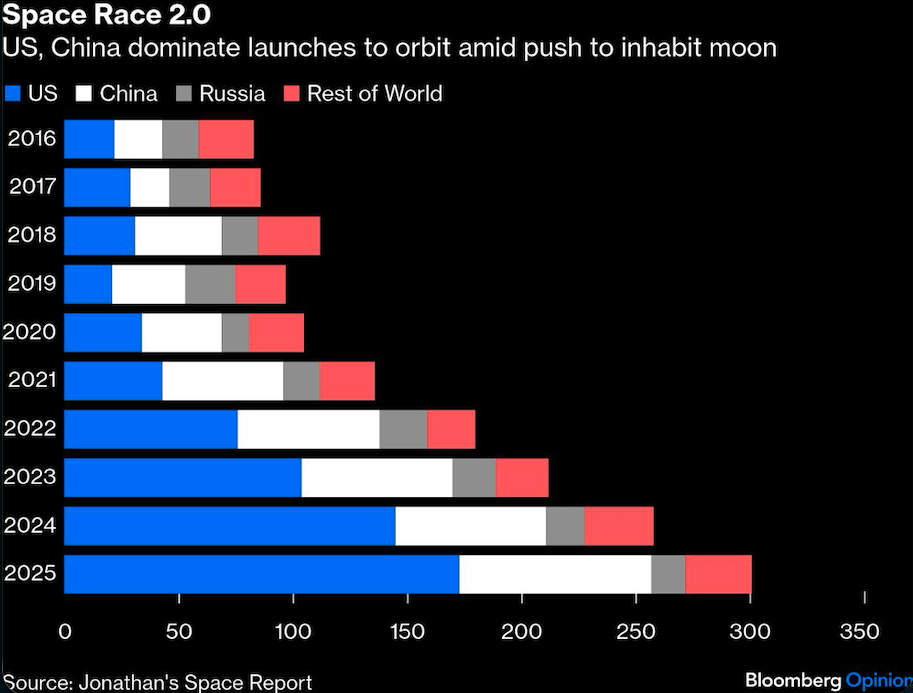
SpaceX’s dominance of rocket launches and satellite broadband internet service was reaffirmed last month with news of an insider share sale that would value the company at $800 billion. There was even speculation that Elon Musk’s space venture might sell shares to the public this year with a target valuation of almost double that amount.
This increased investor enthusiasm comes when SpaceX is under intense pressure to perform this year. Musk’s company will launch for the first time its latest, third version of Starship, its huge and completely reusable rocket. Even more important, SpaceX needs to pull off a test to refuel Starship in space. This is indispensable for meeting NASA’s goal of taking astronauts and materiel to the moon’s surface.
SpaceX isn’t alone. This year will be pressure-packed for NASA and most US space companies — whether legacy ones or startups that are struggling to prove themselves. Space is one of the few areas of bipartisan agreement in Washington, and there’s growing concern, which could turn into alarm, that China will beat the US to the moon and be the first country to establish a permanent base there. Just as in the first space race with the Soviet Union in the 1960s, this showdown is more about national security than science.

In addition to the race back to the moon, the Trump administration is expected to provide more details this year on its Golden Dome project to create an anti-missile system in space. Trump’s space agenda also calls for replacing the aging International Space Station and putting a nuclear power plant on the moon. All of this is supposed to happen by 2030.
The increased activity coincides with a growing commercial space industry that is finding ways to make money in orbit. SpaceX, of course, has a huge first-to-market advantage with Starlink, which provides broadband internet from a collection of more than 9,000 small satellites in low Earth orbit. The service is faster and costs less than the one provided by satellites that are farther away in geosynchronous orbit, and Musk has racked up the customers and cash from rural residences to ships, aircraft, recreational vehicles and anything that moves. Starlink’s revenue this year is estimated to be as much as $24 billion, according to a Bloomberg report.
Blue Origin, the space company founded by Amazon.com Inc.’s Jeff Bezos, is trying to catch up. It had successes with launches of its large rocket last year and the initial deployments of small satellites in its Amazon Leo constellation that’s designed to offer high-speed satellite internet. Blue Origin has also developed a large, reusable rocket to compete with Musk. It plans to ride that momentum this year.
Boeing Co., Lockheed Martin Corp., and other legacy launchers haven’t pivoted yet to reusable rockets and are at risk of falling behind as lower-cost launch capacity is needed to meet demand for the moon base or even building data centers in space. The latter may not seem as far-fetched as it sounds because solar energy is available almost around the clock and is eight times more efficient than on Earth, according to research by Alphabet Inc.’s Google.
At the center of this surge of space activity will be Jared Isaacman, the new NASA administrator. Isaacman, the billionaire founder of Shift4 Payments Inc., will oversee the transition of space exploration from an endeavor that is funded mostly by the government to one that’s driven by private capital. The era of projects being way over budget and well behind schedule should wind down. The legacy space companies will need to step up their game to compete with the new entrants. Isaacman will be successful if he can spur competition that drives down costs and cultivates a commercial space industry.
The first significant challenge for returning to the moon falls precisely on the legacy space companies. As early as February, the Space Launch System, a rocket built by Boeing, Northrop Grumman and L3Harris’s Aerojet Rocketdyne unit, is scheduled to blast into orbit the Orion spacecraft made by Lockheed Martin. It will carry four astronauts who will fly around the moon before returning to Earth in the first lunar mission in five decades.
The moon became much more interesting about 15 years ago with the discovery of water in the polar regions. Water can sustain life, but more important can be used to make fuel. It’s a land grab now, and the US can’t afford to fall behind.
This test run by NASA’s Space Launch System will prepare the ground for NASA’s first mission to land astronauts back on the moon in 2028. This mission — called Artemis III — counts on SpaceX to provide the lunar landing craft to shuttle astronauts from Orion, which will orbit the moon, to the surface of the south pole region. This will require SpaceX to refuel its Starship spacecraft in space — a feat that hasn’t been accomplished before.
SpaceX said it’s seeking to perform the first orbital refueling in a test this year during a long-duration flight of the so-called human landing system. Failure on refueling is not an option for SpaceX. Besides being crucial for ferrying astronauts to the moon and back, refueling in space is a foundational technology required to fulfill Musk’s dream of human existence on Mars.
SpaceX designed Starship from the beginning to refuel in space and views propellant transfer as a straightforward engineering challenge that the company has been working on for some time. Still, orbital refueling is delicate because an explosion could potentially scatter debris that would whiz around at high speeds for years. This means SpaceX’s traditional testing recipe — blow up and then fix — won’t work with refueling in space.
In 2023, NASA selected Blue Origin to build a second lunar lander that would be put into action in the fifth mission of the Artemis moon program. Isaacman pressured SpaceX in December to meet its lunar-lander schedule by saying NASA would take whichever lander was ready first.
Isaacman should continue to push companies to compete. The legacy space launchers had become complacent and were caught off guard by the efficiency of reusable rockets. US companies can retain their lead on China by executing on missions and tests this year that will pave the way for a permanent human presence on the moon. SpaceX in particular will have an opportunity to earn its valuation.
A message from Advisor Perspectives and VettaFi: Discover something new! Click here to register for our upcoming webcasts.
Bloomberg News provided this article. For more articles like this please visit
bloomberg.com.
Read more articles by Thomas Black