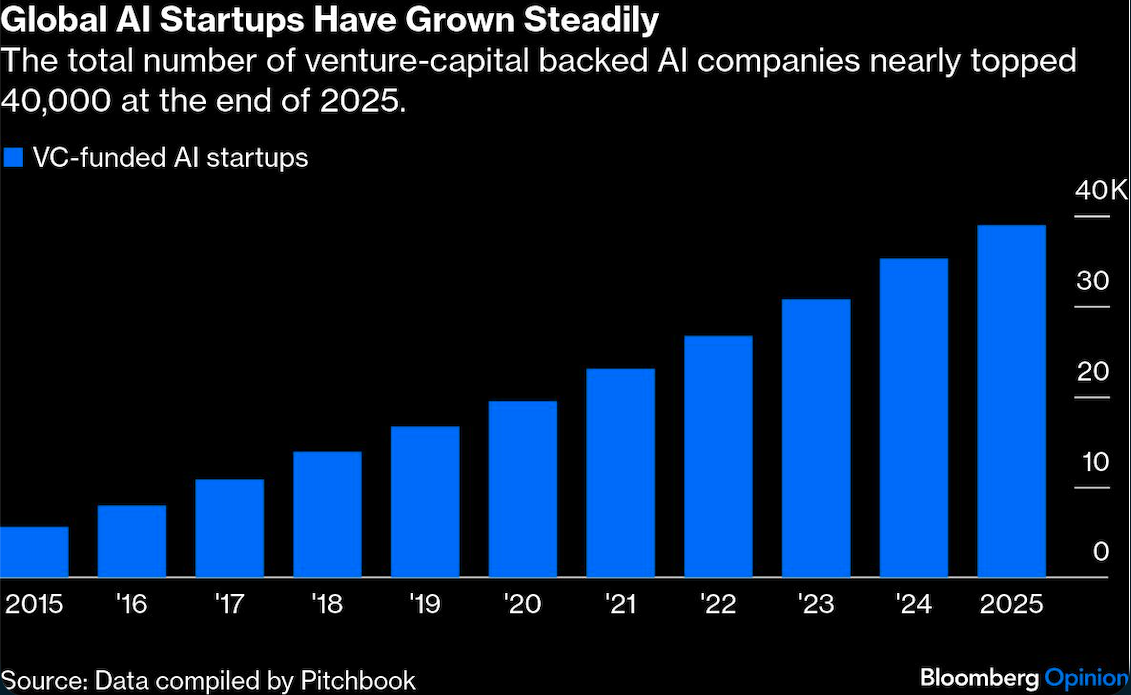
Venture capitalist Marc Andreessen famously declared in 2011 that “software is eating the world.” This year, Silicon Valley will be looking to feast on artificial intelligence, as the relentless hype that’s driven the creation of nearly 40,000 AI startups crashes into the cold logic of business economics.
US companies spent $37 billion on generative AI software in 2025, up from $11.5 billion the year before, according to venture capital firm Menlo Ventures. But much of that spending has been across a motley array of tools. With pressure mounting to show a meaningful return on investment, 2026 will see a Darwinian thinning as a few AI winners continue selling while many weaker players get gobbled up by large technology firms. When a swathe of startups seek to solve the same problem but only two or three manage to capture the market, some of the rest could become acquisition targets. The same pattern occurred with cloud software, leading to a wave of private equity-driven acquisitions in 2020 and 2021.
Two deals hastily wrapped up before New Year offer clues to how that may play out with AI: Silicon Valley’s biggest companies will look to China to buy AI startups outright, and scoop up Western firms through stealth acquisitions.
The key in both approaches will be to cleverly avoid the ire of regulators by trying not to trigger outbound investment rules when they buy Chinese firms, and by using hiring-and-licensing deals — known in the industry as acquihires — to avoid antitrust scrutiny when they grab competitors in the US and Europe. A loss of confidence in AI could accelerate that consolidation as tech giants take advantage of what could become a fire-sale for startups. The result: Big Tech weathers the market storm and entrenches its domination, picking up talent and intellectual property along the way.
The first of those year-end deals saw Nvidia Corp. enter a $20 billion “non-exclusive licensing arrangement” with Groq Inc., a San Jose-based chipmaking startup, on Dec. 24. Some media reports called the deal an acquisition, which maybe it was in spirit but not technically. Nvidia paid for the right to use Groq’s technology and to integrate its chip design into future products, with some Groq executives also joining join Nvidia. What sounds like an outright purchase was more of a backdoor acquisition aimed at dodging antitrust review, a technique that’s become part of the Silicon Valley playbook in the AI era.

Microsoft Corp. kicked things off in 2024 with a $650 million licensing deal with Inflection, a promising AI startup whose chief executive officer, a co-founder of Google’s DeepMind, ended up going to the software giant as part of the deal. Alphabet Inc.’s Google did much the same with Character.AI in a $2.7 billion tie-up, as did Amazon Inc. with its acqui-hire of high-flying startup Adept, and Google again with the $2.4 billion purchase of the assets and talent at AI-coding startup Windsurf in 2025.
Regulators may be slow, but they’re not stupid; both the U.S. Federal Trade Commission and Department of Justice are investigating some of these deals-that-smell-like-acquisitions. But President Donald Trump’s December 2025 executive order signaled a potentially softer line on antitrust enforcement. However closely the FTC may be watching, these quasi mergers look set to continue.
The other deal that offers a glimpse of the future was Meta Platforms Inc.’s December acquisition of Manus, one of the highest-profile AI startups to come out of China after DeepSeek. There was nothing stealthy about this outright purchase — said to be worth $2 billion — which will help Meta sell AI agents to companies. Why? Because Trump is also eager to see the US win the broader AI race with China, and part of his strategy is to disrupt China’s efforts at self sufficiency by flooding its market with American products — hence his willingness to let Nvidia continue selling chips to China. He may likewise look favorably on Silicon Valley neutralizing some of the Chinese competition through M&A.
That will benefit the tech giants, thanks to how the pendulum has swung in the China-US tech dynamic. In the early years of the mobile internet, Chinese companies flagrantly copied products from Silicon Valley, as Alibaba Group did with eBay Inc. But the direction of travel has shifted, says Winston Ma, a professor at New York University School of Law and a partner at Dragon Global. China is now producing the innovators. “Meta copied TikTok features to develop its Instagram and Meta short video ecosystem,” Ma tells me. “Now in the AI age, Meta purchases Manus.” He expects other AI startups in China could follow a similar path, seeking lucrative exits through the Silicon Valley giants.
Manus’s Chinese founders seem notable for how they distanced themselves from their homeland, headquartering their company in Singapore and scrubbing away links to China over the past year so that Meta, when it announced the purchase, could officially rule out any “Chinese ownership interests” in the startup.
But there’s a deeper reason why Manus could position itself to sell to the US: China’s AI entrepreneurs have a more global approach to doing business than their predecessors. This new batch of young founders grew up with the Internet and accessed U.S. platforms like Reddit, Twitter and Google with the help of virtual private networks (VPNs) that got them around China’s great online firewall. One leading Chinese AI startup named all their meeting rooms after Western rock bands like Led Zeppelin, a venture capitalist in Beijing tells me. Manus’s founder named his first company Nightingale after Oscar Wilde’s book, The Nightingale and the Rose. These entrepreneurs are more attuned with the West, and more interested in building products with widespread impact and worldwide userbases than making money and killing their competitors as Alibaba’s founder Jack Ma did. Selling to established global platforms thus looks more appealing.
Geopolitical sensitivities, of course, make the sale of DeepSeek, the bellwether of Chinese AI startups, unlikely. But others such as Beijing-based Moonshot AI, which develops large language models, and Zhipu AI could be valuable add-ons for the likes of Alphabet and Microsoft. The latter has a long-established presence in China.
AI hype created a torrent of new companies, but there’s sadly little chance that any of them — even large ones like OpenAI and Anthropic — will unseat the so-called Magnificent Seven. As three years of AI trials and experiment now shift towards favoring a few vendors, a veritable buffet of struggling startups across the globe will look for a way out. The Silicon Valley establishment will have its feast.
A message from Advisor Perspectives and VettaFi: Discover something new! Click here to register for our upcoming webcasts.
Bloomberg News provided this article. For more articles like this please visit
bloomberg.com.
Read more articles by Parmy Olson