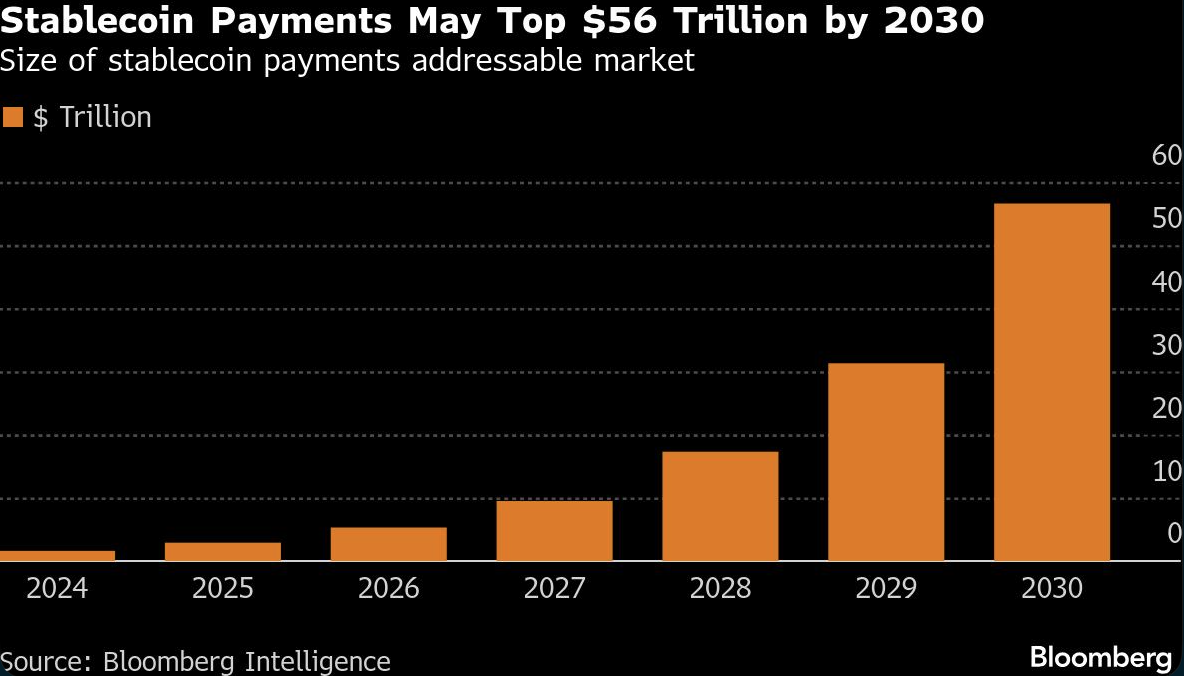
Stablecoin transactions reached unprecedented heights last year, buoyed by favorable policy in the US under pro-crypto President Donald Trump.
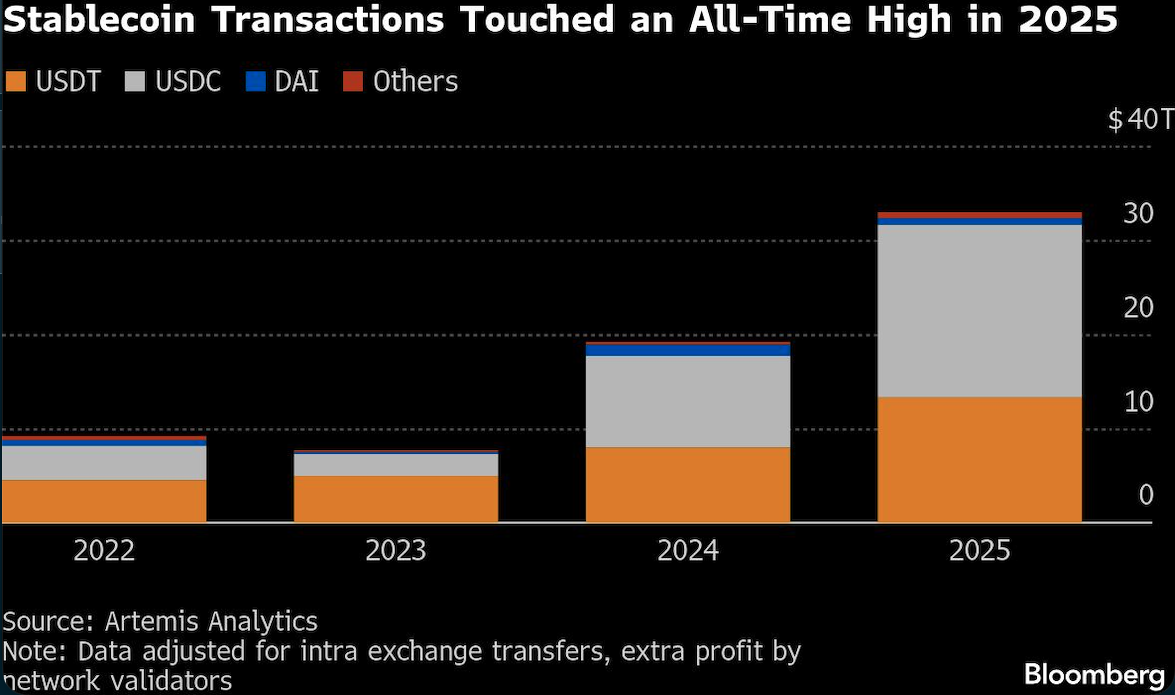
Total stablecoin transaction volumes soared 72% to $33 trillion in 2025, according to data compiled by Artemis Analytics Inc. Leading the way was USDC, a digital dollar developed by Circle Internet Group Inc., which accounted for $18.3 trillion worth of transactions, while Tether Holdings SA’s USDT recorded $13.3 trillion.
Stablecoins are a kind of cryptocurrency engineered to mimic the price of a mainstream asset, most often the US dollar. Trump’s administration has embraced them, pushing through dedicated legislation under the Genius Act in July. That in turn led to a broader adoption of the technology among institutions, with heavyweights including Standard Chartered, Walmart and Amazon exploring launches. World Liberty Financial Inc., one of the Trump family’s crypto ventures, launched a stablecoin called USD1 in March.
While total flows rose in 2025, the share of volumes on decentralized crypto platforms fell, suggesting wider mainstream usage and “signaling mass adoption of digital US dollars especially in an increasingly unstable geopolitical landscape,” said Anthony Yim, co-founder of Artemis. Citizens of countries dogged by inflation and instability prefer to hold dollars, and stablecoins are the simplest way to do that, Yim added.
Tether’s USDT is the world’s largest stablecoin by market value, with a circulation of $187 billion, according to CoinGecko data. That dwarfs Circle’s USDC, whose market value stands at $75 billion.
Yet the Artemis data suggest USDC is dominating transaction flows.
USDC is the preferred stablecoin on decentralized finance or “DeFi” platforms, which carry out lending or trading activities using automated blockchain software. DeFi traders frequently move in and out of positions, meaning the same dollar of USDC is reused many times, Yim said. By contrast, Tether is more often used for everyday payments, business transactions, or simply holding value, so people tend to keep it in their wallets rather than moving it around.