The US economy seems to be in the throes of one of its biggest bursts of productivity in decades, weighing on business labor costs and hastening the disinflation process. If artificial intelligence is partly the reason for the gains, then it’s plausible that we’re in the early days of durable improvements to efficiency. And yet, the numbers are also shrouded in mystery, and the Federal Reserve should greet them caution rather than as a green light to keep lowering interest rates.
Labor productivity, or nonfarm employee output per hour, increased at a 4.9% annualized rate in the third quarter, the strongest since 2023, according to the Bureau of Labor Statistics. Excluding the bounce-back quarters around recessions, it was the second-strongest reading in two decades. Meanwhile, unit labor costs plunged for a second consecutive quarter, dropping 1.9% after declining 2.9% in the April through June period (originally reported as an increase of 1%.)
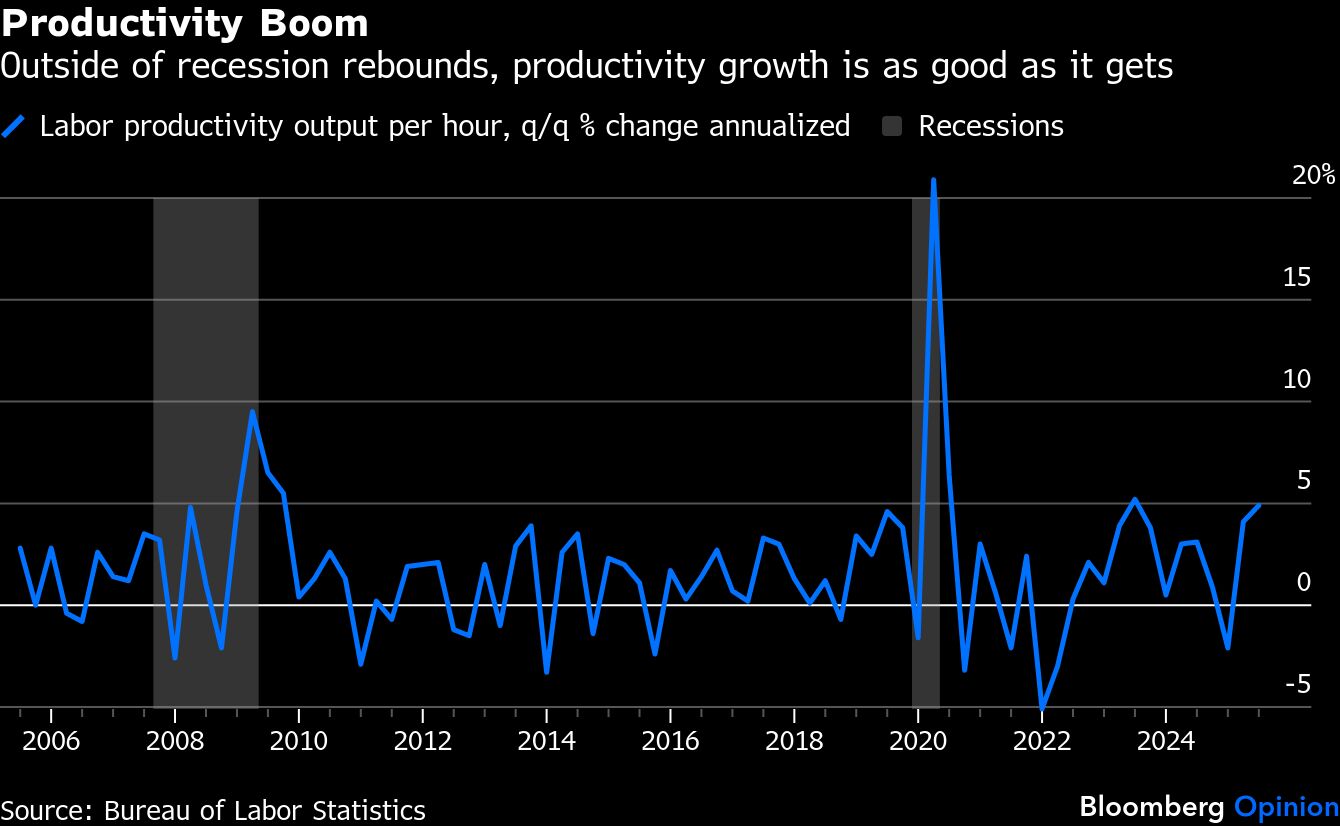
Taking them at face value, rising productivity and lower costs are worthy of celebration. America’s increasing efficiency is creating the conditions for a continued slowdown in inflation that has been happening for three years even as the economy powers ahead and the stock market plumbs record highs. And yet, no one can say for sure what’s behind the numbers, whether it will continue and what it means for interest rates. And that goes for Fed policymakers as well, who would do well to exhibit some humility in the months ahead.
So is it AI? Maybe. The most obvious explanation is often the right one. According the Census Bureau’s Business Trends and Outlook Survey, around 18% of US firms now report having used AI in the past two weeks. That’s more than triple the adoption in early 2024. (Granted, a recent jump in the numbers probably reflects a reframing of the survey question: The Bureau used to ask firms if they were using AI for “the production of goods and services,” but now they ask if they use it for “any business function.”)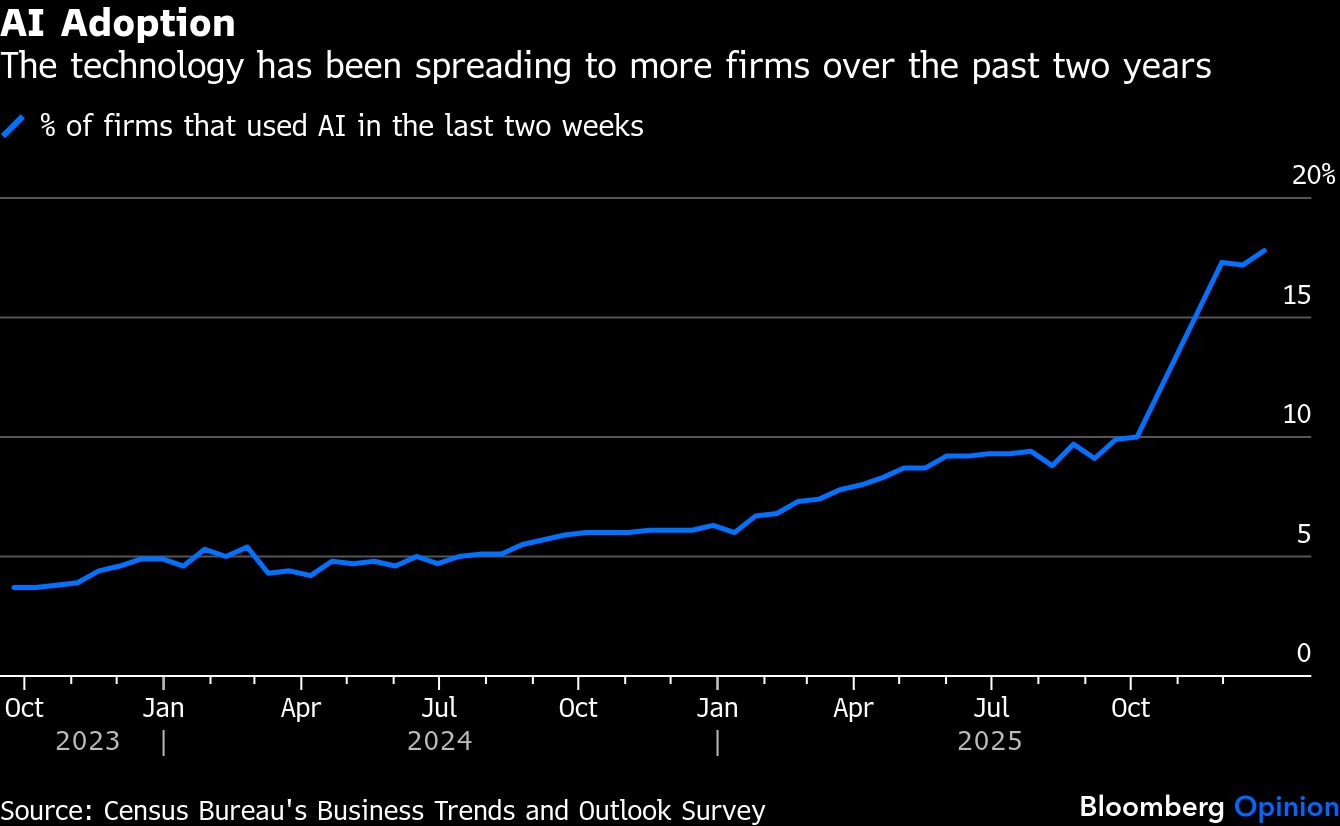
Estimates of how AI will ultimately affect productivity run the gamut, but it’s probably a game-changer for several types of knowledge work. One experiment in the field of marketing conducted by researchers Harang Ju and Sinan Aral found that human-AI teams were a shocking 73% more productive than human-human teams. In the field of software development, another study recently found that developers using an AI tool completed 26% more tasks.
To be sure, “older economy” businesses may struggle to find highly effective uses for the tech. Consider the case of taxi drivers presented with an AI tool to find customers: The tool provided a modest 7% productivity boost to low-skilled drivers but a near-zero impact on the performance of drivers who were already good at their jobs. Evidently, the usefulness of AI is not only dependent on industry and context, but on the starting skill levels of the humans using it.
As for the policy implications, those too are hazy. While lower unit labor costs are disinflationary, higher productivity is typically associated with higher demand for investment capital and a higher potential growth rate for the economy. On balance, that can help raise the so-called “neutral” rate of interest, which is the rate at which monetary policy neither restrains nor fans economic growth.












