Wall Street loves few things more than a good acronym to describe a trading thesis. Think FANG, FOMO/YOLO and TACO.
Now Ed Clissold wants to coin a new moniker. He’s calling it the Big MAC trade, a play on Big Midterms Are Coming. The chief US strategist at Ned Davis Research is aiming to capture what he thinks will be the main theme of 2026: the policy implications in the runup to and fallout from this fall’s Congressional vote.
President Donald Trump’s flurry of quasi-policy proclamations to start the year — fired off mostly on social media, with virtually zero legislative clout behind them — reveal his focus on improving the Republican party’s political fortunes in November. The president is keying on what the chattering classes have distilled to America’s “affordability problem.”
The implications for the stock market may well be profound. Take the past week. Trump sent bank stocks into a tailspin after demanding credit card issuers cap interest at 10%, not even half the current average. Military contractors took a hit when the president demanded they halt dividends and invest in production. And much of Wall Street shuddered Monday after the latest administration attack on the independence of the Federal Reserve.
“President Trump’s focus on affordability heading into midterm elections has led to a series of actions targeting oil prices, mortgage rates, credit card rates, and the fed funds rate,” Clissold said.
The clearest risks, he said, are to the financial sector, with actions targeting mortgages, credit cards and overall interest rates. Indeed, Big MAC is more of a theme than a specific trading strategy for risk-conscious investors: “industry-specific policy action is a risk heading into midterms,” Clissold wrote. It’s not obvious how to manage that risk.
Government policy “chaos” is an additional risk to markets in 2026, said Sevens Report founder Tom Essaye. He worries that the muted reaction to many of Trump’s latest attempts to rewrite economic and business policies may be sending a signal that the market is neutral on the nuts and bolts.
“This is a risk we need to monitor going forward because the lack of market reaction to this policy uncertainty seems to be emboldening the administration,” he wrote Monday.
“At some point, uncertainty will take a toll and while we’re not there yet, we are getting closer,” Essaye said.
Futures on the S&P 500 Index traded 0.4% lower at 7:57 a.m. in New York. The cash index closed at a record on Monday before paring its gains the next day. The VVIX Index, which measures the volatility of the VIX Index, is hovering at the highest level since November.
While Trump’s policy-by-tweet has mostly only caused short-lived market ripples, it has stoked fear among investors and strategists. The sheer volume of comments from the president that have implications up and down Wall Street makes it difficult to stick to any trading strategy.
“You don’t want to come in on a daily basis and find out a stock or a sector that you’re in is the one being targeted today and your shares open down five or 10%,” said Michael O’Rourke, chief market strategist at Jonestrading Institutional Services LLC.
There are 42 weeks left before the US midterm elections, O’Rourke noted, which means there’s plenty of time for the White House to introduce other sector-specific risks that could upend the market. And that risks a selloff in a market priced for perfection.
“If by the end of this week or next, you have another industry or two under siege from the executive branch, people will start to say, ‘Okay, valuations are high, there’s no point in me sticking around for this,’” he said by phone.
To Clissold, the new acronym is needed after a solid run for the “TACO” trade — coined by a Financial Times journalist for Trump’s penchant to threaten punitive tariffs only to “chicken out” before implementing them.
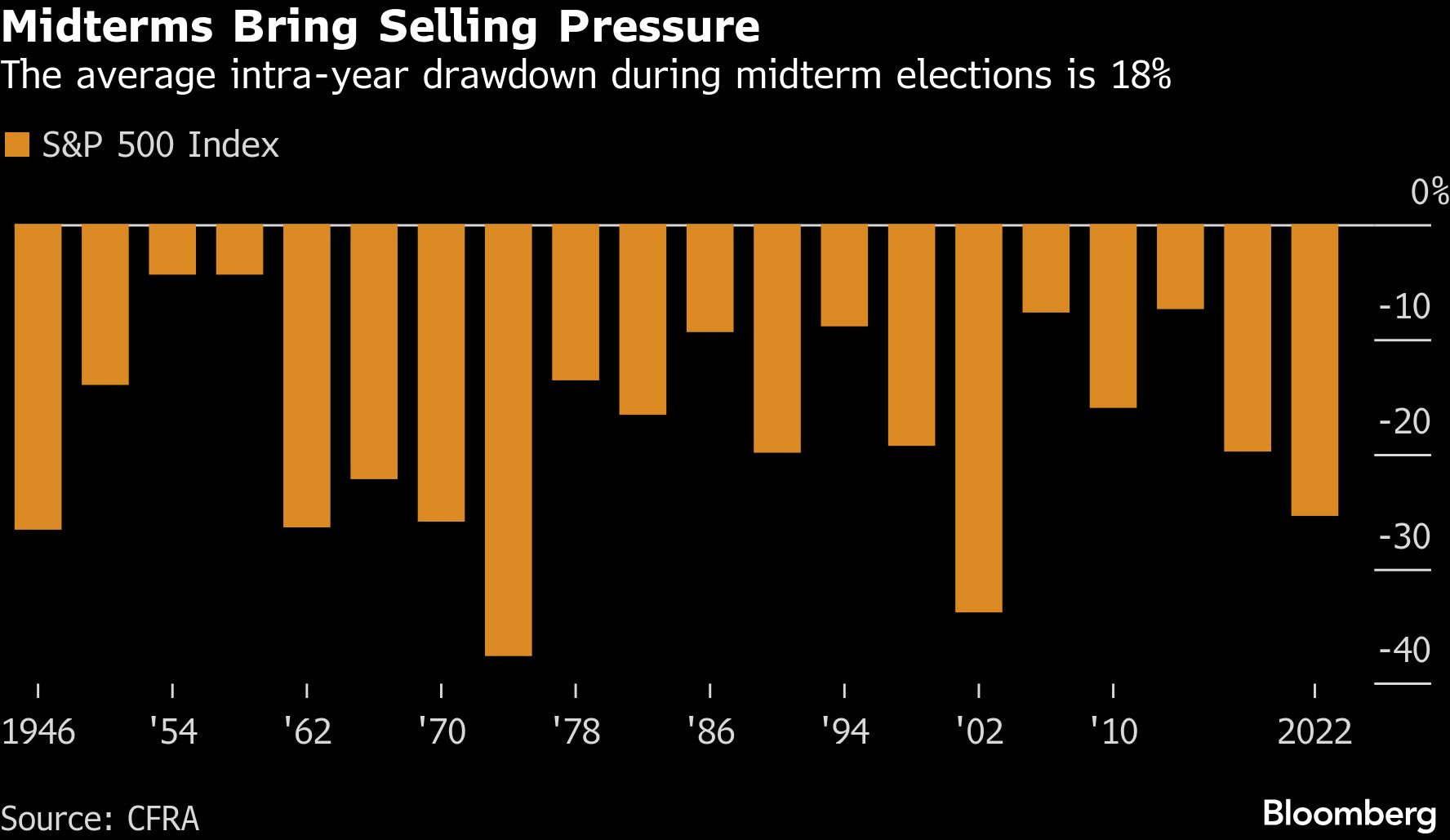
Even without the unorthodox approach to economic statecraft from the Trump White House, midterm years tend to bring lower than average equity returns, owing largely to uncertainty around policy positions. In the postwar era, the party controlling the executive branch has tended to fare poorly in the Congressional election.

The S&P 500 has endured an average 18% intra-year drawdown during midterm years, according to data from CFRA Research. When the vote is held with one party in control of both houses of Congress and the presidency and faces the prospect of a loss of control, the market’s average annual advance since 1945 is just 3.8%, with losses occurring almost half of the time, CFRA chief investment strategist Sam Stovall wrote in a note.
The impact of politics and idiosyncratic events on individual names has single-stock realized volatility trading nearly 22 points higher than the same metric for the main index.
“Most of the impact from headlines is being felt at the company or sector level,” said Dennis Debusschere, president and chief market strategist at 22V Research LLC. Macro influence on the overall S&P 500 Index is still low by historical standards, he said.
Still, some investors have shifted toward a more cautious outlook. JPMorgan’s trading desk, which said US stocks may underperform in the near term given the pressure on the US Federal Reserve. Similarly, Scotiabank strategists said Tuesday that global equities may outperform the S&P 500 once again in 2026 as “intensified legal attacks on Powell” could raise the risk premium investors demand to hold US equities.
To navigate the additional political risk, investors need to have a longer time horizon that extends past the current political cycle, said Kimberly Forrest, chief investment officer at Bokeh Capital Partners LLC. She said she’s looking out three to five years.
Forrest said her firm owns Exxon Mobil Corp., which drew the ire of Trump when it called Venezuela “uninvestable” last week.
“I don’t care that they’re not going to go into Venezuela,” she said by phone of Exxon, adding that she’s looking at the stock as a longer-term play. For funds that are trading on a shortened time horizon, she said the current environment is tough.
Her advice: “Good luck.”
A message from Advisor Perspectives and VettaFi: Discover something new! Click here to register for our upcoming webcasts.
Bloomberg News provided this article. For more articles like this please visit
bloomberg.com.
Read more articles by Geoffrey Morgan