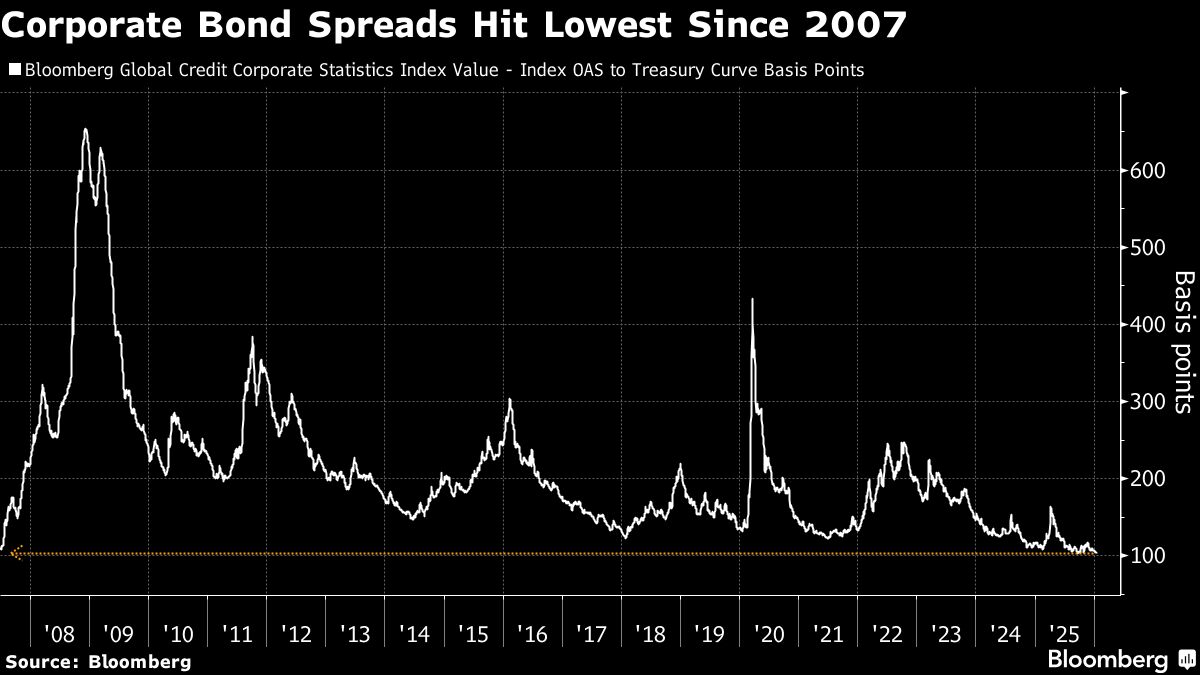
Global credit markets are running at their hottest in two decades, prompting some of the world’s biggest money managers including Aberdeen Investments and Pimco to warn against complacency.
Yield premiums on corporate debt have narrowed to 103 basis points, the least since June 2007 amid a resilient economic outlook, a Bloomberg index of bonds across currencies and ratings shows.
That all presents a paradox. Money managers don’t want to miss out. But they also must accept a smaller amount of compensation against risks that are increasingly swirling — unpredictable US policy, geopolitical tensions and hidden debts sparking sudden corporate collapses.
“Complacency should be the scariest word in risk markets right now,” said Luke Hickmore, an investment director for fixed income at Aberdeen Investments. “All you can do is not lean too hard into high-risk areas.”

For now, many money managers continue to dive into the rally, in part due to the prospects of interest-rate cuts by the Federal Reserve and some other central banks. Such easing could help the global economy navigate threats from US President Donald Trump’s tariffs. Earlier this week, the World Bank raised its forecast for global real gross domestic product to expand by 2.6%.
Policy makers must balance steps to sustain that momentum with efforts to prevent inflation from quickening again. The fraught balancing act has been thrust into the limelight as the US Department of Justice pursues a probe of Jerome Powell. The Fed Chair has said that the threat of criminal charges stems from the central bank setting interest rates based on its best assessment, rather than following Trump’s preferences for more cuts.
“You’ve heard lots of credit managers talk about the fact that fundamentals do justify, that corporates’ balance sheets are very strong and that you are seeing reasons for credit spreads being so tight, but from our point of view, there is clearly nothing priced in terms of geopolitical,” said Alexandra Ralph, senior fund manager at Nedgroup Investments in London.
For now, though, the bullish mood in credit is also buoying riskier debt. The extra yield investors demand to hold junk notes has also dropped to the lowest in nearly two decades.
“Strong recent returns have fueled complacency,” Pacific Investment Management Co. authors Tiffany Wilding and Andrew Balls wrote in a research note this month. Pimco is becoming more selective about where it deploys its funds across credit markets due to expectation that fundamentals will deteriorate, they said.
For their part, borrowers are scooping up money in a flurry of deals.
Companies issued roughly $435 billion of bonds in the first half of January, a record for the period, and more than a third above last year’s tally at this point, according to data compiled by Bloomberg.
Goldman Sachs Group Inc. on Thursday raised $16 billion with the largest investment-grade debt sale ever from a Wall Street bank, in what’s expected to be a record year of corporate bond issuance.
Even so, investors are so flush with cash that spreads have got tighter and valuations higher. Usually borrowers price deals with a new-issue concession to draw buyers, and the borrowers’ old bonds lose value as investors sell to raise money for the new notes. That’s just not happening this year, with many outstanding deals actually tightening on average.
“Most of the outlooks and news coverage featured the expectation of record supply and I think people read that and were positioned for that,” said Max Huefner, head of global credit and European investment grade at BlackRock Inc. “We are positioned to buy new deals, we are cautious but in the end we need to make returns and we like carry. I see this year as a year where you have to have good carry.”
As the flood of supply isn’t prompting any retrenchment, 2026 is off to a strong start, building on excess returns over Treasuries for both dollar-denominated investment-grade and junk bonds over the past three years.
But if other risks flare down the line, denting the broader bullish mood, the large supply of debt could come back to haunt investors.
A message from Advisor Perspectives and VettaFi: Discover something new! Click here to register for our upcoming webcasts.
Bloomberg News provided this article. For more articles like this please visit
bloomberg.com.
Read more articles by Finbarr Flynn, Ronan Martin