PJM is the name given to the largest regional US electricity grid, stretching from Chicago to the Chesapeake. It is also synonymous with the AI-power surge, being home to Virginia’s ‘datacenter alley’ and seeing recent big increases in bills tied to concerns that the electricity needs of artificial intelligence will swamp supply.
PJM has just undergone a week of whiplash, beginning with a cut to its projections of electricity demand — which you might think would ease those concerns — and ending with that reliable indicator of bubbling angst, a White House plan, followed by what looks like an actual plan from the grid operator itself.
If the lowered projections suggested the AI boom has been deferred, the new proposals set forth by President Donald Trump and several state governors, plus PJM’s own set, demonstrate the political storm around that boom has merely gathered strength. A dash by Big Tech to commandeer the existing grid for its own ends seems to be giving way to a new era where it must bring its own generation.
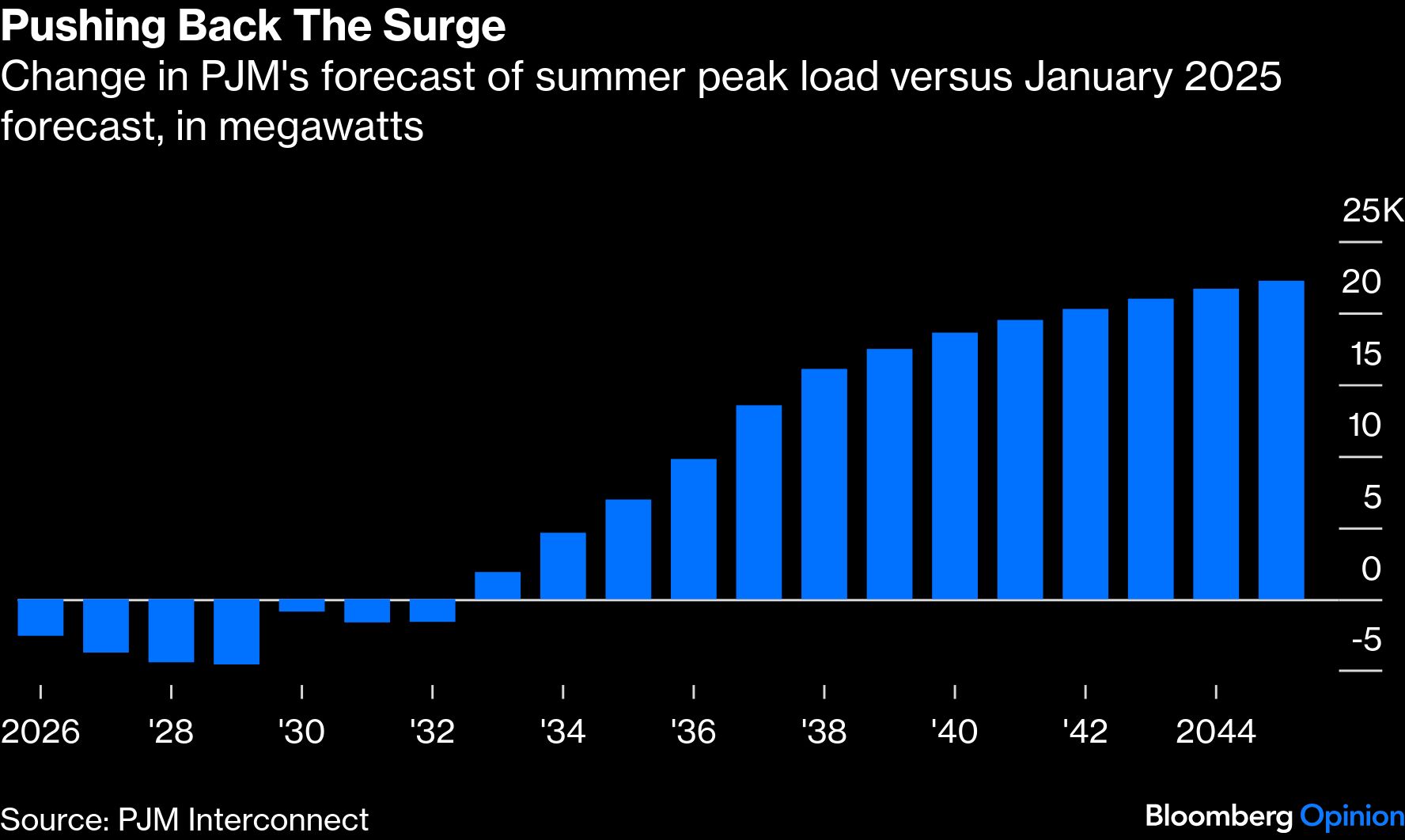
The AI-influenced bull market in electricity, and the stocks of companies generating it, owes much to recent increases in PJM’s peak demand forecasts after years of flatlining. The latest projections, however, pulled back — kind of. Forecasts for peak demand through 2032 were lowered slightly, while those further out were raised, and by much more.

The AI-power boom is haunted by three interrelated ‘E’s. The first two are efficiency and exuberance. More efficient datacenters would undercut bullish demand forecasts, while excess enthusiasm tees up excess supply — for which not just investors but also households can end up paying. This has happened before, in the early 2000s, and a more recent warning arrived last year with the DeepSeek freakout. Moreover, analysts at CreditSights calculate that US grid-connection requests are more than double the consensus forecast for actual datacenter demand, suggesting a bubble is forming.
PJM’s cut would appear to reinforce such concerns. but the truth is that no-one knows the scope and timing of AI’s impact for sure.
Meanwhile, there are clear signs of tight supply and demand. After all, PJM’s near-term cuts to peak demand forecasts, maxing out at about 4.5 gigawatts, are less than the shortfall of about 6.5 gigawatts that featured in the last capacity auction — when prices hit their maximum allowed level. (This auction sets a price paid to power plants for committing to have capacity available during a certain time period, like an insurance premium). In addition, electricity prices in the PJM region are set to continue rising this year and next, according to the Department of Energy’s own short-term energy outlook, also out last week.
Hence, state governors exasperated by rising bills, and a president threatened by them, directed PJM to hold an emergency auction for hyperscalers to bid on 15-year supply contracts to encourage new power plants onto the grid. The current capacity auction process, where prices have soared to the extent that regulatory caps have been introduced, is broken. Its time period is too short and it doesn’t differentiate between existing and new capacity. The result is mostly a windfall to incumbent generators without encouraging enough new power plants — the winning consumer proposition of higher prices for less reliable service.
Such a directive is, however, less an off-the-shelf solution, more a political document. Even its big number of $15 billion is less than meets the eye given inflation, equating to perhaps 6 or 7 gigawatts of new capacity when peak demand is anticipated to rise by more like 40 gigawatts by the early 2030s. It was, however, a signal that patience has run out.
In that sense, it may be deemed useful: PJM Interconnect released its own, more detailed set of proposals a few hours later. That timing, along with a looming deadline for PJM to update federal regulators anyway, lends the White House’s and governors’ move an air of kabuki. In any case, they get to look decisive and PJM’s proposals are useful.
For one thing, PJM recognizes the existing capacity auction is inadequate, especially in terms of its short duration, and set a deadline of June to study reforms. It also nods to the White House plan of an emergency auction to address near-term needs, albeit without prejudging amounts or contract lengths.
The most important element, however, is what is termed BYOG: Bring your own generation. PJM proposes an incentive of expedited connection to the grid for incremental capacity that offsets additional large loads. On the flip-side, new large loads that aren’t matched with new power generation would be subject to curtailment — switched off or dialed down when grid conditions demand, in other words.
These are sensible measures and represent a shot across the bows of both Big Tech and the merchant generators riding the AI wave.
The week before last, Meta Platforms Inc. signed a 20-year deal at a premium price to secure supply from three nuclear power plants in Ohio and Pennsylvania owned by Vistra Corp. While one-sixth of the 2.6 gigawatts of capacity secured relates to an expansion, the vast majority is existing capacity. Vistra emphasized that this deal would underwrite applying for extensions to the three plants’ operating licenses. If that was designed to head off criticism that a hyperscaler was grabbing existing capacity from an already tight grid, it wasn’t convincing. It is tough to see any existing nuclear operator in the PJM area contemplating shutting down in this environment, hyperscaler contract or no.
Friday’s sharp declines in shares of Vistra and fellow PJM incumbents Constellation Energy Corp. and Talen Energy Corp. suggest the market heard that shot. The multiple bottlenecks in PJM, ranging from interconnection queues to turbine backorders to the capacity auction process itself, have raised the price of existing assets to the means of the richest bidders, the hyperscalers, but with the added twist that, on a grid, ordinary customers pay at least some of that price, too.
The BYOG proposals indicate that era is drawing to a close. Such plans should be technology neutral, but that looks hard with a White House touting its focus on affordable energy while simultaneously attempting to shut down nearly built offshore wind farms. Natural gas generation will win big in a new BYOG era, but grid batteries should, too. Implementing all this successfully wouldn’t just be equitable, it could actually unlock savings for households, as the cost of the grid for all gets spread across more kilowatt-hours. Delay or failure, on the other hand, would raise the prospect of that other ‘E’ threatening politicians, Big Tech and power providers: Elections.
A message from Advisor Perspectives and VettaFi: Discover something new! Click here to register for our upcoming webcasts.
Bloomberg News provided this article. For more articles like this please visit
bloomberg.com.
Read more articles by Liam Denning