The world is getting excited about small capitalization US equities again, and I’m starting to get that Groundhog Day feeling.
- The Russell 2000 has rallied 8% this year, 7 percentage points better than the S&P 500 Index.
- The gains were led by precious metals miners and a series of data-center energy plays, one of which — Oklo Inc. — is backed by Sam Altman.
- And Morgan Stanley strategists led by Michael Wilson say they “continue to see small caps outperforming as fundamentals improve.”
Unfortunately, we’ve been down this road before, and it reliably ends in disappointment. Small caps seemed to be gaining momentum against their large-cap brethren back in late 2023 and then mid-2024 — and then again later that same year. But each time, the short-lived rallies were undone by underwhelming earnings prospects and a jump in Treasury yields.
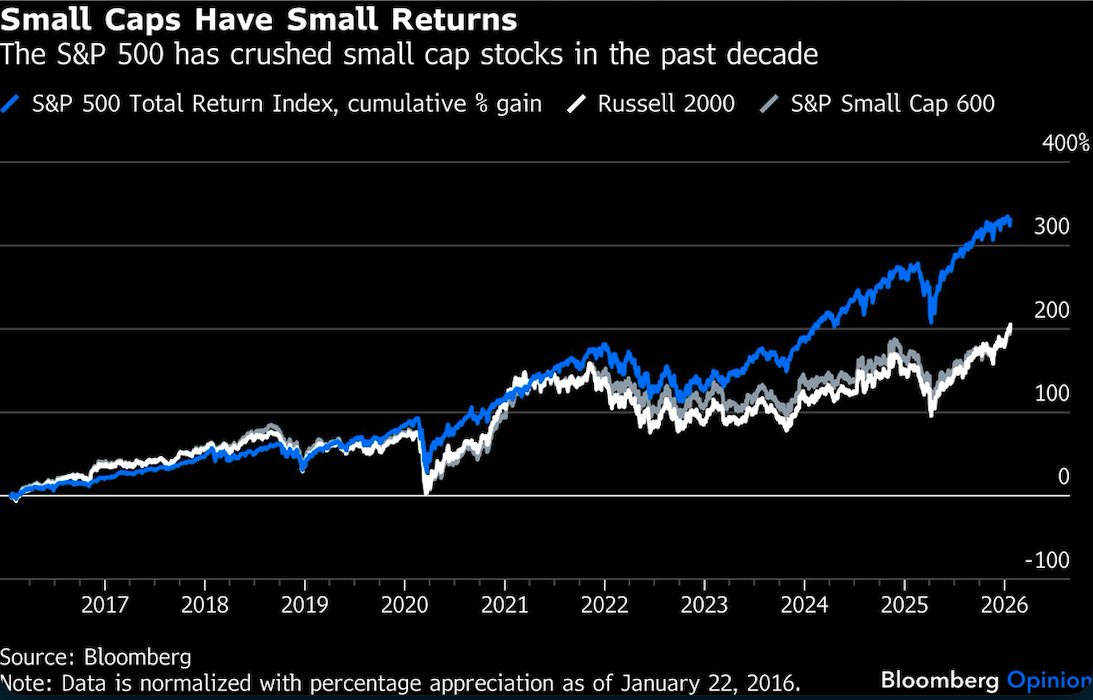
Despite spurts of popularity, small-caps have been big underperformers for the past 10 years. The reason? The best growth opportunities are overwhelmingly found among highly scalable technology and communications companies. Many of them get started with the help of venture-capital funding and are already behemoths when they go public. And then, in our winner-take-all global economy, they emerge as superstar firms in middle age. We can debate whether antitrust authorities are proactive enough and if these trends are great for society (probably not), but the implication for investors is clear: You want to own the winners.
Overweighting small-cap stocks is often a great way to miss out on the main technological developments reshaping our world. The small-cap indexes have less than half as much technology exposure as the S&P 500; they’re overallocated instead to industrials, health care, financials and energy. That’s why the S&P 500 more than quadrupled in the past decade, and the small-cap gauges merely tripled.

It’s far from clear why things should be any different in the age of artificial intelligence — a technology that demands billions in capital outlays and will favor incumbents that can finance expenditures out of existing cash flows. In an AI landscape of the near future, superstar companies will also benefit from their access to specialized data sets and vast user networks. Meanwhile, smaller businesses — which lack the scale and negotiating leverage of large caps — will continue to bear the brunt of negative tariff impacts on profit margins, and their debt-reliance will make them more sensitive to persistently elevated bond yields.
Certainly, small-cap earnings prospects appear to be modestly improving in 2026. Instead of growing their top lines by 1% as in earlier quarters, Russell 2000 investors can look forward, perhaps, to a whopping 3% pace of revenue growth this earnings season — hold onto your hats!
It’s also possible that investors have gotten over their skis investing in large-cap tech stocks, and small caps could be a sort of refuge in the event of a correction or outright crash. That was the case in the dot-com bust with some small-cap stocks, but it matters tremendously how you define the investment universe.
The Russell 2000’s problem is that it includes a lot of low quality stocks with high debt and low or no profitability — stocks whose small market capitalizations reflect their minimal prospects. Recall also that some of its best performers this month are themselves energy companies that are tethered to the success of the AI revolution, so it may not be the world’s best AI diversifier. A better choice in the dot-com bust was the S&P Small Cap 600, an index which has a profitability screen that helps with quality control. From 1999 to 2002, the Small Cap 600 returned almost 2% even as the Russell lost 21% and the S&P 500 lost 38%.
It’s entirely possible that the 2026 small-cap rally could have a bit further to run, especially if Treasury yields behave themselves. But ultimately it’s just a fad and a clever trade, and America’s largest stocks still look to be the best investments. I’d by shocked if that changes anytime soon.
A message from Advisor Perspectives and VettaFi: Discover something new! Click here to register for our upcoming webcasts.
Bloomberg News provided this article. For more articles like this please visit
bloomberg.com.
Read more articles by Jonathan Levin