Advisor Perspectives welcomes guest contributions. The views presented here do not necessarily represent those of Advisor Perspectives.
At a recent advisor presentation, I was asked an interesting question about this year’s consensus outlook and what could happen if it doesn’t come to fruition. Indeed, you can make the case that consensus coming into 2026 is sanguine. U.S. GDP growth is expected to be around 2%, with some economists forecasting even higher growth due to the benefit of fiscal stimulus from the One Big Beautiful Bill Act.
It is challenging to find anyone calling for a U.S. economic recession, despite concerning trends in employment and inflation. Certainly, this outlook contrasts with that of late 2022, when almost everyone was forecasting a recession in 2023. That recession never materialized. The lesson? The consensus view isn’t always right.
Strong Earnings Growth in the Forecast
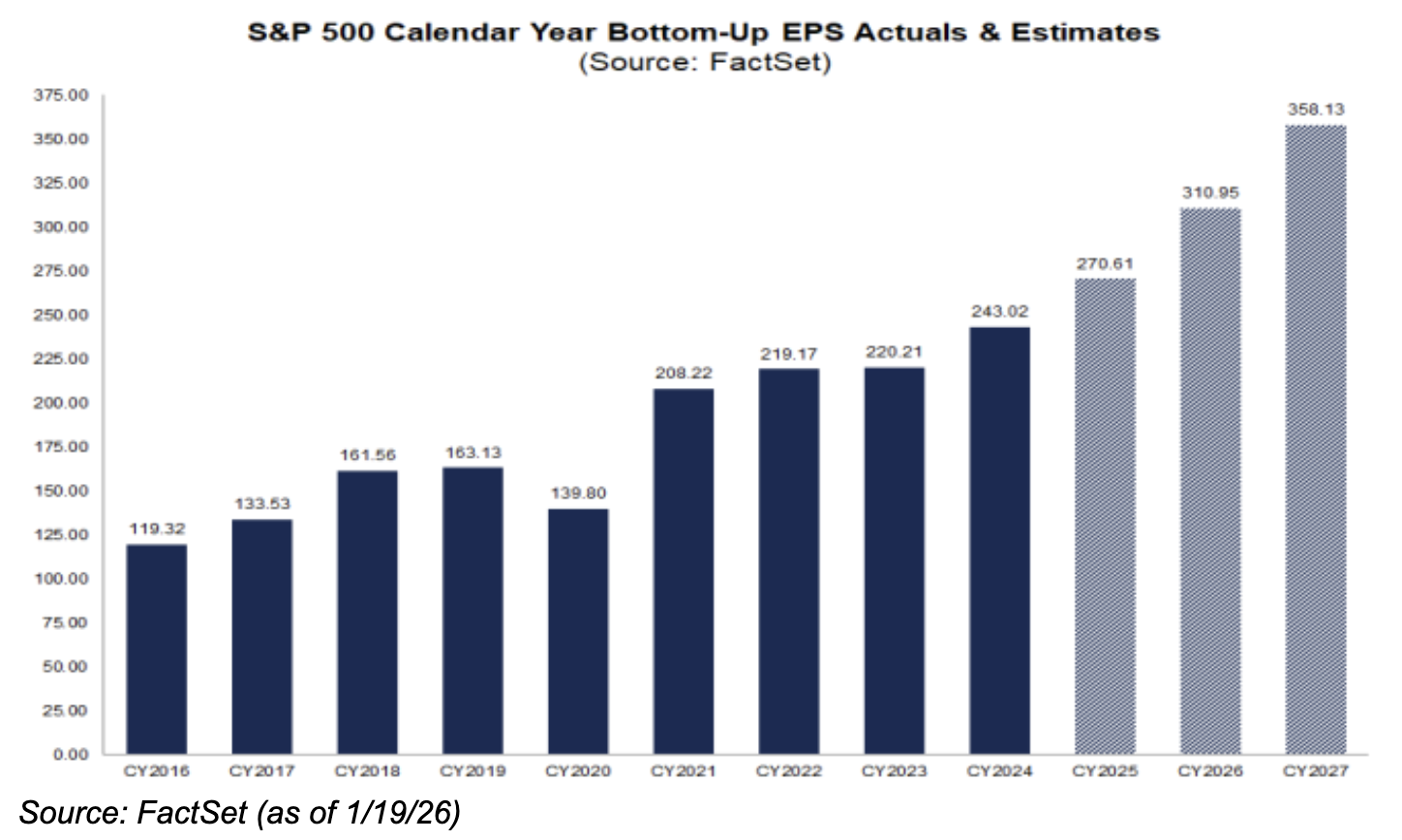
Economists have company when it comes to being upbeat. The consensus economic outlook has led to optimism from analysts, who are forecasting strong earnings growth (see chart below).
Currently, 2026 earnings growth for S&P 500 companies is expected to be just under 15%. This would follow back-to-back earnings growth of 10% in 2024 and an expected 11% in 2025 (pending fourth-quarter earnings results). That would be an impressive run, no matter how you look at it.
Given the concentration of the top 10 names in the S&P 500, which now represent about 40 percent of the index on a capitalization-weighted basis, as well as the multiples those stocks command, the valuation for the index is at elevated levels relative to history. The S&P 500 trades at a price-to-earnings ratio of 22 times forward estimates. That highlights just how important it is for the earnings estimates to come to fruition in order to support the market at current levels.
What About the Risks?
The first two weeks of the year have been rife with reminders that the world we live and invest in is filled with uncertainty. All the possible known risks have been in the news headlines almost daily.
There have been multiple instances of geopolitical risks impacting markets, at least for a brief time. We continue to see uncertainty in the war between Russia and Ukraine, which has been ongoing for almost four years. Military operations in Venezuela, the peace plan for Gaza, and rhetoric surrounding Iran and Greenland have also driven headlines.
Further, geopolitical hotspots serve as a reminder about policy risks, with additional tariffs back on the table in Europe. Since the Liberation Day sell-off last year, investors have determined that the threat from tariffs had peaked and would be minimized over time through trade deal negotiations. For the most part, that view has proven true. Recent headlines, however, may have market participants rethinking that idea.
Finally, risks around the Fed have been front and center. Whether it is the recent investigation of Chairman Jerome Powell, the case in front of the Supreme Court to determine Governor Lisa Cook’s future, or the parlor game of identifying the replacement for Powell as his term as Fed chair concludes in May, investors have had a fair amount to think about. This news flow comes on top of the ongoing debate about if and when the Fed will reduce interest rates in 2026, as the disagreement about the path forward is well-known given recent weak employment and sticky inflation data.
Markets Still Climbing the Wall of Worry
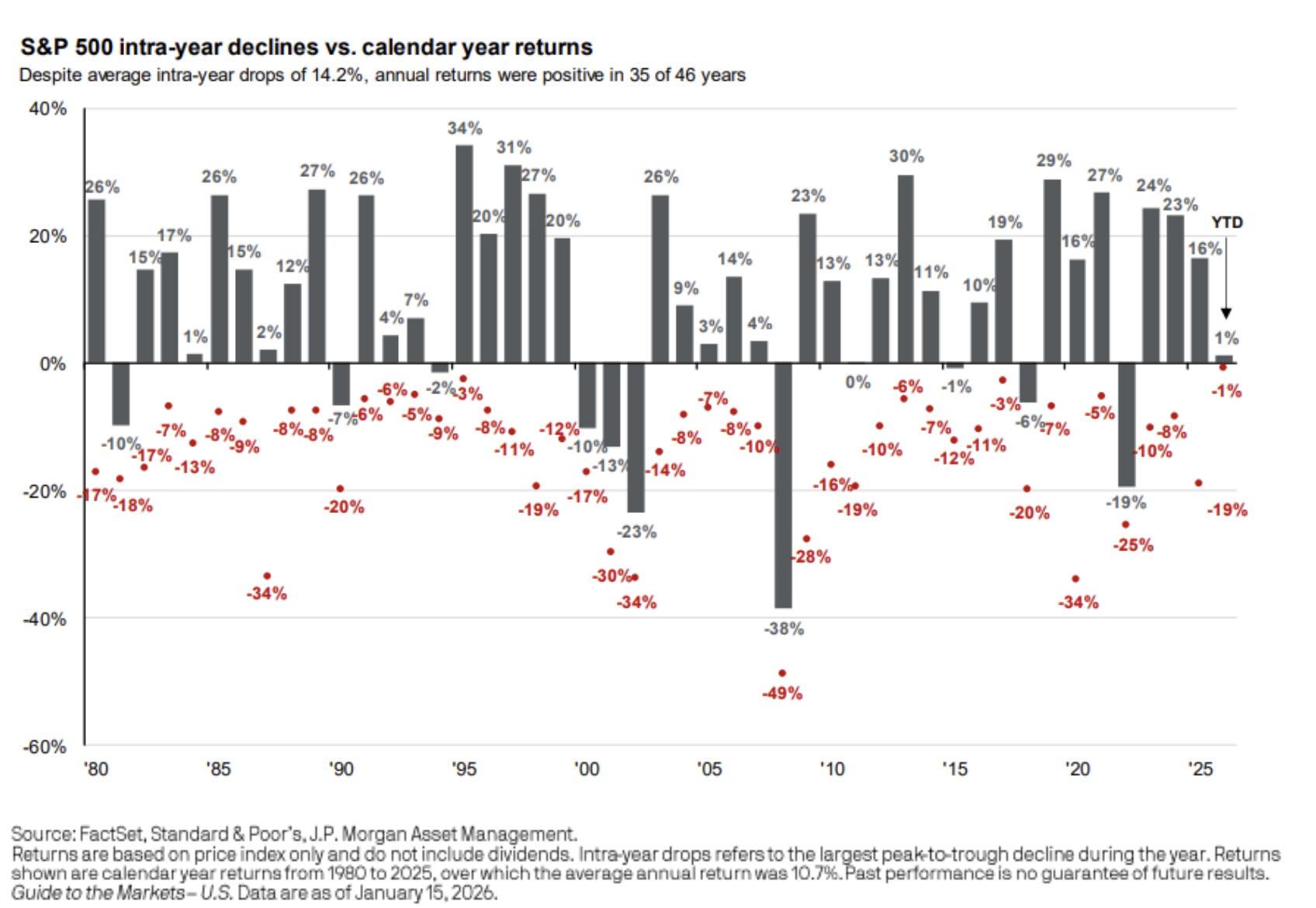
With these headlines swirling, it wouldn’t have been surprising if markets started the year lower. But as of mid-January, they haven’t. That could certainly change, though. Most years, there is a sell-off of some magnitude. It is usually at least a double-digit percentage negative decline.
The early 2000s saw three straight years of negative returns. Over the past 23 years since then, only four of those years saw a negative return for the S&P 500; in two of those years, the returns were single digits (1% and 6%) (see chart below).
It would be surprising if we didn’t see a similar correction at some point in 2026. Last year, we experienced a 19% decline early in the year; ultimately, the market rallied to return just under 16%. The lesson of last year was that policy can change and headlines will dissipate. Through the end of last week, investors seemed to be counting on that happening again and the impact on the U.S. economy being minimal.
Strength in Different Areas of the Market
While timing the market isn’t an investment process, neither is doing nothing. The market is showing signs of broadening, which is positive for the market’s health. The equal-weighted S&P 500 closed higher in mid-January, although the market-cap-weighted S&P 500 declined. For the year, the equal-weighted index has outperformed the more popular market-cap-weighted one.
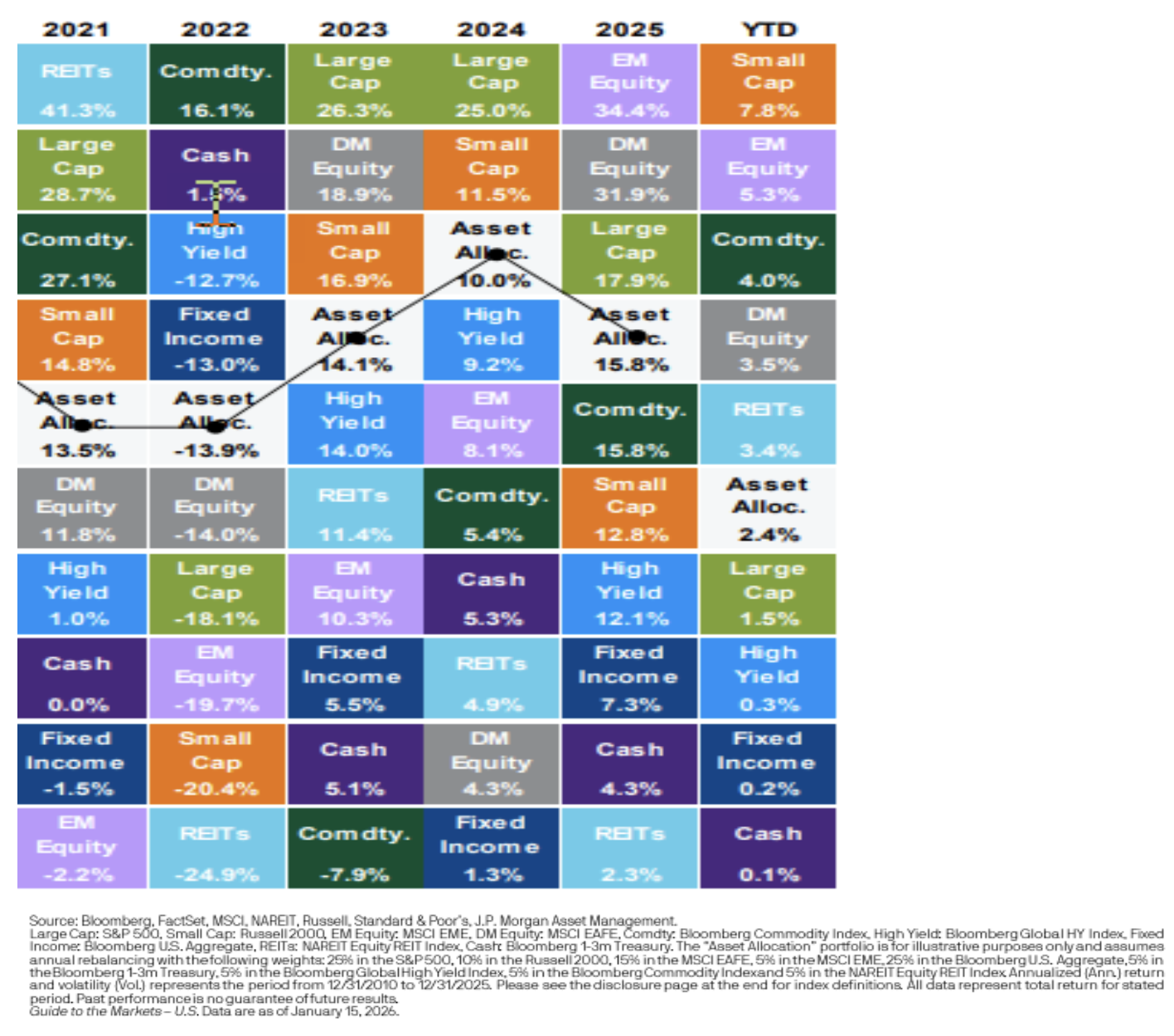
At the same time, the small-cap Russell 2000 Index finished the week at its closing all-time high and has been the best asset class year-to-date. U.S. investors have been rotating out of the large growth companies that have driven U.S. returns over the past few years, and the rest of the market is benefiting (see chart below).
Additionally, international stocks were strong outperformers last year, with returns of more than 30%. With improving fundamentals overseas, international markets have been benefiting from any concerns the headlines might ultimately have on the U.S.
Risks and Opportunities
Headlines are hard to ignore, and market declines lead to heightened concerns and emotions. It is never a good idea to ignore the risks to consensus views. But it also doesn’t make sense to make short-term portfolio decisions when trying to achieve long-term investment objectives.
In my view, the best strategy is to focus on long-term objectives and look for opportunities that result from short-term market moves. The opportunity set for investors is expanding. Now is a good time to check to see if portfolios have exposure to these areas.
There is always uncertainty about the most likely path forward for the economy and markets — and now is no different. We will continue to watch the headlines and data to see the ultimate impact on the consensus view. While overweighting one asset class has worked for investors in the recent past, that is not indicative of the best approach to portfolio construction when looking through a longer-term lens. Volatility is likely here to stay. As a result, we believe portfolios with balance and diversification across asset classes are the best way to manage risk and participate in future upside.
The Russell 2000 measures the performance of the small-cap stocks. The “asset allocation” portfolio shown in the third chart is for illustrative purposes only. No specific investments were used in this example. Actual results will vary.
Chris Fasciano is the chief marketing strategist at Commonwealth Financial Network.
A message from Advisor Perspectives and VettaFi: Discover something new! Click here to register for our upcoming webcasts.
Read more articles by Chris Fasciano
 Advisor Perspectives welcomes guest contributions. The views presented here do not necessarily represent those of Advisor Perspectives.