Money managers at BlackRock Inc., Bridgewater Associates and Pacific Investment Management Co. are shoring up their portfolios against a fresh bout of inflation.
A BlackRock fund is building short positions in US Treasuries and gilts in case lower interest rates fail to materialize. Bridgewater prefers stocks to bonds. Pimco likes the buffer afforded by Treasuries that have an inflation adjustment baked into their yield.
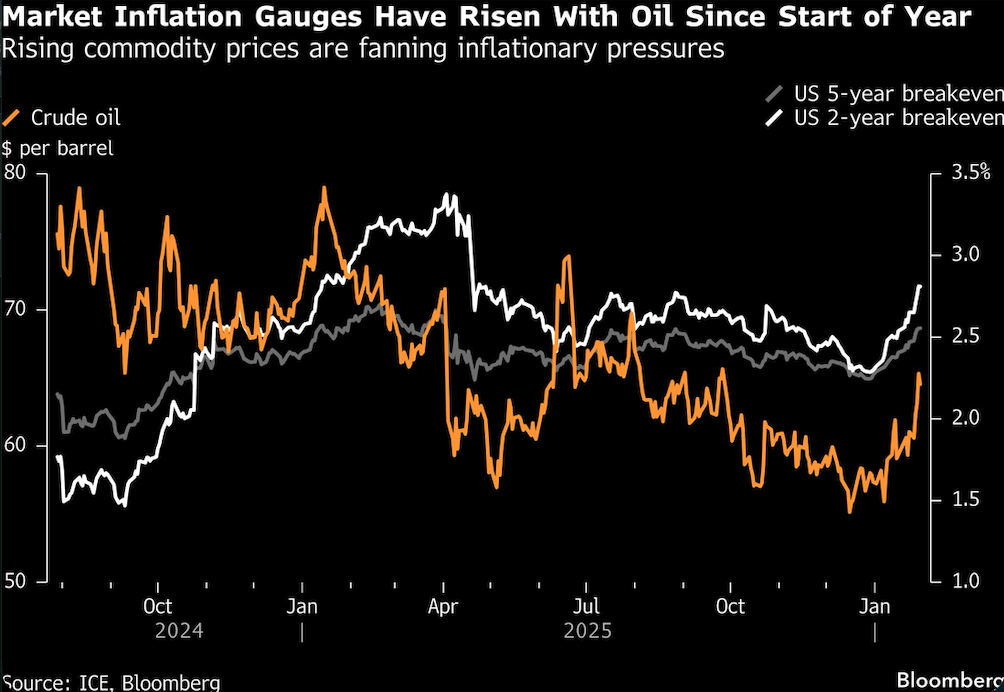
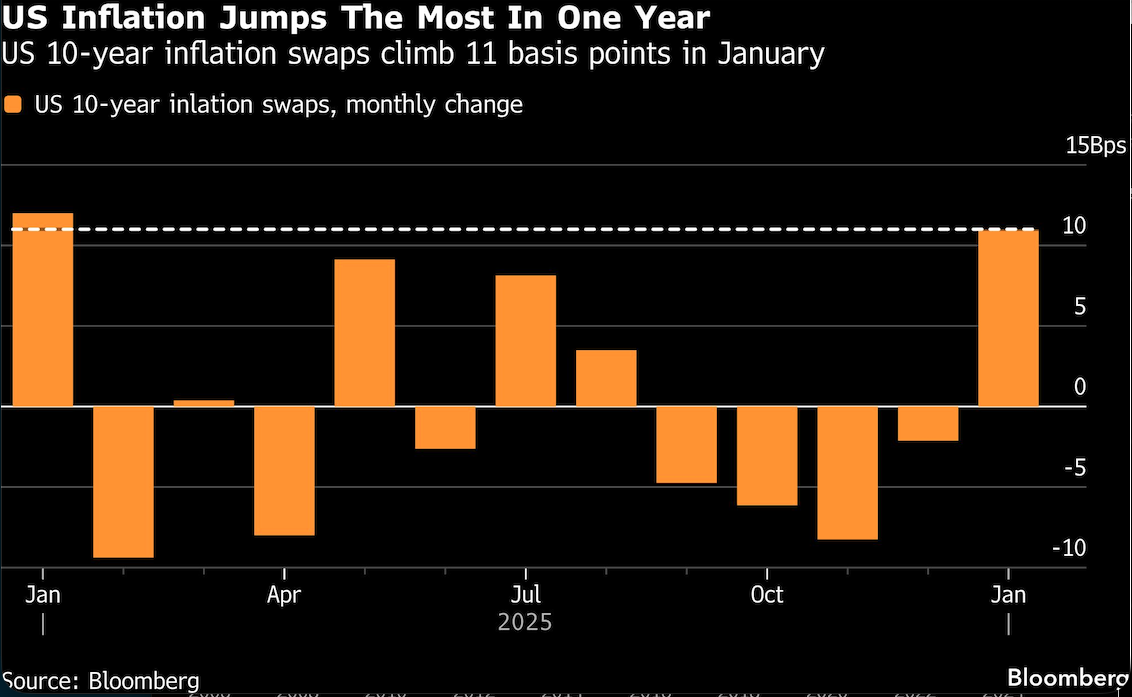
There are growing signs their concern is warranted: The difference between yields on ordinary Treasuries and inflation-protected notes has climbed sharply in January to the highest levels in months. Inflation swaps, another gauge of market expectations, have also risen.
It’s a view motivated by expectations a robust US economy will reignite price growth, particularly if Kevin Warsh — nominated by US President Donald Trump on Friday as the next Federal Reserve chair — steers policymakers toward quicker or deeper interest-rate cuts. More globally, higher commodity prices, heavy government borrowing and soaring artificial intelligence spending add to the pressure.

A US-led “inflationary boom” is the biggest risk underpriced by investors this year, according to Ben Pearson, a senior trader at UBS Group AG.
If that materializes, it would keep the Fed “fully on the sidelines” in the first half of the year and force markets to price in interest-rate hikes for the second, Pearson said. Steven Barrow, head of G-10 strategy at Standard Bank, predicts the 10-year bond yield could jump as high as 5% from around 4.25% now if the White House’s hunger for rate cuts is stymied.
It points to a challenging start for Warsh, who would succeed Jerome Powell when his term ends in May if confirmed by the Senate. Investors will need to weigh Warsh’s longstanding reputation as an inflation hawk against his willingness to deliver the rate cuts Trump has sought.
Money markets were pricing 54 basis points of cuts by year-end on Monday, six basis points more than at Thursday’s close.
Global View
Their caution contrasts with the more widespread market conviction that inflation, which hobbled bond returns in the post-pandemic years, is broadly back under control.
In the euro zone, investors are largely convinced that price growth will stick at target — or even dip below it. While longer-term inflation expectations have drifted higher with US gauges, they’re still just a whisker above the European Central Bank’s 2% target.
Things are murkier in the UK. Gilts have been a favored bet in recent months on the view that disinflation will enable the Bank of England to resume rate cuts. But a flurry of positive economic data have forced traders to rethink how quickly that can happen. Earlier in January, two more interest-rate reductions were seen as highly likely. Now, the odds of a second cut by year-end are about 50%.
Elsewhere, Australia is already proving inflation pessimists right. Traders have ramped up wagers that the central bank will hike rates on Tuesday as domestic price growth creeps higher — a potentially awkward about-face less than six months after policymakers last reduced borrowing costs.
Split Opinions
But it’s the world’s largest economy that investors are watching most closely, and where the biggest divergence in opinion has emerged.
Steven Williams, head of global fixed income for Europe, the Middle East and Africa at Amova Asset Management, is convinced that price pressures are easing and says a CPI reading below 2% is possible by the summer. It’s plateaued at around 2.7%.
“Everything is telling me that the disinflation trend is going to continue,” he said. “It’s going to be two or more, maybe four cuts this year, if our inflation view comes to fruition.”
That’s the polar opposite of Peter Orszag’s view. The chief executive officer of Lazard recently argued that US inflation back above 4% by year-end is not just plausible, but the “most likely scenario.”
Forecasting inflation has rarely been so fraught.
Resurgent tariff tensions and the emergence of burgeoning new technologies are all muddying the picture. On top of that, investors must contend with Trump’s on-again, off-again threats against Iran which have sent oil prices spiking, as well as a rapid rally in industrial metals. Still, the commodities rally was thrown into reverse on Friday and Monday, clouding the near-term outlook.
The message from the Federal Reserve last week, as it kept rates on hold, was that inflation remains “somewhat elevated.”
What Bloomberg strategists say...
Kevin Warsh “is set to have a difficult task whatever happens, either defending cutting rates when it’s clear inflation is a problem, or suggesting to President Donald Trump that a hike is necessary.
With inflation pressures building across the board, doing nothing won’t be an option in perpetuity.”
— Simon White, Macro Strategist, London
Bridgewater flags the artificial intelligence boom as another wildcard. Even if the technology ultimately proves disinflationary by boosting productivity and cutting costs, the insatiable near-term demand for chips, electricity, data scientists and more exacerbates a “challenging environment” for bonds, according to the hedge fund giant.
BlackRock’s Tom Becker — who co-manages the $4.1 billion BlackRock Tactical Opportunities Fund — has been adding to short positions in long-end Treasuries and gilts since late last year. He expects strong economic growth and rising commodity prices to keep upward pressure on consumer prices.
Against such an uncertain backdrop, Treasury Inflation-Protected Securities, or TIPS, offer a potential hedge.
To be sure, the notes aren’t without risks of their own. Breakevens could drop swiftly again if the oil price, which they’ve tracked closely so far, were to collapse, said Brian Quigley, senior portfolio manager at Vanguard. Quigley entered the year with a US curve-steepening strategy and retains that positioning.
But for Pimco, TIPS offer cheap insurance: despite inflation above central-bank targets and the near-term risk of reacceleration, longer-term breakevens remain low.
“If inflation were to outpace the Fed’s target, which it has for the past four or five years, then we think that’s decent protection,” said Michael Cudzil, senior portfolio manager at the Newport Beach-headquartered firm in an interview last week.
A message from Advisor Perspectives and VettaFi: Discover something new! Click here to register for our upcoming webcasts.
Bloomberg News provided this article. For more articles like this please visit
bloomberg.com.
Read more articles by Alice Gledhill