Warren Buffett has a great line on how hard it is to pick winners when major industrial change is afoot. “What you really should have done in 1905 or so, when you saw what was going to happen with the auto, is you should have gone short horses,” the Oracle of Omaha once said.
No one knows which firm will ultimately win the artificial intelligence race, but many people have clocked that a lot of enterprise software companies could soon be put out to pasture. If investors aren’t outright betting against the sector, they’re taking money off the table.
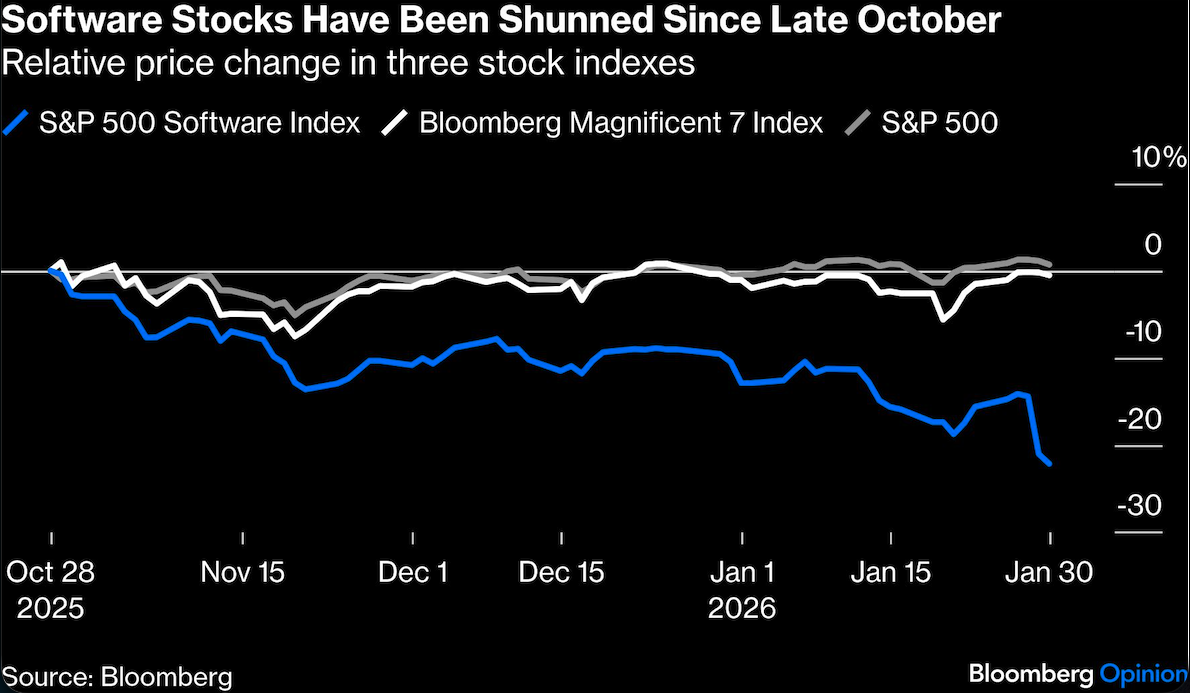
In public markets, shares and bonds of these businesses are being hit. Since late October the software segment of the S&P 500 is down by more than a fifth, while the full index is roughly flat. Meanwhile, bond prices for companies such as McAfee LLC, ION Platform Investment Group Ltd. and Rackspace Technology Global Inc. have taken a beating.

But it’s in private markets where the shock could be worst. The lack of regular reporting from private equity-owned, or private credit-funded, firms means the trouble isn’t immediately obvious, but there are signs. Team.Blue, a privately owned European software firm, was forced to halt a loan refinancing last week as lenders sour on the sector.
Across the Atlantic, the much better known Blue Owl Capital Inc. suffered unusually large redemptions from its software-focused private credit fund in the final months of last year, when it had to pay out about 15% of its assets. The fund, an unlisted business-development company called Blue Owl Technology Income Corp., told investors last week that elevated withdrawal requests were common in periods of market volatility.
Indeed, several BDCs run by marquee private-capital names such as Ares Management Corp. and Blackstone Inc. also faced heavy demands to release cash in late 2025. That was due in part to falling yields on the floating-rate loans these funds hold, and to growing concern about potential losses in private credit more broadly after some high-profile defaults. But Blue Owl’s technology fund had the largest withdrawals, which is telling.
One big problem for the private backers of software businesses is the vintage of acquisitions made earlier this decade. Many buyouts and the loans behind them were done at what turned out to be peak valuations for the tech sector just after Covid. At the same time, rising interest rates shut down the traditional way of financing these deals with syndicated loans arranged by investment banks. These lenders had been stuck holding leveraged debt they couldn’t sell, and didn’t have the capacity for fresh deals. Private credit stepped into the breach.
The market share taken by direct lenders in funding buyouts jumped to between 40% and 70%, depending on the quarter, between 2022 and 2023, according to Matthew Mish, a US-based credit strategist at UBS Group AG. The share pre-Covid was 15%-25%.
This concentration of funding for this vintage of deals means private credit is now more exposed to AI disruption, Mish told me. The traditional leveraged-loans market — which funds public and private companies across a range of industries — is also more diversified than direct lending.
Some 25%-35% of private credit portfolios face heightened threats from the AI boom, based on Mish’s analysis of the portfolios of listed BDCs. Bankruptcy filings from technology and business-services firms are increasing and he forecasts private credit default rates to rise by about 2 percentage points this year to around 6%.
Software businesses owned by buyout firms are getting harder to sell, too. That’s not simply down to them overpaying for this vintage of deals, it’s also because investors are right now only interested in AI-related stories.
Even blue-chip public companies like Adobe Inc. and Salesforce Inc. are sliding in the stock markets, so the chances of exiting smaller, younger businesses bought by private equity between 2021 and 2022 look bleak, unless owners are ready to swallow big discounts. To try to avoid the worst, industry specialist Vista Equity Partners created an “agentic factory” last summer to build AI elements for all its portfolio companies, according to The Information.
Software faces a range of AI threats: Everything from a steep drop in sales growth and a shorter lifespan for their installed base of customers, to near-immediate obsolescence. The kinds of business most vulnerable are those focused on admin, data analytics or other back-office functions where switching costs are low, according to Mish. Software-as-a-service that’s highly tailored for specific industries is less endangered. Toast Inc., which runs order-management systems and payments for restaurants, might be one example.
For lenders, a particular problem is the potential for very low cash recoveries if a company goes bust. The assets are mostly intangible – skills, licenses and intellectual property – and not as easy to seize and sell as inventory, buildings or other physical equipment.
It’s far from certain how far AI will get, or how quickly — or whether this bubble is just waiting to burst. But the direction of travel looks clear, and investors may once more have found themselves in the wrong mode of transport.
A message from Advisor Perspectives and VettaFi: Discover something new! Click here to register for our upcoming webcasts.
Bloomberg News provided this article. For more articles like this please visit
bloomberg.com.
Read more articles by Paul J. Davies