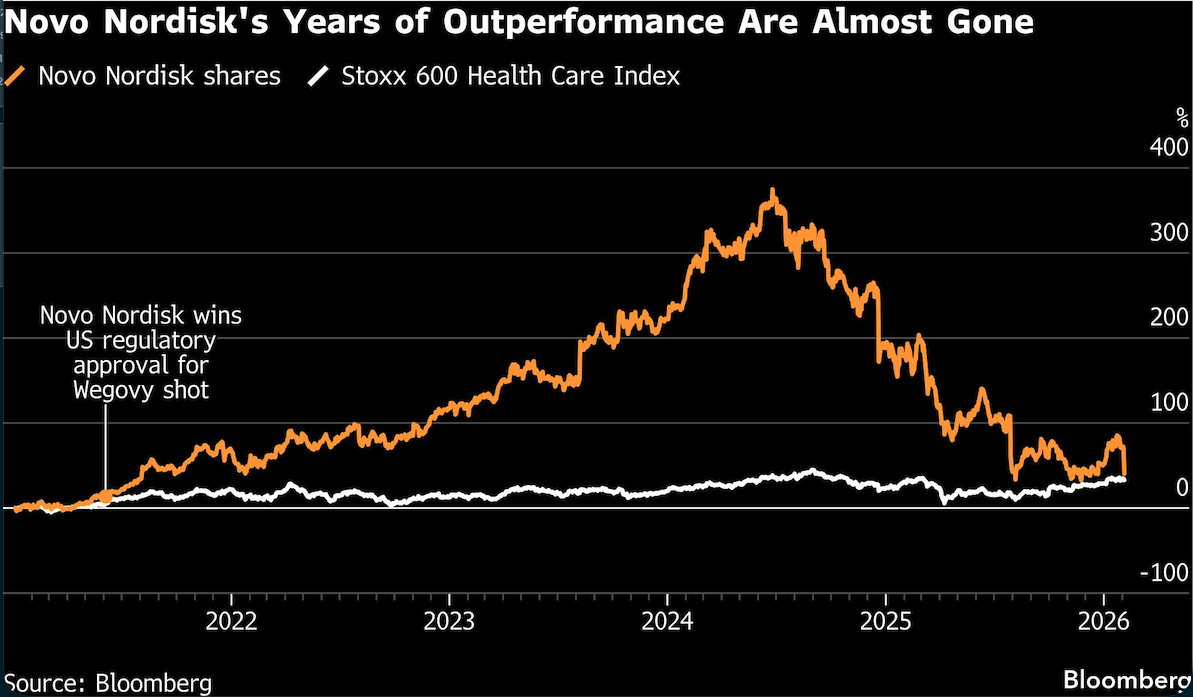
Novo Nordisk A/S’s chief executive officer asked investors to stick with him after a dire sales forecast caused a share price rout, saying a surge in prescriptions for cheaper obesity drugs will eventually revive growth.
The Danish drugmaker predicted sales will drop as much as 13% this year because of unprecedented price pressure in the US and competition from generic versions of its blockbusters in some markets. By contrast, its chief rival Eli Lilly & Co. forecast sales growth of as much as 27% this year.
Novo CEO Mike Doustdar on Wednesday said the process of reversing its sales slump will happen prescription by prescription, as lower prices make obesity drugs affordable for more patients.
“The price reduction that is happening now — and it is in some way painful to the financial numbers — is an investment for our future,” Doustdar told journalists. “That is our strategy and we’re going to stick to it.”
Novo’s shares tumbled as much as 20% in Copenhagen, more than wiping out this year’s gains. The company’s market value has fallen to about $215 billion from more than $600 billion in 2024, when it became Europe’s most valuable company.
Lilly’s shares rose as much as 11% in US pre-market trading. The stock is up about 21% in the past year.
This year’s forecast sales drop is the latest blow for Novo as the company struggles to regain its footing in the obesity market it pioneered. Lilly is leading in the US market with its more powerful shot Zepbound, even as compounding pharmacies continue to win over consumers with copycat versions of Novo’s own blockbuster Wegovy.
Cheap Shots
Doustdar has been arguing to investors for the past six or seven months that short-term pricing pain will lead to long-term gain, he told Bloomberg TV. He has so far refused to put a timeline on a revival. Instead, he pointed toward more than 170,000 prescriptions this year for the company’s newest version of its weight-loss drug Wegovy, a pill that’s priced at $149 a month for an introductory dose in the US.
The drugmaker is also offering Wegovy shots for $199 a month, a fraction of the earlier monthly list price of $1,349.
“These are new patients, and they’re coming in because the price is $149,” Doustdar at a press conference. In the Bloomberg TV interview, he called the prescription growth the first signal of a boost in volume that can drive gains in the longer term.
The rapid uptake of the pill has been driven in part by Novo’s telehealth partners, who used social media to get the word out, bringing “a totally different ramp in terms of demand,” Chief Financial Officer Karsten Munk Knudsen said at a press briefing in Copenhagen.
A high-dose version of Wegovy is also on track for approval in the US in the first quarter, Doustdar said. The higher dose offers weight loss on par with Zepbound, he said. Novo is already seeing positive early signs out of the UK, where the product was approved last month, he added.
Since taking over as CEO last August, Doustdar has slashed 11% of the company’s workforce and pledged to make the drugmaker more aggressive and performance-focused. On Wednesday, he said he plans no more mass layoffs this year.
In pockets of the company, Novo will hire more workers, and in other parts of the business there will be further reductions, he said in the TV interview.
“The new guidance is really something that intensifies the competitive landscape, putting even more focus on costs,” Lars Hytting, head of trading at ArthaScope, an investor in the Danish drugmaker, said in an interview. “They’re probably not quite there yet on that front.”
Doustdar has moved to shuffle management. Jamey Millar, who is currently at UnitedHealth Group Inc. and previously worked at GSK Plc and Procter & Gamble Co., will replace Dave Moore as head of the US business. “He really brings in the collection of exactly what we need today leading our US organization,” Doustdar said.
Novo also appointed Hong Chow to lead product and portfolio strategy, replacing Ludovic Helfgott. She most recently oversaw the China and international business for Merck Healthcare, part of Merck KGaA in Germany.
The last time Novo’s annual sales fell was in 2017, during a price war over insulin in the US. This time around, the company is trying to fend off competition on multiple fronts, from Lilly’s Zepbound to generic copies of Ozempic likely to emerge in international markets this year.
Like obesity drugs, “the insulin war was a market that started with just a few players, and where people more or less assumed they only had good days ahead,” said Hytting. “And the insulin heaven came to an abrupt halt. And so will this. That’s the kind of moves we’re seeing.”
A message from Advisor Perspectives and VettaFi: Discover something new! Click here to register for our upcoming webcasts.
Bloomberg News provided this article. For more articles like this please visit
bloomberg.com.