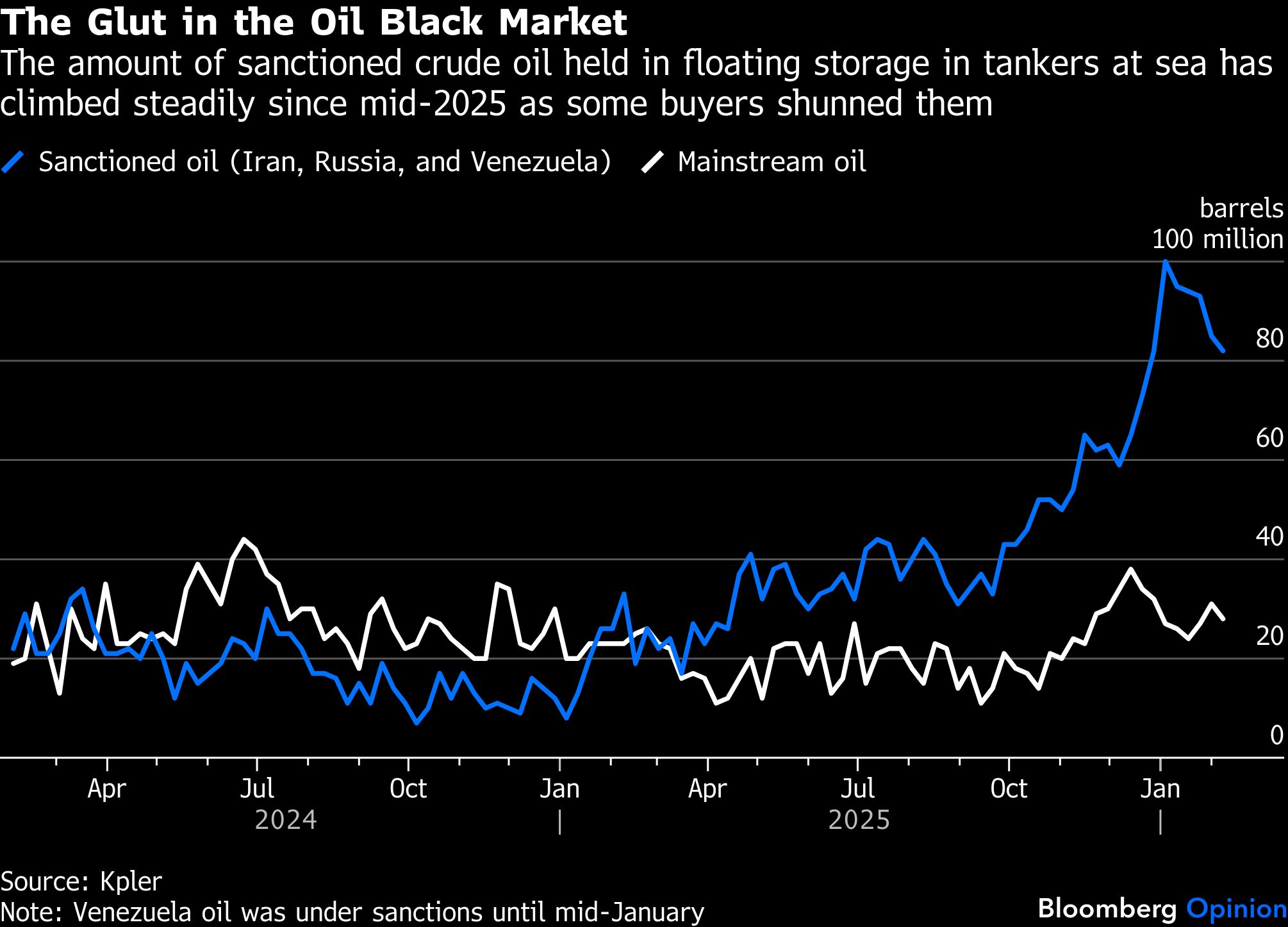
Oil smuggling has been so enormously profitable that no matter how many obstacles Washington and Brussels put up, the barrels kept flowing. With a daily turnover of $1 billion, the black market has been just too attractive. For the first time, however, I see cracks in the illicit business. Millions of barrels of unsold Iranian and Russian crude are accumulating in storage.
The reason isn’t just more US and European sanctions and political pressure. Sure, they’ve helped. But the key factor is more mundane: The buyers of sanctioned crude oil have plenty of alternative aboveboard barrels available — at reasonable prices. Playing by the rules carries a smaller cost.
Buyers of sanctioned oil, notably India and Turkey, have been switching with ease over the last 60 days to unsanctioned barrels. For now, this means any glut of unsold crude is being concentrated in the shadows of the black market, away from the limelight of the world’s top oil-price benchmarks: Brent, West Texas Intermediate and Dubai.
If anything, the switch has made the mainstream oil market tighter, putting a floor under prices. Add the risk of conflict in the Middle East, and the cost of a barrel has gone up 10% over the last two months. At $63 or so for WTI, the price is still alluring enough to make buying illicit stuff not worth the bother.
The exact size of the black-market glut is difficult to ascertain. My educated guess is that the stockpile, spread between onshore tanks and oil tankers at sea turned into temporary floating-storage facilities, is hovering at more than 100 million barrels. At current prices, even factoring in the discounts that traders offer for sanctioned crude, it’s worth at least $5 billion. Kpler, a commodity-intelligence firm, puts the amount of Russian and Iranian crude in floating storage alone at 58 million barrels. It was 6 million early last year.

To understand what’s happening, look at India, traditionally the largest buyer of sanctioned oil after China. At its peak New Delhi bought more than 2 million barrels of black-market barrels, first from Iran, then from Russia. Under pressure from the US and the European Union, it stopped importing Iranian oil in 2019, and now it has reduced its purchases of Russian crude.
In January, India imported about 1.3 million barrels a day of Russian oil, down about 35% from the middle of last year. Despite US President Donald Trump saying New Delhi had agreed to completely stop buying Russian crude, I don’t believe it will do so in the short-term. My industry soundings indicate that purchases will probably fall to 800,000-900,000 barrels a day in February and March, less than half of the peak. For the US, that might be enough.
Indian refiners are buying non-sanctioned crude from all over: the Middle East, West Africa, Brazil, Guyana, the US, even Argentina. When I visited the country last week, refiners told me they’d been surprised about how easy it had been so far to secure alternative supplies.
Sure, maybe replacing even more of the flow of sanctioned crude will prove more difficult. And, sure, there’s a price to pay. Non-sanctioned barrels are still more expensive. But with crude hovering around $60 a barrel, instead of $80-$100, the financial pain of switching is bearable. I doubt India and others would shun the black market if regular oil was pricier.
It helps, of course, that Venezuelan crude isn’t sanctioned any more. That shifts 800,000 barrels a day from the black market into the regular market. India is already tapping some of that.
What comes next is crucial. For now, Russia and Iran have been able to keep pumping even if some barrels go unsold, putting the surplus into storage. But there’s a physical limit to capacity. Using oil tankers as floating holding tanks gives them both extra time. But either they find new customers, or sooner or later they’ll have to reduce production. The alternative is that Moscow and Tehran cut a deal with the White House to ease, or remove, the sanctions. But we’re still a ways from that.
China is the wildcard. Beijing already purchases about 95% of the crude that Iran exports, and about 60% of Russia’s. Put simply, this black market wouldn’t exist without China. It’s a symbiotic relationship: Iran and Russia sell their product, keeping their war economies afloat, and China secures energy at a bargain price, and significant political leverage in the Middle East and Moscow.
Last month Chinese refiners increased purchases of Russian crude to near-record levels, in part to offset their loss of Venezuelan oil. In theory, China can go further still, offsetting whatever barrels India and Turkey don’t buy by storing them in its strategic petroleum reserve.
So Beijing’s next move will have profound implications for the global market. Decline to mop up the black-market glut and Russia and Iran would have to cut production, pushing up the crude price for everyone. Buy more illicit stuff and China could cut its purchases of non-sanctioned barrels, making more of them available and potentially forcing prices down. Not for the first time, Beijing finds itself in a position of influence over strategic resources.
A message from Advisor Perspectives and VettaFi: Discover something new! Click here to register for our upcoming webcasts.
Bloomberg News provided this article. For more articles like this please visit
bloomberg.com.
Read more articles by Javier Blas