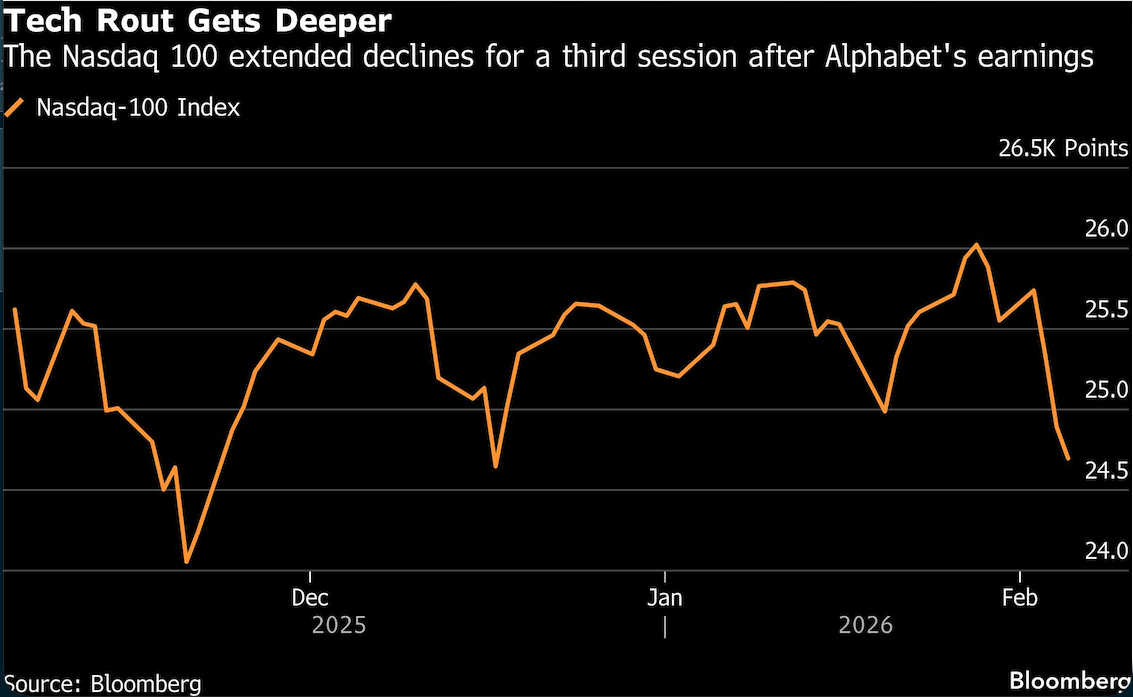
US stocks continued to slide on Thursday as technology shares fell and private jobs data revived worries of an economic slowdown.
The Nasdaq 100 Index was down 1% at 1:40 p.m. in New York, paring a drop of as much as 1.8% earlier in the session. The S&P 500 Index fell 1%, while the Cboe Volatility Index hovered at around 21.
“I think we’re seeing the unwind of a three-year economic and market bifurcation that’s beginning to broaden out,” said Michael Kantrowitz, chief investment strategist at Piper Sandler.
The S&P 500 “is testing the 100-day moving average today,” said Wells Fargo Investment Institute’s Scott Wren, though he notes that the “real support comes in at 6,550” and then at the 200-day moving average “that is coming in today at 6,460.”
“Near those are levels where we want to commit funds if you have time on your side,” Wren added.
The rout in tech stocks continued, with Alphabet Inc. dropping 2.4% as investors balked at the Google parent’s ambitious capital spending plans for the year. The internet-search giant said its massive investments in artificial intelligence — funding new infrastructure, research and talent — are essential for competing against rivals including Amazon.com Inc., Microsoft Corp. and OpenAI.

Alphabet’s results contributed to the growing malaise around tech stocks. A rotation out of the sector, particularly in software names, rolled on for a third-straight session.
“This sell-off feels a great deal like the DeepSeek to Liberation Day rout in technology,” said Nancy Tengler, CEO and chief investment officer of Laffer Tengler Investments, referring to the market tumble that occurred in the early months of 2025.
Investors have become increasingly skeptical of Big Tech’s swelling budgets for AI. While some companies, including Meta Platforms Inc., have been able to win investors over with their spending plans, others — such as Tesla Inc. and Microsoft — are having a harder time.
Bloomberg’s gauge for the Magnificent Seven tumbled 1.5% on Thursday. Amazon will report earnings after the bell.
“Everybody was pushed into the same stocks, now we’re seeing broader macro and earnings data, so investors have alternatives to put their money,” Kantrowitz said. “There are more questions on the technology and AI trade earnings and valuations while parts of the economy and market that had been weak for three years are coming back to life.”
Jobs and Earnings
Data on the labor market also weighed on stocks. Job openings saw an unexpected decline in December to the lowest level since 2020 and layoffs edged up, according to data from the Bureau of Labor Statistics released on Thursday.
Meanwhile, new data from Challenger, Gray & Christmas Inc. showed that companies announced the largest number of job cuts for any January since the depths of the Great Recession in 2009.
And applications for unemployment benefits topped estimates last week as severe winter weather curtailed business activity. Initial claims increased by 22,000 to 231,000 in the final week of January, according to Labor Department data released Thursday.
“All three missed, and while none are critical, it’ll incrementally weigh on the US growth story, which is the key driver of cyclicals, which have basically held up equities year to date,” said Vishal Vivek, a strategist on Citigroup’s trading desk.
In company-specific news, Qualcomm Inc., the largest maker of smartphone processors, dropped 7.8% after giving a lackluster revenue forecast for the current period. Estée Lauder Cos. plunged 20% after its profit view failed to reassure investors about the pace of its turnaround.
Elf Beauty Inc. advanced as the cosmetics company boosted its adjusted Ebitda guidance for the full year, with analysts highlighting a strong performance in the newly-acquired Rhode.
Crypto-linked stocks extended losses after Bitcoin slumped to the lowest level since 2024. An unwinding of leveraged bets and broader market turbulence has deepened a selloff that’s hammered cryptocurrencies over the past three weeks.
“Stocks are nervous in the wake of continued selling in assets that have already crashed — silver, gold, crypto,” said Julian Emanuel, chief equity and quantitative strategist at Evercore ISI. “And hedge funds are actively degrossing.”
A message from Advisor Perspectives and VettaFi: Discover something new! Click here to register for our upcoming webcasts.
Bloomberg News provided this article. For more articles like this please visit
bloomberg.com.
Read more articles by Joel Leon, Alexandra Semenova