Investing these days feels harder than ever. So much has changed, and there are so many uncertainties, from the financial (what’s going on with tech stocks?) to the cosmic (what will the new economic world order look like?). To make matters worse, there is no haven — not gold, not crypto, not even US Treasuries.
There is a way to manage this environment: Embrace Finance 101. Recall the basics you learned in financial literacy class in high school, or in that one finance course you took in college, or while getting your MBA, or just from reading the classics on investing. Everything you need to know to manage this market environment is contained in a few nuggets of wisdom.
Markets are efficient after all. This does not mean that prices are always “correct,” just that they generally reflect the available information. When investors learn that software firms’ products may be displaced by AI, their prices fall, as they did last week. They will probably go back up, then fall again, as the market learns exactly what AI will mean for the economy and who the winners and losers will be. It will be a messy process — but there will also be a lot of upside. That’s because the implication of the efficient markets theory is there is no excess return without more risk, and timing the market is nearly impossible (at least to pull off consistently). If you are in markets for the long haul, settle in for a bumpy ride. Odds are, it will pay off eventually.
There is a larger benefit as well: Efficient markets are transparent and the best way to allocate capital. Private markets are not efficient, because prices aren’t updated as new information comes in. This can result in some nasty surprises for investors as public markets deliver their verdict.
Diversify your portfolio as much as possible. For the last quarter century, you almost couldn’t go wrong with big US tech stocks. If in 2005 you had invested $1,000 in four stocks — Apple, Alphabet, Nvidia and Amazon — you’d have $31,800 today. If you invested it all in the S&P 500 instead, you’d have just $5,800. The so-called Magnificent 7’s growth has been so spectacular they dominate the S&P, and their performance seemed to demonstrate that diversification was for suckers.
But hindsight is always 20/20. AOL also looked like a winner once. OpenAI could be this year’s Mozilla. Concentration in indexes is not so unusual, it comes and goes. What matters is broad exposure.
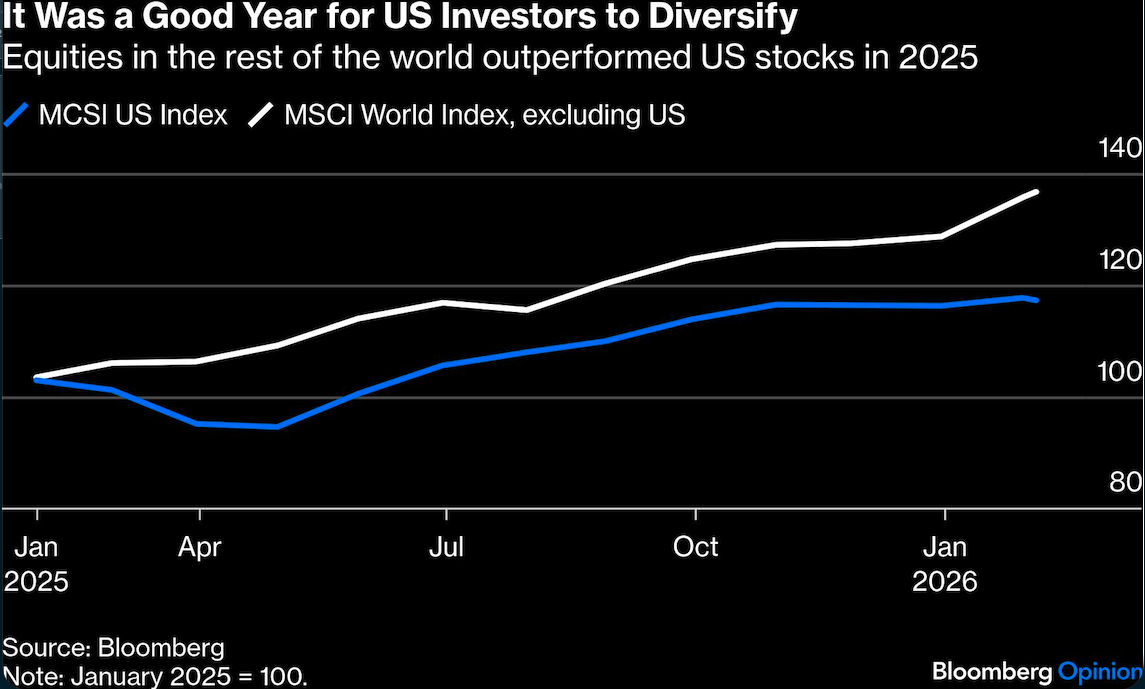
One of the lessons of financial economics is that more diversification is better — and that includes investing abroad. For the last few decades, you’d have paid for that choice; the US market trounced all others. But no trend is permanent, not even a 20-year one.
In fact, last year global markets outperformed the US stock market. This could happen again this year, or not — but it’s a safe bet it will happen again at some point. There is no easy way of knowing what the future holds for any given country, which is why a well-diversified international portfolio won’t pay off every year. But it is the right balance of risk and reward.

Nothing is truly risk-free, but some things are lower-risk than others. And the main “risk-free” asset — it is a relative term — is probably a US government bond. The defining feature of a risk-free asset is that its price does not move much when the stock market does. Adding this kind of security to your portfolio offers the best possible hedge. Most of the time that means a short-term US Treasury. But if you have a longer duration liability, risk-free means a long-term bond, hedged for inflation.
These assets aren’t perfect, but from a risk perspective they’re as good as it gets. Gold is not a safe asset, it offers no duration and its price is extremely volatile and hard to predict. It does not offer consistent correlation with markets. And crypto, as last week illustrated, is definitely not a safe asset. It may be perceived as a dollar hedge, but it never fulfilled the basic criteria as a currency; its latest price drop coincided with a dollar depreciation. Crypto is also very volatile and correlated with markets. None of this is a surprise; crypto’s meteoric rise violated every rule of Finance 101.
Bond yields revert to the mean. It is true that yields on sovereign bonds have trended down a bit over time, as the world became safer and defaults less common. But bonds aren’t like stocks: Yields can go only so low (people won’t pay much to lend money) and they tend to fluctuate around a long-term average that reflects the return to capital, inflation risk, and how much we value the future. The near-zero rates of the 2010s were never going to last. Bond prices may be more volatile in the future, especially if the world gets riskier. But the age of free money is probably over.
When you took Finance 101, if you ever did, you probably expected to learn how to be the next Warren Buffet. But the true lesson of Finance 101 is humility. Nothing is predictable, conditions change every day, the best you can do is decide how much risk you can tolerate and then diversify, hedge or insure. And if the global economy continues to grow, as it has for a few centuries now, it should all work out. Even with AI.
A message from Advisor Perspectives and VettaFi: Discover something new! Click here to register for our upcoming webcasts.
Bloomberg News provided this article. For more articles like this please visit
bloomberg.com.
Read more articles by Allison Schrager