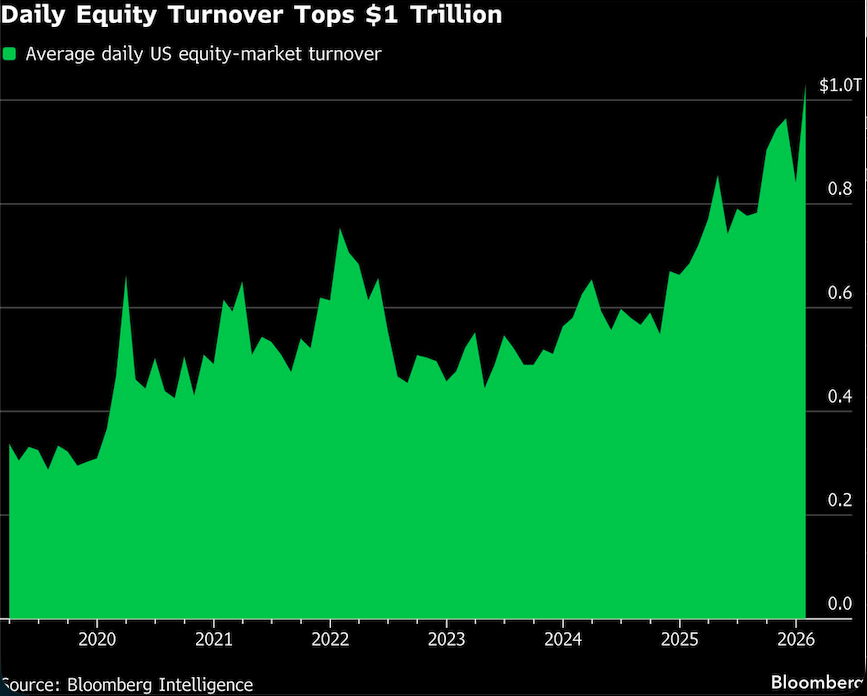
US equity markets are moving more money than ever before, blowing past $1 trillion in shares traded each day as heavy volume becomes the new norm.
The surge marks a sharp step-up from a year ago. Equity turnover averaged a record $1.03 trillion in January, a roughly 50% increase from the same period in 2025, according to data compiled by Bloomberg Intelligence. More than 19 billion shares traded hands daily over the span, the second-most ever, the data show.
The jump reflects a broad-based increase in participation across the market. Mom-and-pop investors and institutional players alike have become more active as US stocks hover near record highs. Yet the influx is unfolding amid concerns over stretched valuations, raising the stakes for those crowding into the market.
“There’s more trading from retail, pod shops and hedge funds, and market makers, while automated trading is more prevalent than ever,” said Bloomberg Intelligence market structure research analyst Jackson Gutenplan. “To a certain extent, trading incentivizes more trading. More liquidity makes it easier to get in and out of positions.”

Unlike past episodes when trading surges were driven by volatility spikes, January’s jump in volume came amid relatively calm markets. The Cboe Volatility Index averaged 16.2 last month, underscoring that market turmoil was not a prerequisite for the heavy turnover, and signaling “strong, sustained liquidity,” Gutenplan and colleague Larry R. Tabb wrote in a report Monday.
One reason for the increase in trading is the rally itself. The higher stocks rise, the more money needed to transact the same number of shares. The S&P 500 Index advanced 15% in the 12 months through the end of January.
But higher prices alone don’t explain the persistence of the volume surge. Across all of 2025, 93 sessions saw the number of shares traded eclipse 18 billion, roughly 37% of all trading days. In January, 14 of 20 sessions breached that threshold, or 70%. That compares with just 4% of days in 2024, the data show.
Market watchers such as Dave Lutz, an equity sales trader and macro strategist at JonesTrading, point to additional reasons for the surge in trading volume, including “the advent of zero-day to expiry trades and retail embracing trading further through Robinhood or Schwab.” He also noted that the “explosion in exchange-traded funds is certainty causing more turnover at times.”
A surge in sector rotation also likely helped fuel last month’s trading boom, as investors moved out of megacap technology stocks and into lagging areas such as energy, materials and industrials. The shift marked the sharpest market broadening in five years, according to data from Societe Generale SA.
“Investors have been trading around large core positions in the tech sector for a couple of years,” said Matt Maley chief market strategist at Miller Tabak + Co. “Now, they’re actually making significant changes to their portfolio holdings.”
Trading activity has surpassed 15 billion shares per day in each of the past 13 months, something that prior to 2025 occurred just three times, according to Bloomberg Intelligence.
“With trading volume increasingly disconnected from volatility, we expect this elevated activity to persist regardless of market events or shocks,” Gutenplan and Tabb wrote.
A message from Advisor Perspectives and VettaFi: Discover something new! Click here to register for our upcoming webcasts.
Bloomberg News provided this article. For more articles like this please visit
bloomberg.com.
Read more articles by Alexandra Semenova