Market pros increasingly think the punishment of software stocks over the past few weeks went too far, creating new bargains in shares that were beaten down in an indiscriminate selloff.
Strategists at JPMorgan Chase & Co. see potential for a software rebound based on the “overly bearish outlook on AI disruption and solid fundamentals,” they wrote in a note to clients Tuesday. Meanwhile, Goldman Sachs Group Inc. Chief Executive Officer David Solomon said Tuesday that he thinks the selloff was “too broad.”
“People are acting like software is on a straight line to zero,” said Mark Luschini, chief investment strategist at Janney Montgomery Scott. “It is so much of a one-way trade that it could be ripe for a counter-trend rally.”
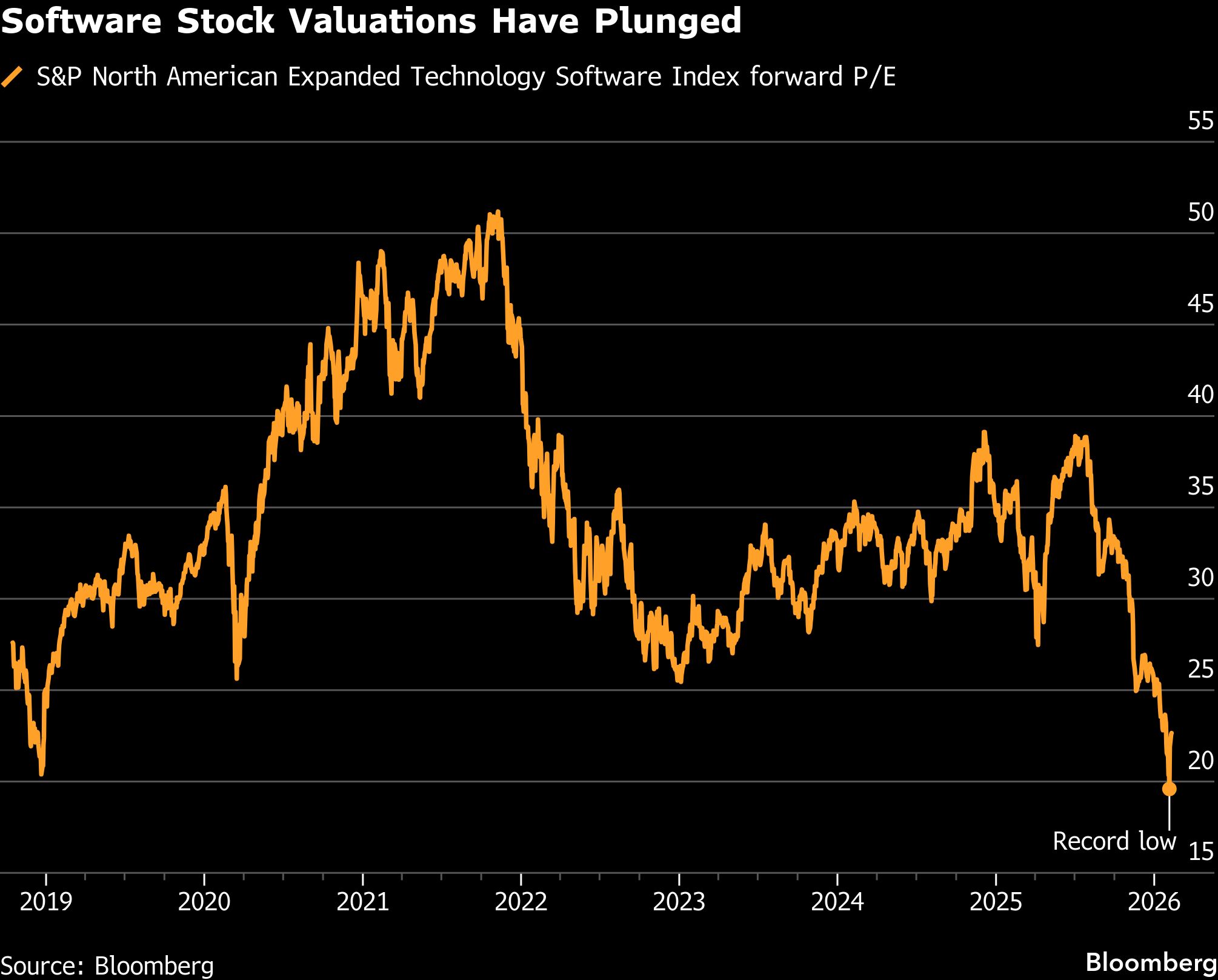
The stocks are now historically cheap. The S&P North American software index traded below 20 times forward earnings last week for the first time ever. It’s at roughly 23 now as the stocks rebound somewhat, still well below its long-term average multiple of 34.

Jefferies looked at 64 stocks in its software coverage and found that “42% are trading at or close to their historical low valuations,” analysts led by Brent Thill wrote in a note to clients on Sunday.
“I think we’re due for a vicious rally in software,” said Michael Toomey, who works on the equity trading desk at Jefferies. This view was echoed by technical traders at BTIG, who wrote in a note last week that software is “in capitulation territory and should be finding a tactical low here.”
The bounce back already appears to have started. A widely followed exchange-traded fund tracking the software industry lost 15% during an eight-session losing streak from Jan. 26 to Feb. 4, but rallied 7.2% since then. The ETF has seen “record” buying by retail investors, according to Vanda Research, which it described as “one of the more aggressive episodes of retail dip-buying in tech, and especially software, that we’ve observed in our dataset.”
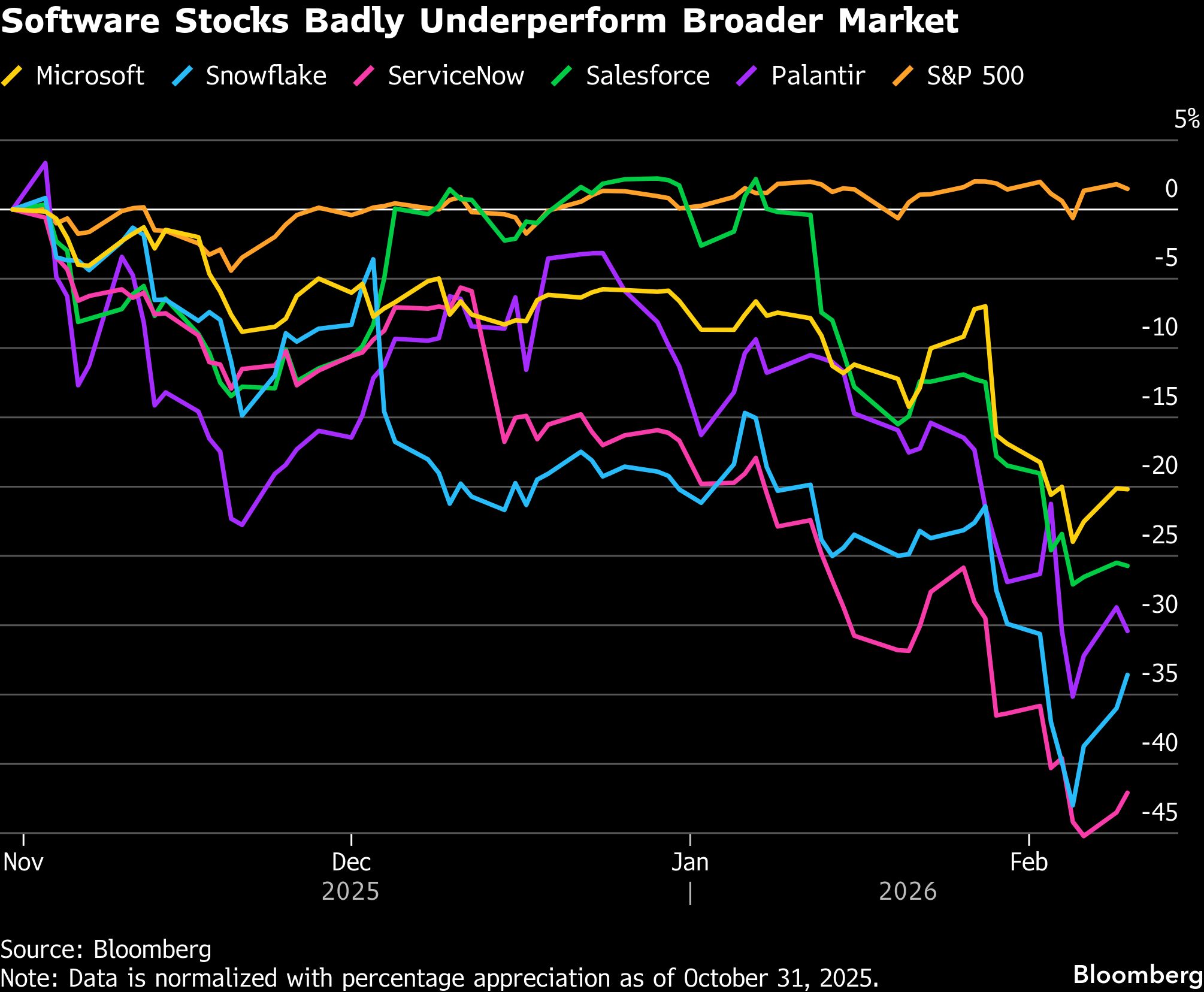
While the uncertainty overhanging the group is real, the selling was so sweeping that many anticipated long-term winners got caught up in it. The names most consistently mentioned by market pros are: Microsoft Corp., Snowflake Inc., ServiceNow Inc., Salesforce Inc. and Palantir Technologies Inc.
Snowflake, which makes data analysis software, lost 27% in just six sessions from Jan. 29 to Feb. 5. However, the company is well placed within the AI ecosystem, signing a $200 million multi-year partnership agreement with OpenAI last week and a similar deal with Anthropic PBC in December, making it “one of the clearest AI beneficiaries in all of public software,” Thill wrote in a note to clients on Feb. 5. It was also singled out by UBS, Loop Capital, Wedbush, Bank of America and D.A. Davidson.
The weakness in Salesforce, ServiceNow and Workday Inc. was notable to Michael Mullaney, director of global market research at Boston Partners. He said he’d be buying the dip in those stocks if he was focused on growth rather than value.
Datadog Inc. also received mentions, and the stock soared 14% Tuesday, its biggest gain since November, after posting strong results and offering a better than expected revenue outlook.
Vibe coding, or using AI to write software code, is at the heart of the eroding sentiment surrounding software. If AI services from companies like Anthropic or OpenAI can replace existing software packages, it will pressure the displaced companies’ revenue, margins and pricing power. Much of the recent rout was sparked by the release of an automation tool for legal work from Anthropic, with a subsequent offering focused on financial research. Before that, an AI tool from Alphabet Inc. tanked video game and mobile ad stocks.
For the most part, this disruption so far is anticipated but largely unquantified. The software and services subsector is expected to post earnings growth of 14.1% in 2026, according to Bloomberg Intelligence. While that’s slower than the 31.7% rate expected for the overall tech sector — which is benefiting from a huge expansion in semiconductors — it’s above the 13.7% pace anticipated for the overall S&P 500 Index. There’s a similar trend for software sales.
“There’s been a lot of speculation about what could happen, but nothing has yet,” said Janney’s Luschini. “The market wants to price in that future risk, but it seems more speculative than real at this juncture.”
That said, software skeptics do have a few signposts for concern. Monday.com Ltd. sank 21% earlier this week after its revenue forecast disappointed. And S&P Global Inc. slid 9.7% on Tuesday following its own underwhelming outlook.
But those cases are largely outliers. So far this earnings season, the 10 software companies in the S&P 500 that have reported results have beaten profit expectations, and eight have for revenue, according to data compiled by Bloomberg. That’s better than the overall index, which has a beat rate of 81% for earnings and 66% for revenue.
Such performance is evidence that the trends aren’t severe enough for investors to just throw in the towel on software, according to Mullaney at Boston Partners.
“A mere deceleration in earnings doesn’t justify to me how much these stocks have come down,” he said. “Although I do think fears of AI disruption is a reasonable reason to take profits.”
A message from Advisor Perspectives and VettaFi: Discover something new! Click here to register for our upcoming webcasts.
Bloomberg News provided this article. For more articles like this please visit
bloomberg.com.
Read more articles by Ryan Vlastelica