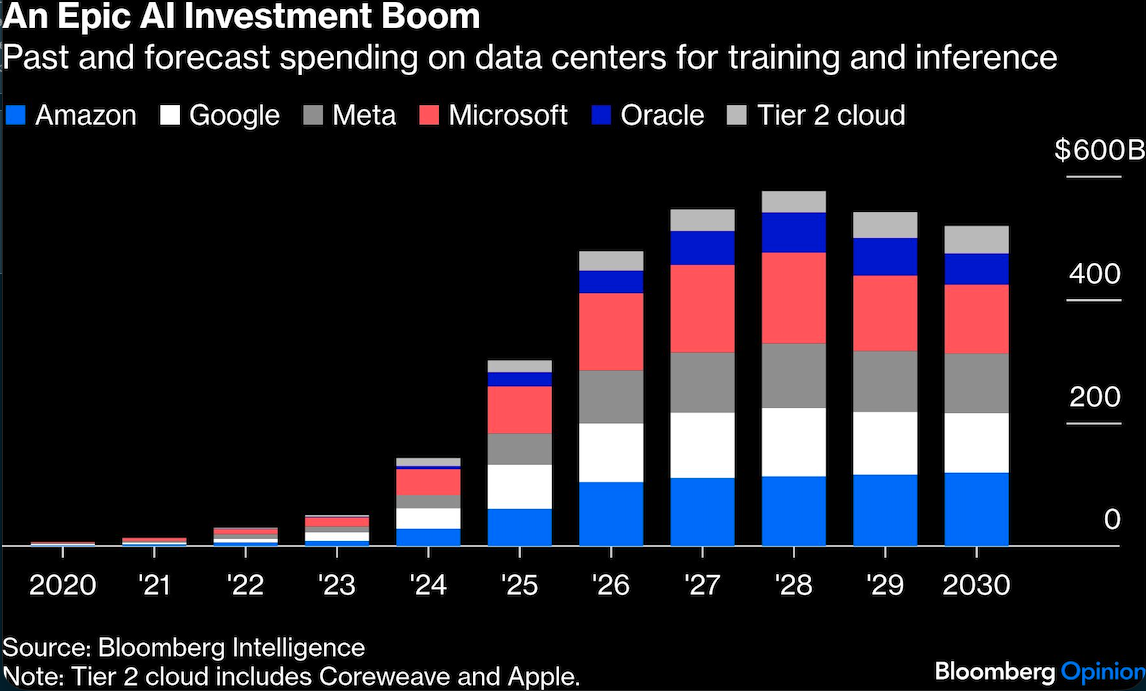
It’s hard not to marvel at how America’s capital markets have rallied to finance the artificial intelligence boom. If all goes as expected, “hyperscalers” such as Meta Platforms Inc. will invest more than $3 trillion through 2030 in data and power infrastructure. It’s an endeavor orders of magnitude greater than the Manhattan Project, funded entirely by private shareholders and creditors.
How, though, will the financial system and the broader economy cope if boom turns to bust? Curmudgeonly as such questions might seem, regulators should be asking them now, while there’s still time to adapt.
AI is already a juggernaut in the stock market. The big tech companies most deeply involved — Alphabet Inc., Amazon.com Inc., Meta, Microsoft Corp., Nvidia Corp. and Oracle Corp. — comprise about a quarter of the S&P 500 Index’s nearly $60 trillion market capitalization. They’re on track to dominate debt markets, too, as they race to fund unprecedented capital expenditures. Meta’s $30 billion deal to finance its Louisiana data center, for example, entailed the largest single corporate bond ever issued.

For the most part, these companies are highly profitable and generate ample cash to fund their epic bets. Yet it’s hard to know whether or how the payoff will come. The history of innovation, from cars to broadband, strongly suggests that most of today’s big players won’t reap the gains they’re hoping for. If returns don’t support the current sky-high valuations, the losses can be large: If Nvidia’s price-to-earnings ratio declined merely to the average for the S&P 500 Index, its capitalization would fall by about $1.5 trillion.
Whether a financial or economic crisis would follow an AI bust depends on where the risk is concentrated. The dot-com bust of the early 2000s led to a relatively mild recession: The losses were spread broadly among stock market investors, who responded by curtailing their spending. By contrast, the subprime bust triggered a global disaster — not only because borrowers couldn’t pay, but also because financial institutions were holding investments structured in such a way that a small increase in defaults would trigger catastrophic losses. If investors are highly leveraged, sharp stock price declines can be destabilizing, too — as happened in 2021, when the demise of Archegos Capital Management precipitated more than $10 billion in losses for its lenders.
In some cases, the AI risk looks adequately dispersed. Consider the Louisiana data center deal. Although it entails financial engineering to keep the debt off Meta’s balance sheet, the company effectively guarantees payment and has ample operating income to meet its obligations. The bond itself isn’t unduly complicated: The ultimate holders are largely mutual funds and ETFs.
AI financing, though, takes many forms. Hyperscalers do private loan deals with insurance companies, some of which are increasingly dependent on short-term financing. Private-credit firms have loaned an estimated $200 billion, some of which is probably borrowed from banks. Tens of billions more are packaged into securitizations offering tranches with various levels of risk and return. It’s hard to see where much of the exposure ultimately resides — and the picture can change rapidly as the debts mount and traders take on new positions.
Beyond that, there’s ample potential for collateral damage. Consider the hundreds of billions in debt piled on software companies whose business AI is poised to disrupt. Other dangers abound, from labor market turmoil to AI-driven trading gone awry.
AI is already a triumph of human ingenuity, and it could prove transformational. But financial authorities must be vigilant. As a start, the Financial Stability Oversight Council should gather the data and do the analysis required to identify concentrations of leverage. Regulators should also insist on ample equity capital, the best guarantor of resilience in any scenario.
The approach of America’s current financial regulators can fairly be described as hoping for the best. They’ve relaxed equity requirements, removed curbs on leveraged lending and de-emphasized monitoring of systemic vulnerabilities. They should spend more time considering what might go wrong.
A message from Advisor Perspectives and VettaFi: Discover something new! Click here to register for our upcoming webcasts.
Bloomberg News provided this article. For more articles like this please visit
bloomberg.com.
Read more articles by The Editors