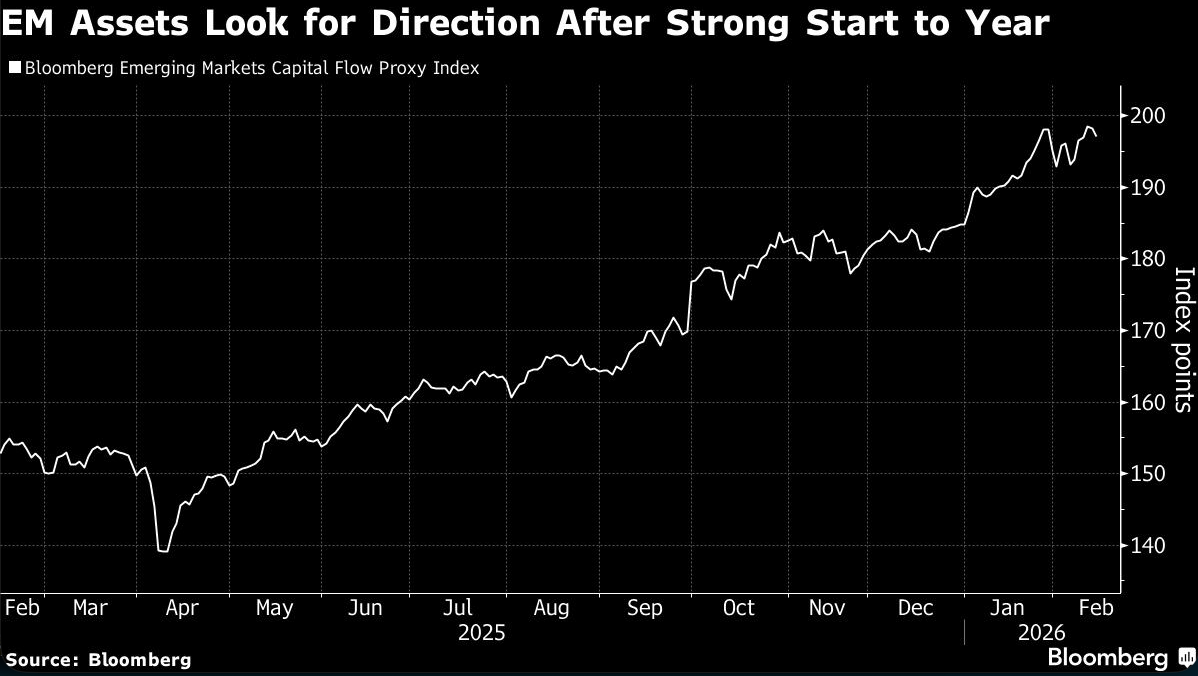
Emerging-market assets were little changed on Tuesday as traders weighed the recent optimism toward the asset class against a firmer US dollar and thinner trading volumes due to holidays in major markets.
An MSCI Inc. gauge of developing-nation equities fell less than 0.1% as of 9:00 a.m. in New York, still hovering near record highs. Trading volumes were lower as Asian bourses were closed for the Lunar New Year while Brazilian markets remain shut for the Carnival holiday. Most currencies edged lower, with South Africa’s rand and Chile’s peso leading losses amid a retreat in metals.
A firmer dollar is weighing on currencies as traders reassess expectations for roughly three interest-rate cuts by the Federal Reserve this year. Investors are the least exposed to the greenback since at least 2012, according to a recent survey by Bank of America Corp.
“Investors are, in part, buying into the asset class because of an improvement in fundamentals,” Morgan Stanley strategists including James Lord wrote in a note. But at the same time, the dollar cycle “is front and centre for the outlook of the asset class.”
India’s Infosys Ltd. climbed, contributing the most to the MSCI gauge’s gains, after saying it plans to develop artificial intelligence solutions for companies in sectors including financial services and telecommunications. The move comes as India hosts one of the world’s largest AI summits, underscoring its push to narrow the gap in the global technology race.

Emerging-market assets have made a strong start to the year as fund inflows accelerate. Net deposits into US exchange-traded funds that buy stocks and bonds in developing nations have topped $30 billion this year, according to data compiled by Bloomberg. Investors are most overweight developing-world equities since early 2021, according to the BofA survey.
While gauges of stocks, bonds and currencies all hit record highs this month, investors say the gains have further to run as a capital rotation out of the US continues amid policy risks. However, some traders have begun to bet on a near-term dollar rebound, seeing its selloff as overdone.
That leaves the dollar’s direction as the key factor for EM assets. The dollar’s stability in recent days has ensured a positive backdrop for local currencies relative to developed markets, said Nick Rees, head of macro research at Monex Europe Ltd..
“Limited volatility is likely to favor higher yielding, higher growth FX, particularly where there is a degree of insulation from any immediate Trump related risks,” he said.
Hungary’s forint traded at the strongest level in a week against the euro as US Secretary of State Marco Rubio reaffirmed the Trump administration’s support for Prime Minister Viktor Orban, even as the Hungarian strongman stares at the possibility of a loss in the April election.
In Latin America, Colombia’s swap rates surged after Labor Minister Antonio Sanguino said the government is set to uphold the 23.7% minimum wage hike that was temporarily suspended by a high court.
A message from Advisor Perspectives and VettaFi: Discover something new! Click here to register for our upcoming webcasts.
Bloomberg News provided this article. For more articles like this please visit
bloomberg.com.
Read more articles by Srinivasan Sivabalan, Vinícius Andrade