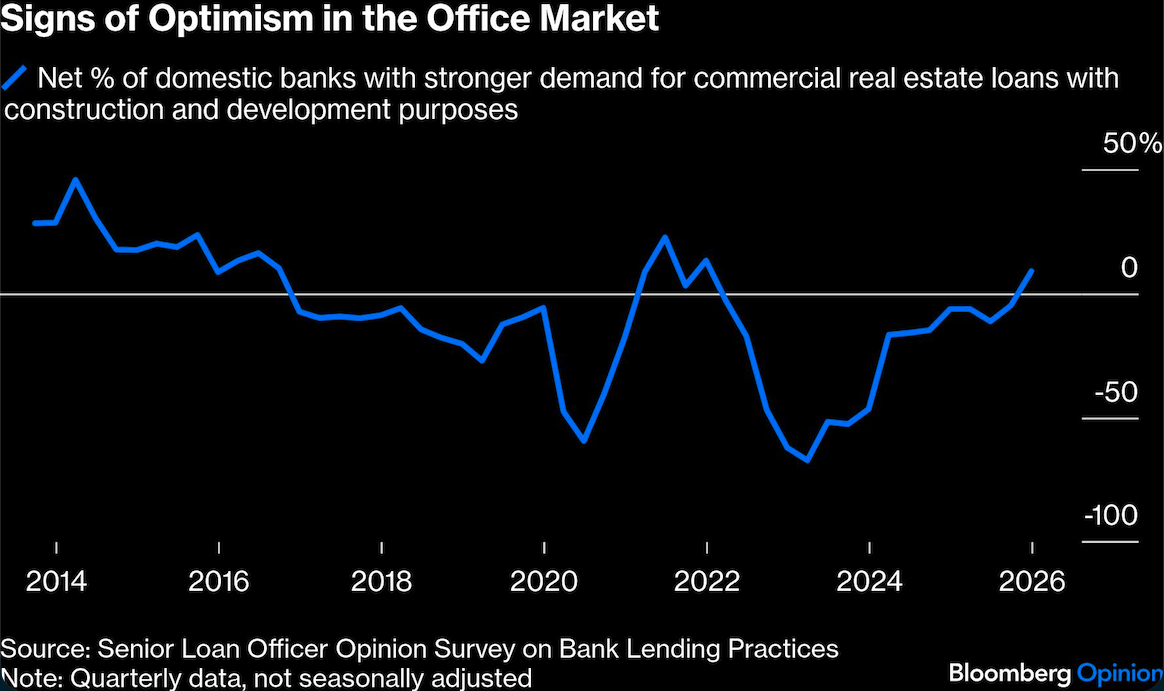
We’ve seen upper-income consumers power consumption growth over the past year even as middle-income and working-class households become more restrained. The message from the office market is starting to sound similar.
2026 is the year that owners of office buildings and developers shift from a recovery mindset to one of expansion. But there’s a catch: This only applies to the highest end of the market in the cities and submarkets that are most attractive to employers in thriving fields such as finance and technology. Look for a smattering of new luxury buildings to go vertical in the likes of New York, Dallas and even Atlanta, while older buildings and less desirable areas continue to struggle throughout the US.
A modest pickup in new construction makes sense because developers don’t have to consider the state of the overall market; what matters is whether there’s a shortage of office space in any slice at rents that cover the costs of building a new tower. Because construction and financing costs are high, developers need tenants to be willing to pay nosebleed rents for them to build.
And strength in the upper end of the office market is at a point where office developers are becoming more confident. This was apparent in the optimism Matthew DiLiberto, chief financial officer of SL Green Realty Corp., expressed on an earnings call last week when asked about a development at 346 Madison Avenue in New York City. “My only wish is that we had the building built and ready to go today, because it would be more than enough demand to fill it,” he said. BXP Inc. landed an anchor tenant last month for its 46-story, 930,000 square foot tower at 343 Madison Avenue that’s still more than three years away from being completed. On its earnings call, executives said they were negotiating a letter of intent for another chunk of the building that would make it almost half leased.
San Francisco’s office recovery, which isn’t as far along as New York’s, is K-shaped as well. There, it’s not just about newer versus older buildings, it’s also about upper versus lower floors within the same building. Douglas Linde, president and director at BXP, said that rents in the “bases of the building” in the San Francisco market haven’t kept up with the top floors.