The captains of artificial intelligence are an impatient lot. There’s good reason for the existence of the Silicon Valley cliché “move fast and break things.” They are certainly moving fast on the buildout of AI infrastructure, rolling out eye-popping spending budgets to buy computer chips and construct data centers to house them.
You can imagine their frustration upon discovering that the wait is years for the normal process of connecting their data centers to the electricity grid. When presented a shortcut — bring your own capacity and we’ll let you skip to the front of the line — these captains of AI didn’t hesitate.
That’s why companies such as Caterpillar Inc., Cummins Inc., Generac Holdings Inc. and other manufacturers of generators are increasing production capacity to meet a surge in demand. These generators, which use natural gas or diesel fuel and usually provide backup power in case of a failure, are now being deployed as primary sources. This bring-your-own-capacity (BYOC) solution skips the traditional sequence of building the data center and then hooking it to the grid. It’s a short-term answer while waiting for large gas turbines or small nuclear reactors to come on line. It’s also one that is good business for the generator makers. In the last 12 months, Caterpillar’s shares jumped 112% while Cummins climbed 56% and Generac rose 59%. The S&P 500 Index gained 12% in the same period.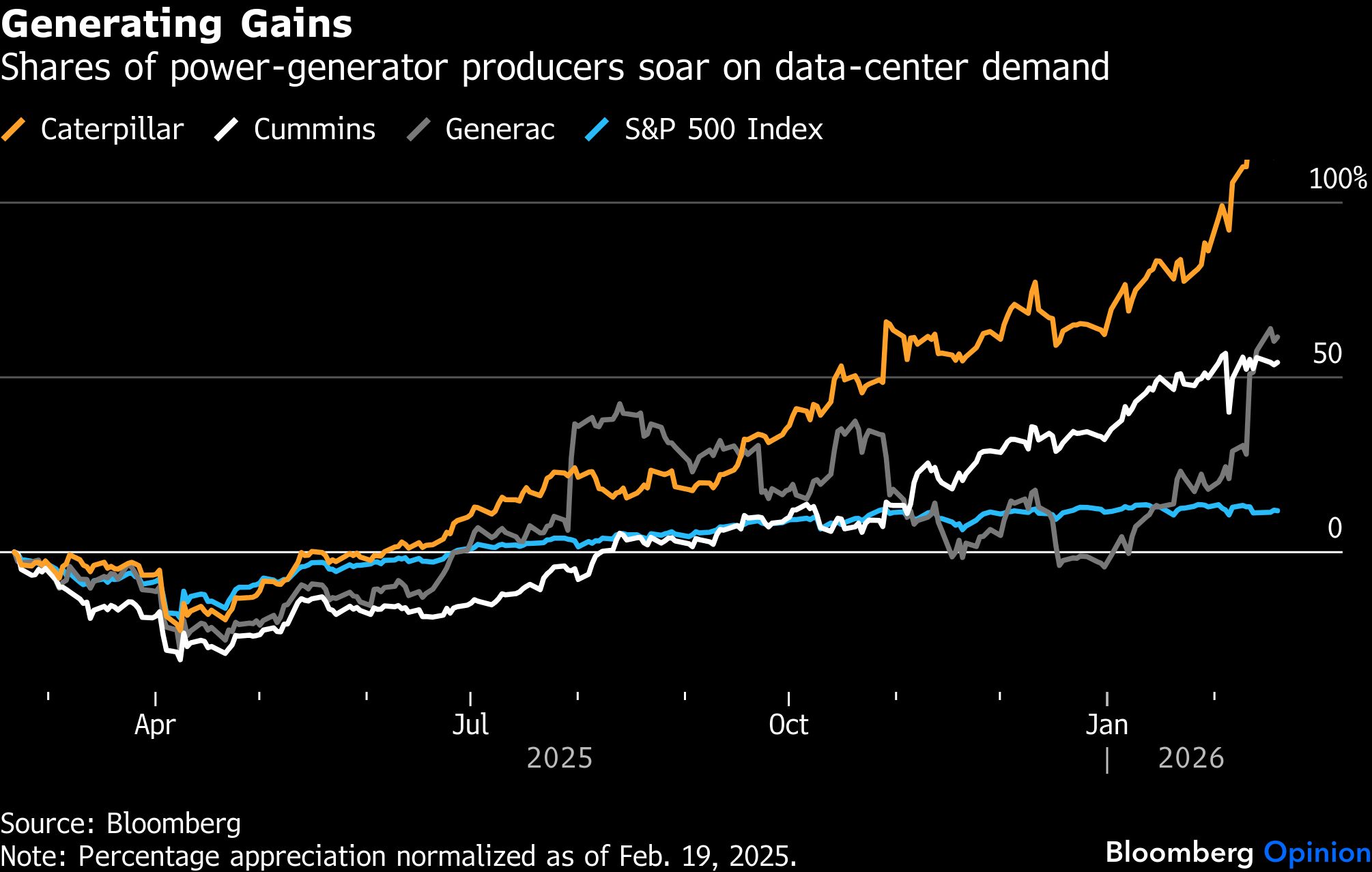
While it takes up to two years to build a data center, the wait to connect to the grid stretches to as many as seven years. This stopgap capacity is more expensive, but the hyperscalers — Microsoft Corp., Meta Platforms Inc., Amazon.com Inc., et al — seem eager to trade higher cost for speed. They don’t need to generate all the electricity on their own. Under flexible contracts, the BYOC — whether generators, solar or battery storage — can kick in during the peak grid use in the morning and evening when residences crank up their demand. This in-house capacity reduces the strain on power generation and transmission while providing the extreme reliability that data centers need.
This trade-off of higher cost for speed to market fits the conviction that the first-mover advantage is a huge deal. The race is on to capture customers and carve out a position as the go-to AI solution or get left behind. The massive spending plans have hurt stock prices of the tech giants, but so far capital expenditure budgets haven’t budged. The heads of these companies — most of them billionaires — are finding ways to skirt a shortage of power and are plowing ahead.
Someone will eat the higher costs of this breakneck pace. This may show up as lower returns on investment or even higher prices for AI subscription services. Where it shouldn’t show up is in the electricity bills of residences nor for companies that have nothing to do with the buildout of AI infrastructure.
Power companies are well aware of widespread concern that residential users will end up footing the bill for the unprecedented plans to expand electricity capacity. NextEra Energy Inc., which owns Florida Power and Light Co., plans to add at least 15 gigawatts of new power generation solely for data centers by 2035, and Chief Executive Officer John Ketchum said he’d be disappointed if his company didn’t double that goal. NextEra, like other power providers, are applying large load tariffs to make sure the tech companies pay for the extra power.
“Keeping customer bills low is our No. 1 priority,” Ketchum said during an earnings conference call in January. Florida Power and Light forecasts that residential rates will rise about 2% annually through 2029, comfortably below the headline inflation rate.
Data center business is expected to help PG&E drive down costs for residents, CEO Patti Poppe said in a Feb. 12 conference call. For every gigawatt of large load added to the grid, monthly residential bills should drop by 1%, she said. Prologis Inc., the industrial real estate giant, has been preparing for BYOC since 2005. It now provides 1.1 gigawatts of solar power supported by battery storage to its customers.












