Corporate bonds are exposed to abrupt downside as liquidity providers are increasingly replaced by liquidity takers.
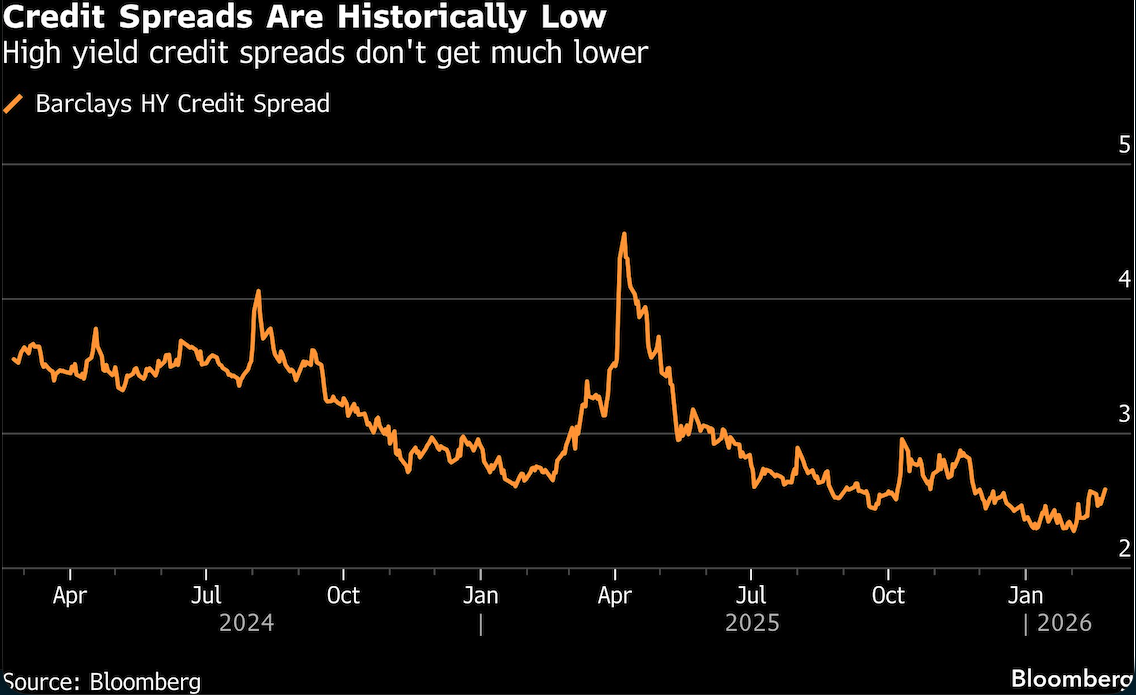
JPMorgan Chase and Co.’s Jamie Dimon has warned of parallels to the era prior to the 2008 financial crisis. He’s not wrong to be concerned, as we will see, but you wouldn’t know it from looking at credit spreads, which are back near historic lows.

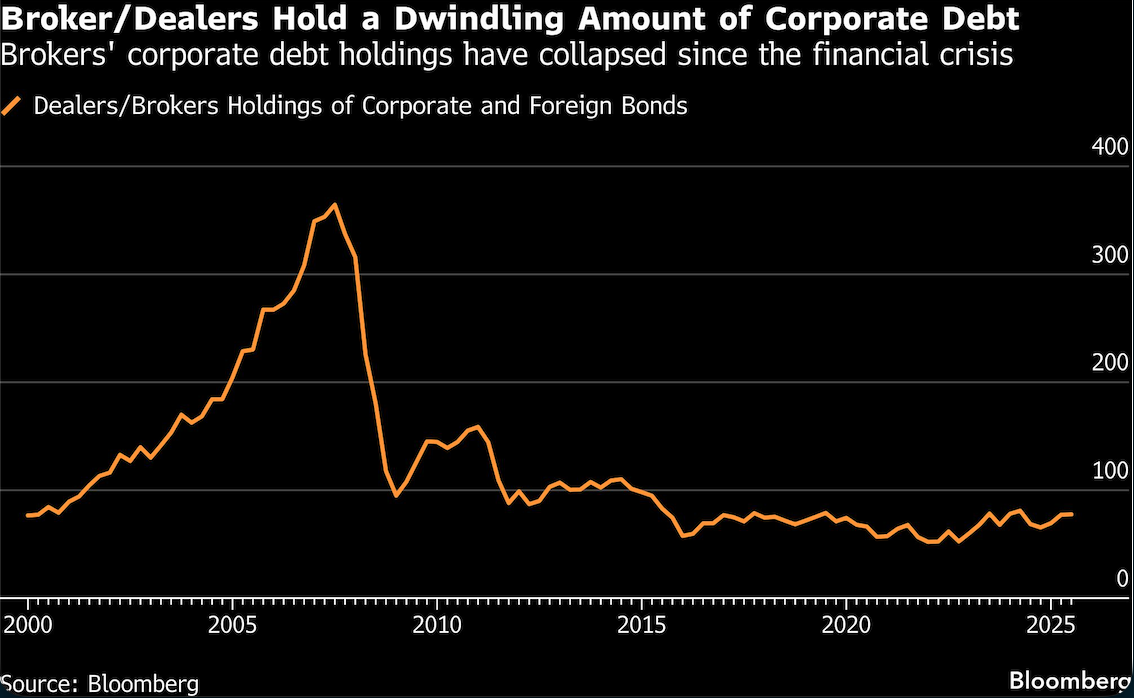
But that doesn’t leave much further upside at a time when downside risks are mounting. Banks and brokers used to be the biggest price makers in the corporate debt market, but they have significantly reduced their footprint, while price takers, most notably exchange-traded funds, have rapidly increased theirs. ETFs now hold about 25%, or $250 billion, more corporate bonds than US banks.
In fact, since 2024 ETFs are the only major sector to have increased their holdings of corporate bonds relative to the roughly $16 trillion outstanding. Other sectors that might provide liquidity or look to opportunistically buy after a drop in prices — such as banks, pension funds and foreigners — have reduced their presence in the market.
Banks’ near-exodus from the corporate debt market came in the wake of the financial crisis. There was the Volcker rule, which limited proprietary trading activity, as well as enhanced liquidity regulation that required banks to hold more high-quality liquid assets, while the balance-sheet cost of holding corporate bonds rose.
Broker/dealers’ holdings of corporate debt have fallen dramatically since the Global Financial Crisis, from well over $300 billion to between $70 billion and $80 billion now, despite a 70% increase in the total outstanding.
Dealers and brokers have gone from holding about six times the average daily volume traded in corporate bonds a decade ago, to barely equal the average daily volume today. And ETFs’ holdings of $1.25 trillion engulf dealers’ holdings by about 25 times.
Furthermore, primary dealers’ inventory of corporates — the net position between securities repo’ed in and repo’ed out — has recently sunk to near zero.
Why is this a problem now? Well, the liquidity mismatch comes as bond funds have likely been increasing their exposure to corporate debt (even if their exposure relative to the total outstanding has fallen slightly). The surge in government bond issuance in recent years damped the return in the aggregate index, which led funds to buy more higher-yielding corporate bonds to soup up returns.
The fingerprints are on the rise of the basis trade. Funds’ extra exposure to corporates leaves their duration too low relative to the aggregate index. To address this, they buy bond futures, which hedge funds are happy to sell to them, extracting the basis between the futures and the underlying cash bond to make a risk-free* profit (* it’s not risk free).
The increase in bond funds’ exposure to corporate debt is also implicit in the rise of their sensitivity to corporate returns, even as the weighting of such debt in the aggregate index has stayed largely static since 2022.
Spreads are tight, but there is no shortage of catalysts that could provoke selling of corporate debt.
Take the $1.8 trillion private credit market. A well-known opaque risk, there are signs that problems are fomenting in the sector in the wake of this year’s software selloff. Business development companies, which are about 20% of the private credit market, have their single largest exposure to tech, overwhelmingly software firms.
Such firms were seen as attractive debtors as they captured high margins and had monopoly or oligopoly potential in their niche. But that has been thrown into doubt by the recent gain of function in coding agents, reducing the barrier to entry to new companies, and potentially commoditizing SaaS businesses.
Blue Owl Capital could be the, well, blue owl in the coal mine. The firm halted redemptions from one of its funds, and instead monies will be returned only when it is deemed market conditions are favorable to dispose of assets.
As with bond ETFs, at heart of this is another liquidity mismatch. The fund in question was marketed to retail investors, offering quarterly redemptions, yet most private credit is held by institutional investors with funds locked up for four to six years, the average maturity of the loans.
You don’t need to be a financial visionary to see this could lead to problems. That’s not stopped the nascent growth in private credit ETFs, whose total market cap has grown to between $1.5 billion to $2 billion from near-zero in only two years (based on private credit ETFs listed on Bloomberg; the total is in the order of a few billion more if ETFs holding the stock of BDCs are included).
Any dislocation in private credit would soon ricochet into listed credit markets through the vector of bank lending. US banks have ramped up their claims on non-bank financial institutions since 2024. As of July 2025, about 14% of the $1.4 trillion (roughly $200 billion) of such loans outstanding are to BDCs, according to the Bank for International Settlements.
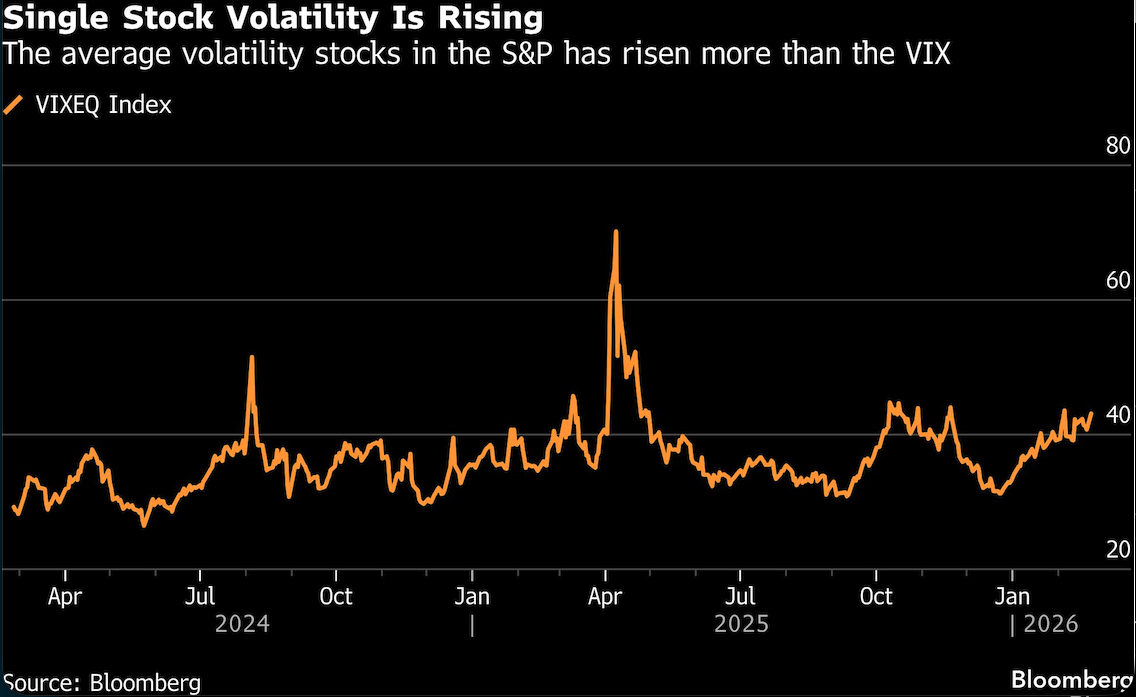
Listed credit spreads, too, are encountering stress from the enormous sums being spent on AI infrastructure. They also face a rude awakening from rising single-stock volatility. The equity of a company is analogous to a perpetual call option on the solvency of the firm. In modeling credit risk, investors and traders often use index equity volatility as an input. But such volatility could jump much higher and become more reflective of elevated single-stock volatility if index correlation – currently quite low – were to rise.
It’s thus not hard to imagine a scenario where credit markets “sour,” in Dimon’s words, prompting a rush for the exits from overweight funds as well as other holders wishing to avoid steep losses.
With few price makers to stabilize any decline, a selloff could morph into a rout. The Federal Reserve unprecedentedly stood willing to buy high-yield corporate debt in 2020; it may have to do so again.
A message from Advisor Perspectives and VettaFi: Discover something new! Click here to register for our upcoming webcasts.
Bloomberg News provided this article. For more articles like this please visit
bloomberg.com.
Read more articles by Simon White