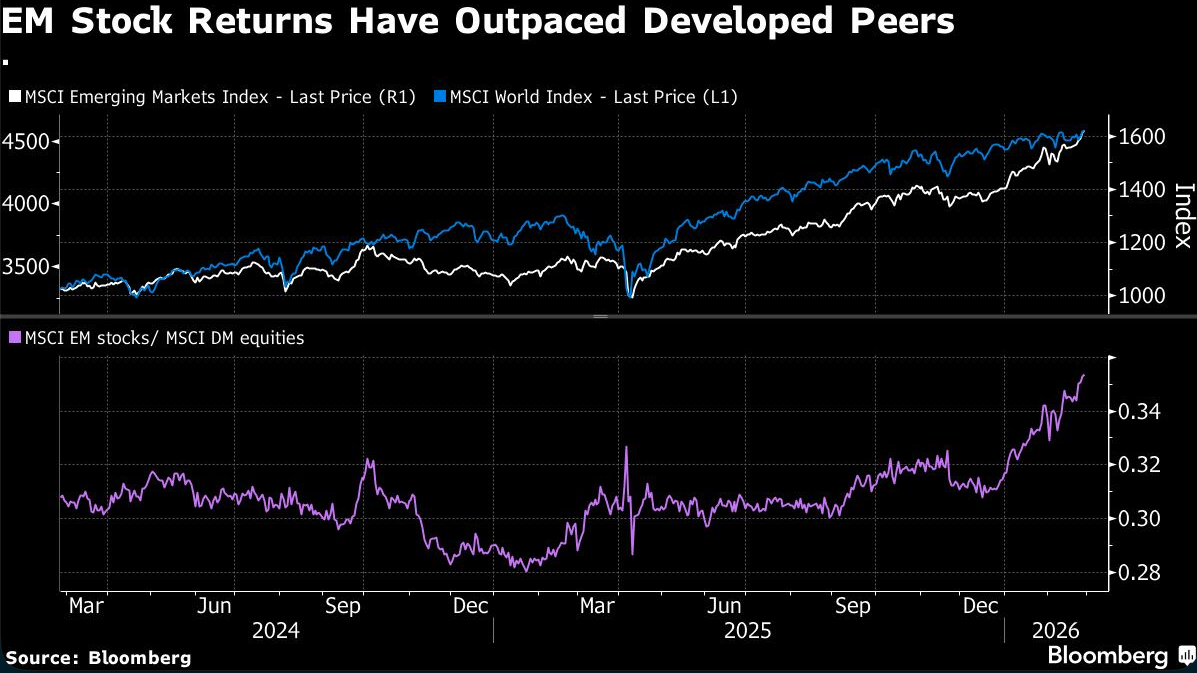
Global asset managers who collectively oversee more than $20 trillion of assets have grown more bullish across emerging-market equities, currencies, domestic bonds and credit, potentially offering fresh momentum to the sector’s record-busting rally.
Citigroup Inc., which reviewed the published outlooks of some of the world’s biggest asset managers, found that funds had added to long positions in markets across Asia, Latin America, as well as Europe, the Middle East and Africa. The findings came as MSCI’s main emerging equity index rose to a fresh record high, bringing year-to-date gains to 15%, as tech-laden bourses in Seoul and Taipei added to their rallies.
Asian tech shares have shrugged off the scare that swept through Wall Street this week, after a report suggested artificial intelligence would disrupt swathes of the economy. That’s because Korean and Taiwanese companies produce the hardware used for building AI networks. South Korean stocks added another 3.8% on Thursday, with Samsung Electronics Co Ltd. up 9%, for its longest winning streak since 1986.
The South Korean bourse, which recently leapfrogged France to become the ninth largest in size globally, has helped drive the emerging stock index 6% higher this month. The S&P 500, meanwhile, is set to end February flat.
Similarly, a gauge for emerging currencies also touched a new all-time high pm Thursday. Gains were led by the Taiwanese dollar which was buoyed by strong foreign investment flows.
The over-arching bullishness on emerging markets is a consequence of increased US policy uncertainty and a blowout fiscal deficit, that’s weighing on the dollar. While that’s forcing more investors to try and diversify exposure away from the greenback, concerns are also mounting over spending increases in Japan, Germany and other developed nations.
Developing nations saw an increase in interest “as managers search for diversification in non-US assets and see opportunities in EM due to improved fundamentals and a weak USD,” Citi analysts told clients.

On bonds, Citi said fund managers have emerging debt for their top duration call, in contrast with short positions in US Treasuries and core European sovereign debt. Emerging debt carries the biggest credit overweight too, while US investment-grade bonds remain a popular underweight, the bank said.
A Bloomberg gauge of EM local currency government bonds has returned 2.2% so far in 2026, following last year’s 8.5% gain which was the best since 2017. A similar index tracking sovereign dollar bonds is up 1.7% in 2026, after a 13% increase last year.
While fund managers have flocked to emerging debt for the higher yields on offer, many also point to policymaking improvements, in particular on controlling inflation and debt levels. South Africa’s budget, for instance, showed debt and debt-service costs peaking this year, pushing yields on its local-currency securities to decade lows. The rand is trading close to three-year highs to the dollar.
Bond investors are giving the benefit of the doubt even to countries with signs of fiscal slippage. On Thursday they lent $4.5 billion to Indonesia, enabling the nation to pull off its biggest global bond sale since at least 2017.
But for all the rallies of recent months, investors say there is room for more, pointing out that emerging assets still are cheaply valued relative to developed counterparts, and global funds’ allocations to the sector remain low.
“Investors haven’t missed the move yet,” said Jean-Louis Nakamura, managing director at Vontobel Asset Management in Zurich. “Even a modest normalization in global allocations could drive substantial inflows.”
Meanwhile, many emerging economies in Africa and Latin America are also getting a boost from the commodity bullrun that’s lifted industrial as well as precious metals to record highs.
Citi said fund managers had added positions in precious metals during the recent rally, citing strong central bank demand and the weaker dollar outlook. Gold in particular is popular as a source of stability, Citi said.
“Overall, EM assets and gold stand out as the most popular consensus trades,” the bank added.
A message from Advisor Perspectives and VettaFi: Discover something new! Click here to register for our upcoming webcasts.
Bloomberg News provided this article. For more articles like this please visit
bloomberg.com.
Read more articles by Marcus Wong