Nvidia Corp. has one of the strongest growth stories in the market after posting blowout earnings on Wednesday. So why is it trading at a level that looks like a value stock?
The chip giant’s shares sank 5.5% Thursday, their worst day since April 16, dragging down the entire S&P 500 Index with them. It added to the selloff with a 2% drop on Friday. The two-day drop has erased about $360 billion off its market capitalization.
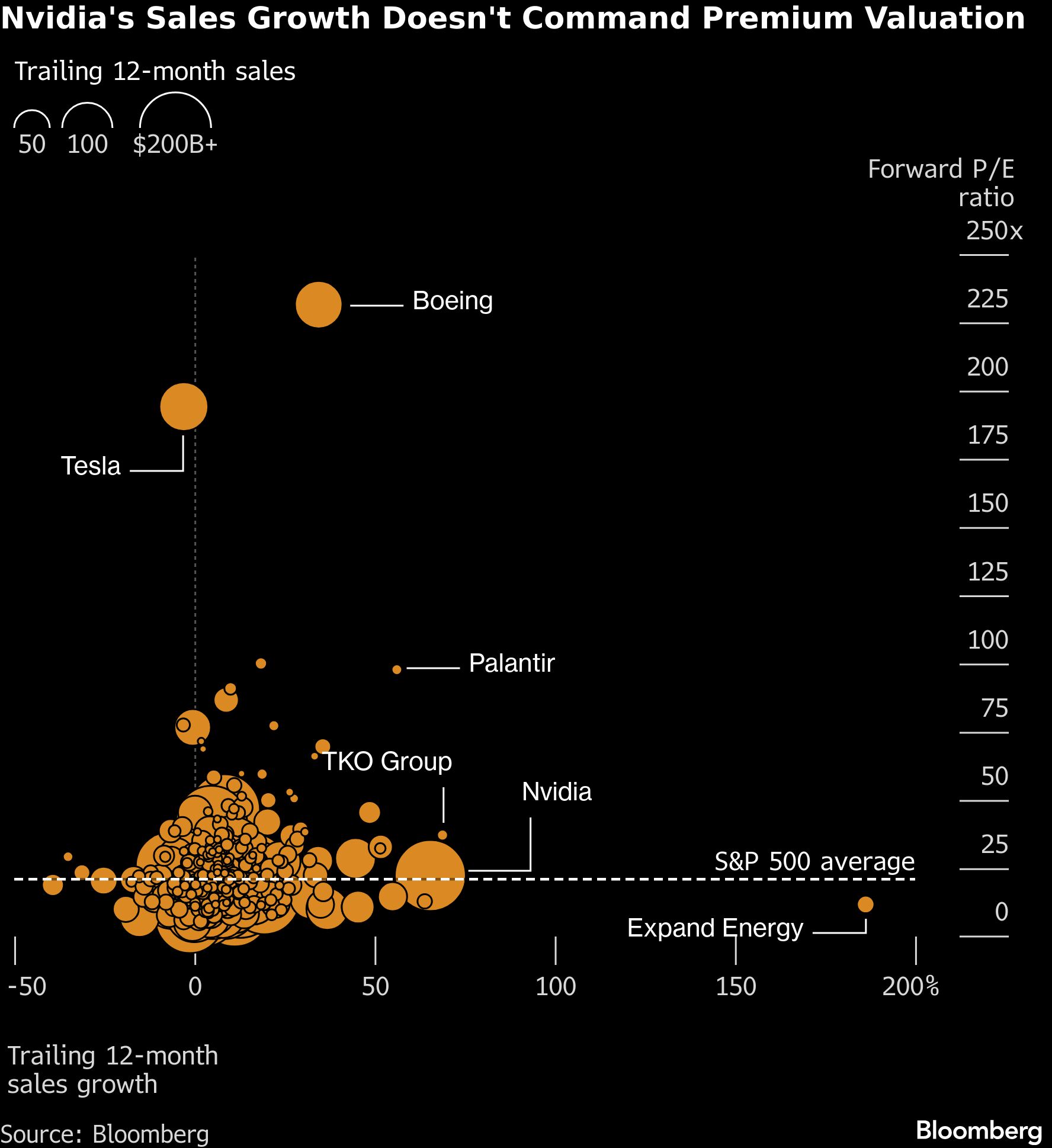
The stock is priced at less than 22 times forward earnings, well below its five-year average of 37 and basically even with the S&P 500’s multiple. And Nvidia’s valuation is expected to fall even further as analysts raise their earnings estimates based on Nvidia’s guidance for first-quarter revenues of $78 billion, which blew away Wall Street’s previous consensus expectation of around $73 billion.
“There’s something of a disconnect between how strong the results were and the stock not doing better,” said Robert Pavlik, senior portfolio manager at Dakota Wealth Management, which owns Nvidia shares. “You’d certainly think it would do well on a report like this. The company is showing really strong growth.”
Nvidia is now cheaper than roughly a third of the stocks in the S&P 500 but its revenue growth over the past 12 months of 65% is the third fastest in the index, according to data compiled by Bloomberg. By comparison, Palantir Technologies Inc.’s revenue expansion ranks fourth in the S&P 500 and its shares trade at roughly 98 times forward earnings.

The reason for the divergence between the chipmaker’s performance and stock price is investors are no longer focused on its numbers. Instead, Wall Street is concerned that the hundreds of billions of dollars in spending pledged by artificial intelligence developers like Meta Platforms Inc., Alphabet Inc., Microsoft Corp. and Amazon.com Inc. will have to be scaled back. If that happens, it would likely hit Nvidia’s revenues hard.
The selloff is “all about the market basically saying is this the peak?” said Daniel Pilling, portfolio manager at Sands Capital Management, which owns Nvidia shares. “That also then bleeds into the multiple.”
The market was already jittery about AI heading into Nvidia’s earnings, as concerns about returns on heavy spending and the threat of disruption caused by the technology sent the shares of software makers and other companies lower.
“This was sort of a lose-lose situation for Nvidia, it almost didn’t matter what it reported,” said Paul Nolte, market strategist and senior wealth manager at Murphy & Sylvest Wealth Management. “It really comes down to, when are we going to see a clear path to the profits from all the capex we’ve seen?”
In addition, there’s the question of how much more upside is left for a stock that has gained almost 1,000% since ChatGPT launched in November 2022.
“Where is the next incremental buyer? All the big holders, the long-only funds, they’ve bought as much as they can, and they’re just maxed out,” said Jay Goldberg, senior analyst at Seaport Group, who has the only sell rating on the stock. “So even if it looks cheap, there’s not really anyone who can take advantage.”
Of course, Wall Street remains incredibly bullish on Nvidia, as many stock market pros see value in the shares trading at one of their lowest multiples since April’s tariff tantrum selloff. The stock has been stuck in a narrow range as investors sell out of Big Tech and move into sectors that are currently considered less risky.
“Nvidia does look like a value opportunity,” said Tejas Dessai, research analyst at Global X. “The stock is being penalized by positioning and rotation, not by deteriorating demand.”
The combination of forward growth and value may signal that investors should think of Nvidia as a growth at a reasonable price pick, a scenario known on Wall Street as “GARP.”
“These results show that this stock at this multiple represents a really good value, and a good opportunity,” Dakota’s Pavlik said. “When you look at the fundamentals, the value, the basic metrics, all of those scream that this is a good-looking name that should be part of your portfolio.”
And while Nvidia’s current multiple might not fit squarely with those commanded by other high-growth companies, Sands Capital’s Pilling is hesitant to consider it a value stock because it doesn’t behave like one.
“It doesn’t trade like a value stock,” he said. “It’s much more volatile.”
Tech Chart of the Day
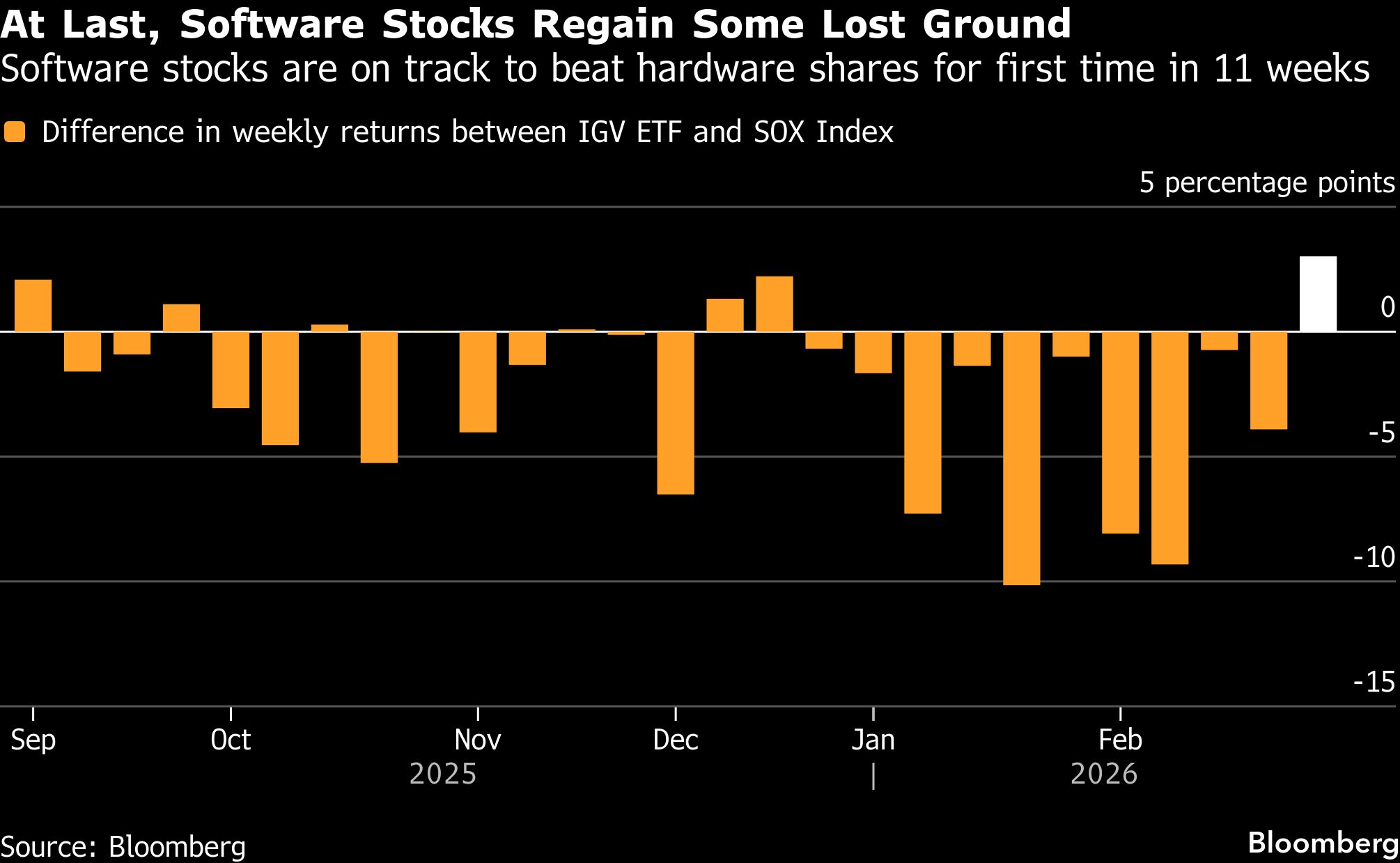
An exchange-traded fund tracking the US software sector is set to outperform the Philadelphia Semiconductor Index for the first week since mid-December, according to data compiled by Bloomberg. Software recouped some lost ground on Thursday as investors rotated out of Nvidia and companies that provide infrastructure to the AI buildout. Earlier this week, Anthropic announced a slew of partnership deals with software and data service providers, providing some relief to the beaten-down sector.
A message from Advisor Perspectives and VettaFi: Discover something new! Click here to register for our upcoming webcasts.
Bloomberg News provided this article. For more articles like this please visit
bloomberg.com.
Read more articles by Carmen Reinicke, Ryan Vlastelica