Gold sank after a four-day rally, as traders weighed the escalating war in the Middle East against the prospect of a stronger dollar and elevated inflation.
Bullion fell more than 4.5%, having earlier advanced 1.1%. The conflict in the Middle East has already resulted in a spike in energy prices that could trickle into inflation data, raising the likelihood that the Federal Reserve will leave rates unchanged for longer. Higher interest rates typically weigh on non-yielding bullion, as does a stronger US dollar.
Silver plummeted as much as 12.8%.
A gauge of the greenback has gained about 1.5% so far this week, while 2-year Treasury yields saw their biggest spike in months on Monday. Traders are now pricing in a rate cut by September, later than previously estimated.
“The experiences of 2022, when the outbreak of the war in Ukraine pushed up oil prices and thus inflation worldwide, probably serve as a blueprint here,” Thu Lan Nguyen, head of forex and commodity research at Commerzbank AG wrote in a note. At that time the Fed reacted early by raising rates, strengthening the dollar, and gold consequently weakened throughout the year, she said.
As well as the dampening effect of a stronger dollar, precious metals often fall in wider risk-off moves, as traders are forced to liquidate metals positions to meet margin calls in other parts of their portfolio. And volatility has been elevated for months in precious metals — partly because rising prices and wild swings strain credit limits between market makers, reducing liquidity.
Still, gold gained as tensions built up and the conflict erupted, as investors sought out safe havens. President Donald Trump said the US would continue its military offensive for as long as it takes, and Israel announced a “wave of strikes” targeting Iran’s command centers. Tehran, meanwhile, has attacked oil and gas infrastructure and threatened shipping in the strategic Strait of Hormuz.
Even before the US-Israeli attacks on Iran over the weekend, there were signs that US inflation was set to rise. Manufacturing input prices soared in February at the fastest pace since 2022, according to a gauge from the Institute for Supply Management. JPMorgan Chase & Co. Chief Executive Officer Jamie Dimon warned that inflation could become a “skunk at a party” for the US economy.
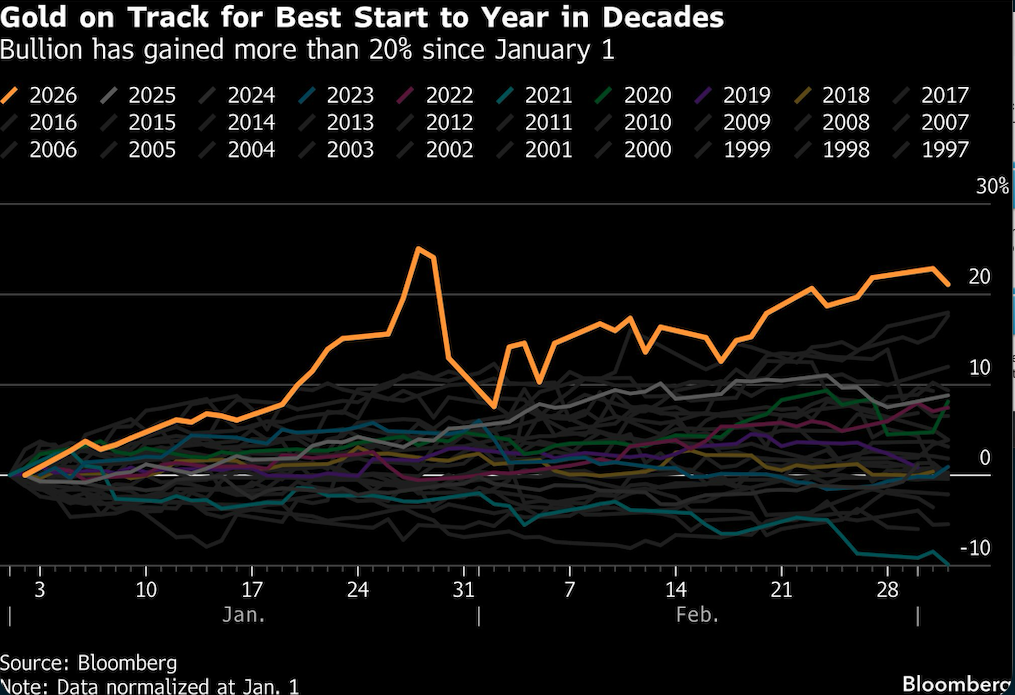
Gold has rallied by about a fifth this year, with demand supported by persistent geopolitical and trade tensions as well as concerns about the Fed’s independence. The revival of investor fears of inflation and currency debasement added fresh impetus to a multiyear rally.

There’s “ample scope” for bullion to challenge a record high above $5,595 an ounce that it hit at the end of January, should the conflict in the Middle East extend for several weeks, Swiss private bank Union Bancaire Privee, UBP SA said in a note. On Monday, the metal closed at its highest level in over a month.
As well as disrupting energy supplies, the war has created bottlenecks for the physical flow of precious metals. The United Arab Emirates, a major conduit for the global gold trade, closed its airspace over the weekend, while several commercial airlines suspended operations in the Gulf region — grounding shipments of gold and silver that are transported in the cargo holds of passenger aircraft.
Representatives of several trading and logistics firms said their metal shipments to and from Dubai had been paused indefinitely. Land transport to airports in other parts of the region is often not possible, as keeping expensive metal on the road is seen as a major risk, the people said, on condition of anonymity because they are not authorized to speak to the media.
Spot gold fell 3.8% to $5,118.50 an ounce as of 11:36 a.m. in London. Silver plunged 10.7% to to fall below $80. Platinum and palladium also slumped.
A message from Advisor Perspectives and VettaFi: Discover something new! Click here to register for our upcoming webcasts.
Bloomberg News provided this article. For more articles like this please visit
bloomberg.com.
Read more articles by Yihui Xie, Jack Ryan