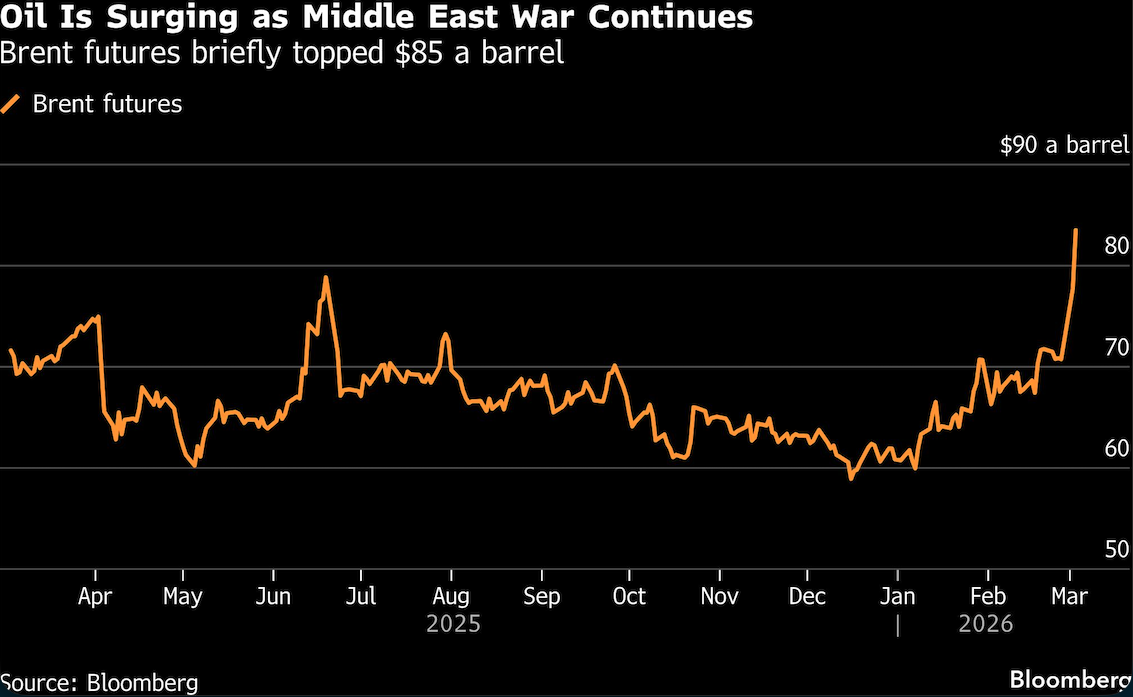
Oil surged for a second day as the US and Israel stepped up their war against Iran, with the sprawling conflict’s impact on energy assets in the Persian Gulf continuing to grow.
Saudi Arabia is exploring the option of delivering more barrels from the Red Sea, with very few ships currently transiting the Strait of Hormuz off Iran’s coast. Debris from an intercepted drone caused a major fire at the United Arab Emirates oil-trading hub of Fujairah. On Monday, Saudi Aramco halted operations at its Ras Tanura refinery after a drone strike.
The fallout for energy markets has sent global benchmark Brent crude jumping as much as 18% in just two days, surpassing $85 a barrel for the first time since July 2024 on Tuesday. Prices eased slightly after an International Energy Agency document showed the body is ready to help stabilize the global oil market in the wake of the conflict.
But there was little sign of the situation calming down as the second trading day of the week was in full swing. Traffic through the Strait of Hormuz has all but ground to a halt, and traders are now assessing how long the region’s oil assets can keep operating as normal without ships entering the crucial waterway.

Rising energy prices are already casting a pall over economic growth prospects and the ability of central banks to keep inflation in check.
While Hormuz handles about a fifth of the world’s oil, the Middle East is also home to about 10 million barrels a day of refining capacity and diesel prices were soaring on Tuesday, at one point leaping as much as 19%. The strait is equally a major waterway for liquefied natural gas tankers, with Qatar shutting production at the world’s largest LNG export facility after it was targeted in an Iranian attack. European gas prices have soared almost 80% this week.
Tuesday also brought more reaction from energy buyers. China — the world’s largest oil importer — called on all sides in the war to ensure the safe passage of ships through the Strait of Hormuz. Indonesia said it will source part of its crude from the US as an alternative to shipments from the Middle East.
The conflict quickly spread as Iran sought to retaliate against Israel and states hosting US forces. President Donald Trump said the US would do “whatever it takes” to achieve its goals and Secretary of State Marco Rubio said the military campaign was set to intensify. Qatar said Iran targeted sites across its territory that weren’t limited to military interests.
An Islamic Revolutionary Guard Corps adviser, meanwhile, told Iranian state television on Monday that forces “will set fire to any ship attempting to pass through” the Strait of Hormuz. So far, excess supplies elsewhere have helped limit the oil price surge, but a prolonged disruption of the waterway could force nations in the region to curb production.
“With the Strait of Hormuz still inactive, the clock is ticking,” JPMorgan Chase & Co. analysts including Natasha Kaneva said in a note, flagging scope for some Persian Gulf producers to cut output within weeks if storage fills. For now, gains in prices “remain contained — despite the staggering geographic scope of the conflict and growing proximity to energy infrastructure — reflecting that a substantial risk premium is already priced,” they added.
China urged “all parties to immediately cease military operations, avoid escalating tensions and safeguard the safety of navigation,” Foreign Ministry spokeswoman Mao Ning said at a regular briefing in Beijing on Tuesday.
Oil’s metrics point to growing near-term tightness. Brent’s prompt spread — the difference between its two closest contracts — widened to $2.87 a barrel in backwardation, a bullish pattern. A week ago, the gap was 19 cents.
The impact of the conflict has also ripped through freight markets. The cost of hauling crude oil from the Middle East to China soared to the highest level on record on Monday, with earnings on the industry’s benchmark route surging to $424,000 a day, according to data from the Baltic Exchange.
Meanwhile, a person familiar with the situation said the Trump administration had no immediate plan to tap the nation’s emergency crude holdings. Any move to release oil from Strategic Petroleum Reserve would likely be coordinated with nations that belong to the International Energy Agency.
A message from Advisor Perspectives and VettaFi: Discover something new! Click here to register for our upcoming webcasts.
Bloomberg News provided this article. For more articles like this please visit
bloomberg.com.
Read more articles by