The last time an armed conflict upended the global energy economy, crude spiked past $100 and shares in oil and gas producers rallied for months. A similar trajectory might be unfolding as war rages in the Middle East.
Already, crude prices have soared more than $10 a barrel, though both Brent and West Texas International remain well below $100. The sharp rise has ushered inflation worries to the top of the list of market threats, and investors are pouring cash into shares of energy producers at a rate not seen since Russia escalated its war against Ukraine in 2022.
Oil and gas prices spiked after key shipping and refining infrastructure was taken offline as the US, Israel and Iran waged a widespread war in the Middle East. The rise in related stocks tracks, though it also serves as a way for investors to hedge against inflation that a prolonged spike in energy prices likely will usher in.
“Events like this point to why you should always have some energy exposure,” said Stacey Morris, head of energy research at VettaFi. She said that traders with a longer-term inflation view are likely to keep adding more oil and gas stocks to their portfolios as a hedge, even though the stocks have climbed sharply to start the year.
“People like to buy stuff when it’s going up, even though we’ve all been taught to buy low,” she said.

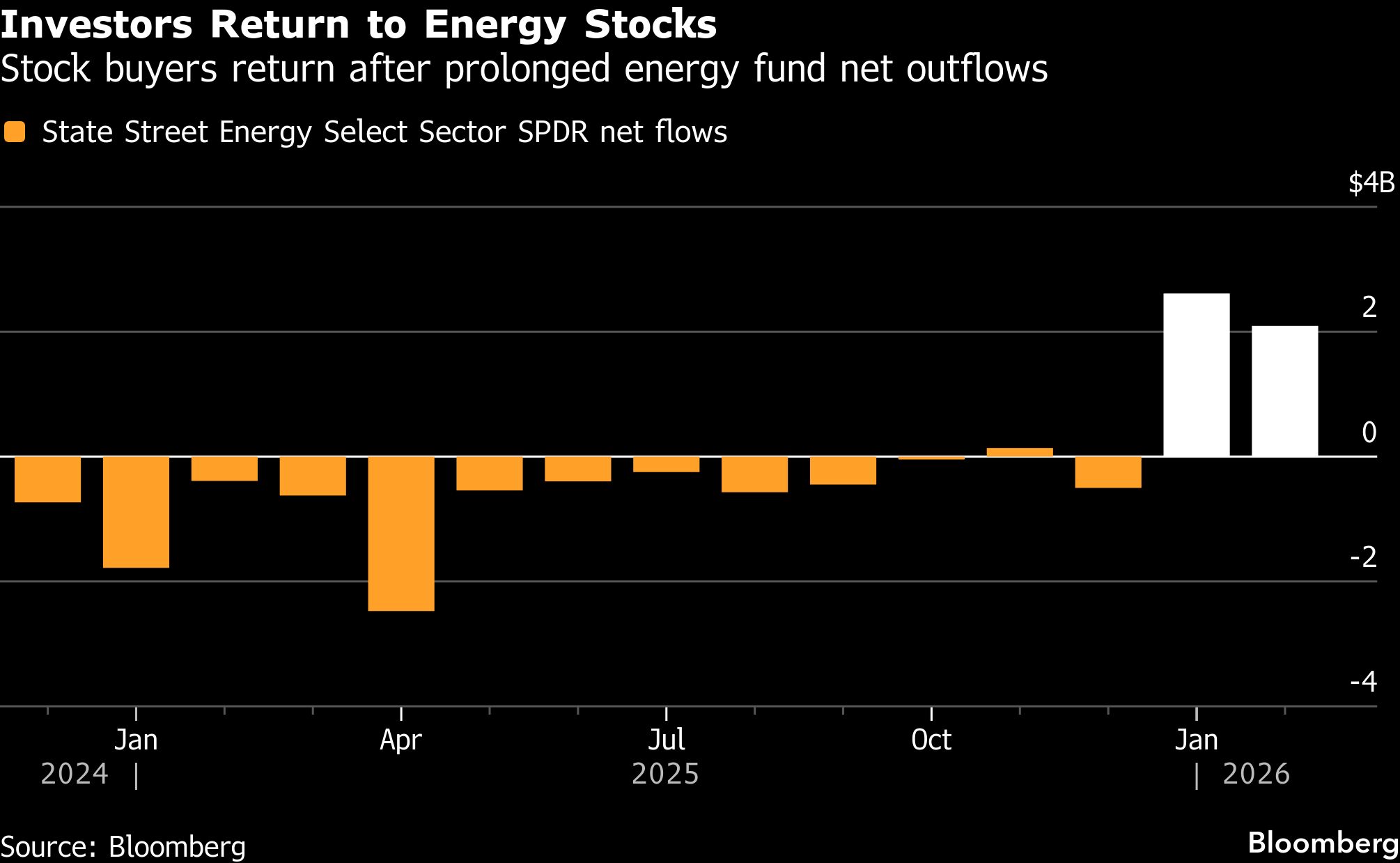
The State Street Energy Select Sector SPDR fund (XLE), which has seen net outflows of nearly $14 billion in the last three years, has taken in $4 billion in the first two months of 2026. The two largest weights in the fund, Exxon Mobil Corp. and Chevron Corp., are up 26% and 24% — even after energy producers joined a broader market selloff Tuesday.
Oil and gas stocks are a perfect inflation hedge, better even than gold, said Sam Baldwin, senior portfolio manager at Guardian Capital LP. “People think of gold as being an inflation hedge, but in 2022 that didn’t work out so well,” Baldwin said. He added that he’s been adding energy stocks over gold stocks for months.
The XLE ETF traded down 0.6% at 8:14 a.m. in New York. Futures on the S&P 500 Index were up 0.4%, while the Nasdaq 100 futures traded 0.7% higher.
The Strait of Hormuz, effectively closed as missiles and drones fly overhead and insurers refuse to do business with tankers, is a “21-mile inflation machine,” as Mark Malek, chief investment officer at Muriel Siebert & Co., put it in a research note.
“Energy shocks change monetary policy narratives faster than headlines do,” he wrote, adding the shock could lead to fewer interest rate cuts by the Federal Reserve.
Elevated inflation, seen in core personal consumption expenditures and services costs, was already a concern for investors before the breakout of the Iran war and leaves the Fed with “little reason for dovishness,” Peter Williams, economist at 22V Research, wrote Tuesday.
The current setup looks similar to energy’s breakout in 2022, when Russia invaded Ukraine and sent oil prices rising over $100 a barrel, said Kevin Gordon, head of macro research and strategy at Charles Schwab.
“What it did a few years ago for the energy sector was actually sort of padded earnings and profits for a year or two,” said Gordon. “So there is that sort of lingering impact in terms of the energy sector’s earnings, but at the same time you also need business confidence to hold up.”
Up to this point, energy has been driven by commodity price appreciation and a re-rating from cheap valuations, said Sameer Samana, head of global equities and real assets at Wells Fargo Investment Institute. He cautioned that “both drivers are reaching extremes.”
Indeed, energy had long been the cheapest sector in the market but it now trades at roughly 22 times its earnings, which is ahead of the utilities, health care and financial sectors in the S&P 500.
Still, the oil and gas stocks that are up by double digits to start 2026 have history on their side. Since 1990, sectors that outpaced the S&P 500 in both January and February ended the year an average of 230 basis points higher than the index, according to data from CFRA. The energy sector is currently headed for its best first quarter since 2022, when Russia invaded Ukraine.
“A sector in motion tends to stay in motion,” Sam Stovall, chief investment strategist at CFRA, said in a note to clients.
A message from Advisor Perspectives and VettaFi: Discover something new! Click here to register for our upcoming webcasts.
Bloomberg News provided this article. For more articles like this please visit
bloomberg.com.
Read more articles by Geoffrey Morgan, Joel Leon