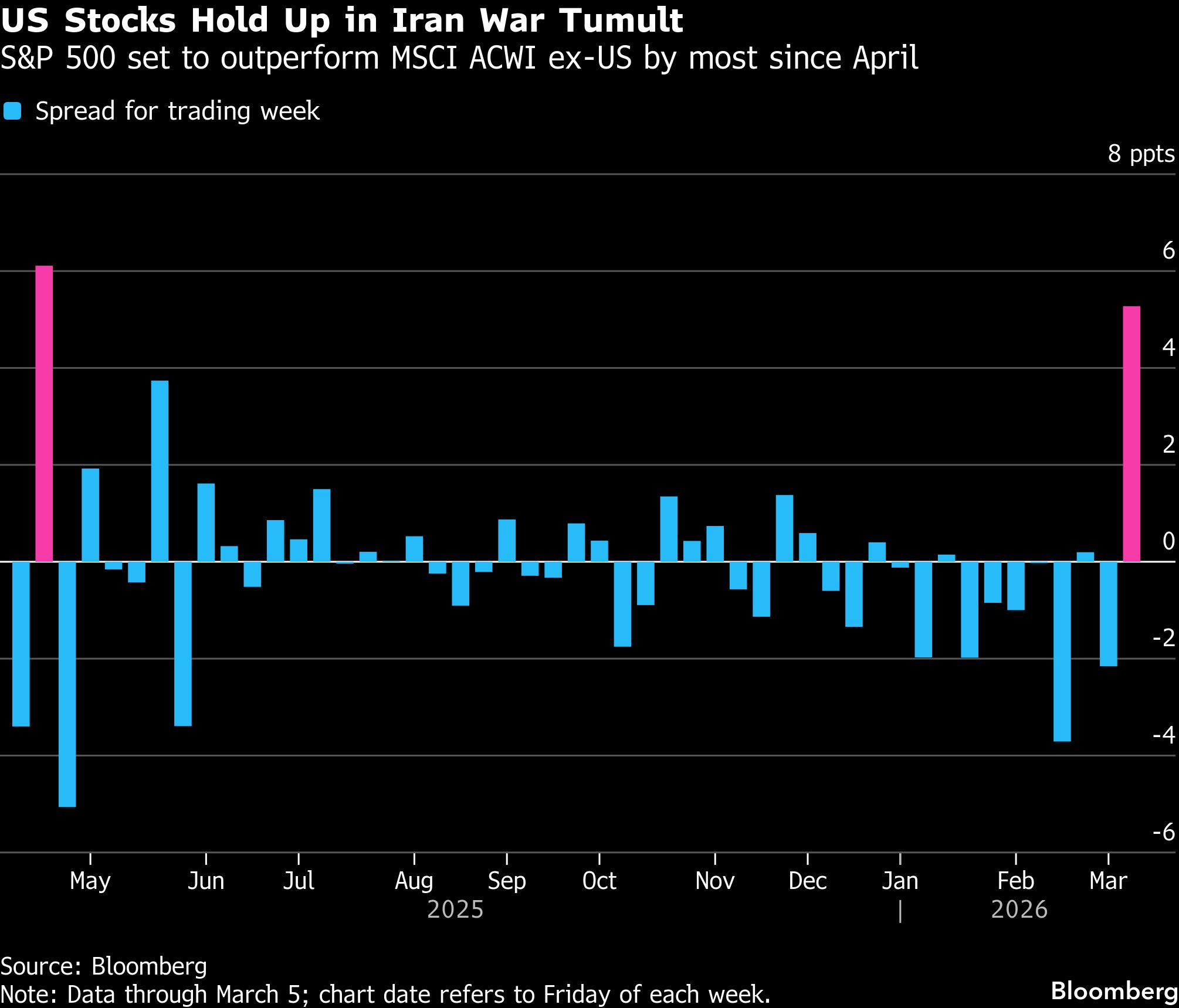
US stocks have flipped the script for international investors since war erupted in the Mideast, handily outpacing the rest of the world after trailing their global peers badly last month.
Traders point to US energy independence at a time when crude prices are soaring and to the dollar’s re-emergence as a dominant haven asset during the conflict. The longer hostilities continue, they say, the more scope American stocks have to keep outshining other markets.
The S&P 500 Index has mostly held its ground this week, falling less than 1% as gains in technology and energy shares helped offset losses elsewhere. Meanwhile, the MSCI All Country World Index excluding the US has tumbled 6%. It’s on track to be the biggest weekly outperformance since April for the US benchmark.
“The US is traditionally a more growth-oriented, higher-quality sector within the global equity landscape and that can be a valuable exposure for clients too, if there’s a broader selloff in equities,” said Adam Hetts, global head of multi-asset at Janus Henderson. “You are seeing ex-US equities being more sensitive to the geopolitical risks and some of the sensitivity to oil prices right now.”

For US stocks, it’s a stark reversal from February, when the S&P 500 essentially treaded water while overseas shares surged. In a period when worry swirled around the disruptive risk to US stocks from artificial intelligence, the MSCI World ex-US gauge beat the US benchmark by the most since the depths of the financial crisis.
The big swing since the weekend shows how fluid sentiment can be as global circumstances change. So far, Asian stocks have borne the brunt of the conflict in the Middle East, with an MSCI benchmark sinking more than 6% through Thursday, and South Korean stocks posting a record plunge before rebounding. An MSCI index of European equities has dropped about 5% this week.
Greenback Reversal
The resurgent greenback is one key reason that US stocks are showing relatively more resilience, traders say. The dollar is up against almost all world currencies this week. That’s weighed on emerging markets, where a weaker US currency had been a tailwind for stocks before hostilities began. The Bloomberg Dollar Spot Index has gained more than 1% this week.
Then there’s the dependency on oil for much of the rest of the world, which has made investors more jittery over international equities as crude prices surged, said Keith Lerner, chief investment officer and chief market strategist at Truist Advisory Services Inc.
On Thursday, with investors fretting about the potential for a prolonged war that constricts production in the Middle East, West Texas Intermediate surged to the highest since 2024.
“The US is in a stronger place to withstand this, because we have stimulus that’s happening here, and we have energy independence,” Lerner said.
Tech Haven
There’s another way the mood has changed since last month: Traders are touting technology stocks as a potential defensive play, because of their earnings growth, rather than a major worry because of their lofty valuations and massive outlays on AI.
“Tech is part of this safety trade right now,” said Truist’s Lerner.
The upshot is that the rest of the world lacks what US stocks can lean on, namely the relative resilience of the world’s biggest economy.
“European stocks have always been lagging the US from a fundamental perspective,” said Aoifinn Devitt, managing director for global wealth at Moneta Group Investment Advisors.
“Growth is lower there and they do not have the uplift of the tech story and they are more exposed to both oil imports as well as Russia-Ukraine tension,” she said.
A message from Advisor Perspectives and VettaFi: Discover something new! Click here to register for our upcoming webcasts.
Bloomberg News provided this article. For more articles like this please visit
bloomberg.com.
Read more articles by Youkyung Lee, Matthew Griffin