Iran’s strategy in its war with the US and Israel is by now clear: Impose an intolerable economic cost on President Donald Trump, forcing him to abandon his “war of choice” as American gasoline prices surge. Is there any way the Islamic Republic’s blueprint for survival can fail? Yes, if its old regional nemesis, Saudi Arabia, can cushion the oil market.
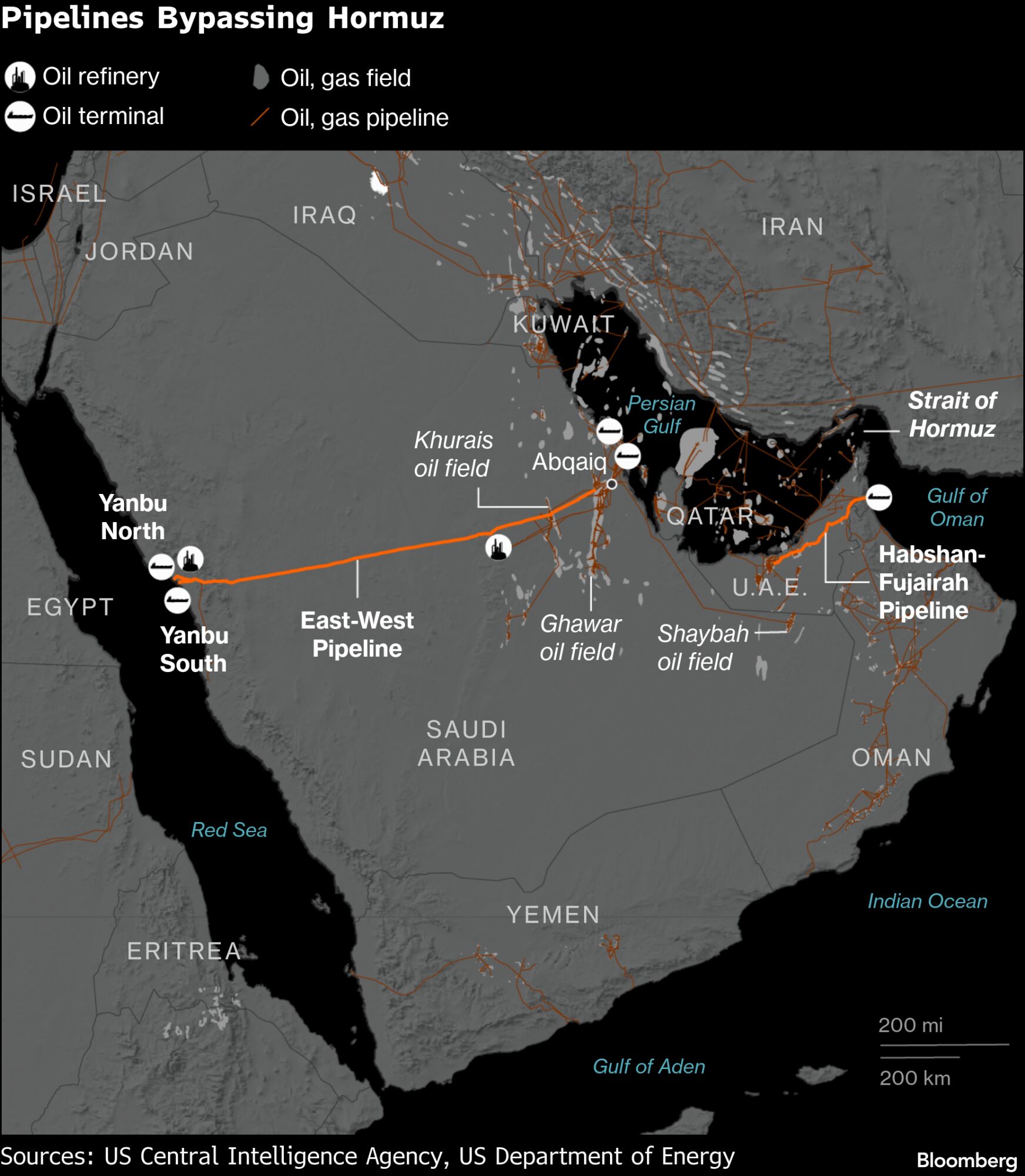
Enter the East-West pipeline, a 1,200-kilometer (746 mile) conduit crisscrossing the Arabian Peninsula from the Persian Gulf to the Red Sea. Its raison d’être is to meet this historic moment: Iran’s closure of the Strait of Hormuz. The Saudis built it 45 years ago thinking that, one day, Tehran would manage to do what was then unthinkable and halt shipments through the narrow waterway.
The strait is a choke point for about 20 million barrels a day of crude and refined products — equal to a fifth of global consumption. The Saudi pipeline can’t offset all of that, nowhere near. But it can provide a workaround for as much as 5 million daily barrels. Another pipeline, owned by the United Arab Emirates, offers a separate bypass option to the Gulf of Oman for 1.5 million barrels. In an emergency, the UAE can probably push it close to 2 million.
So together these pipelines can slow, though not stop, runaway petroleum prices if both countries can get enough tankers into the loading ports where the oil ends up. Right now about 25 supertankers, each capable of loading about 2 million barrels, have diverted from their original destinations and are headed toward the new pickup points. It remains to be seen how the ports will cope with these armadas.

The loss of supply since the first strikes on Iran has been so brutal that oil prices jumped well above $100 a barrel as soon as the energy market opened Sunday night, rising 20% in just a few seconds. But maybe — and I really mean maybe — the pipeline bypasses can delay further gains, buying time for Trump. The White House is still betting all-in that it can finish the war before the petroleum pressure becomes unbearable.
“We figured oil prices would go up, which they will,” Trump told reporters on Saturday night. “They will also come down. They’ll come down very fast. And we will have gotten rid of a major, major cancer on the face of the Earth.”
The strategy appears to have been designed on the fly as the war didn’t go as he planned. To succeed, Trump needs first for the Saudi-UAE bypass pipelines to make a difference. Second, he needs to end the war in days rather than weeks — or at the very least get some supertankers in and out the Strait of Hormuz in that timeframe. The pipelines are only temporary cushions, nothing else. Finally, he needs the region’s oil production, refining and loading facilities to emerge from the war relatively unscathed, allowing for a rapid resumption of exports. All are enormous wagers, now we know the inadequacy of the walk-in-the-park assumptions that Washington made ahead of the war.
On Sunday, state-owned Saudi Aramco was simultaneously loading three very large crude carriers, known as VLCCs in the industry, at its Yanbu and Al Muajjiz terminals on the Red Sea. This is clear evidence that it is diverting as much oil as possible away from the Hormuz route. Adnoc, Abu Dhabi’s state producer, was loading another VLCC at Fujairah, outside the strait. The scale of the operation at these three sites is unprecedented.
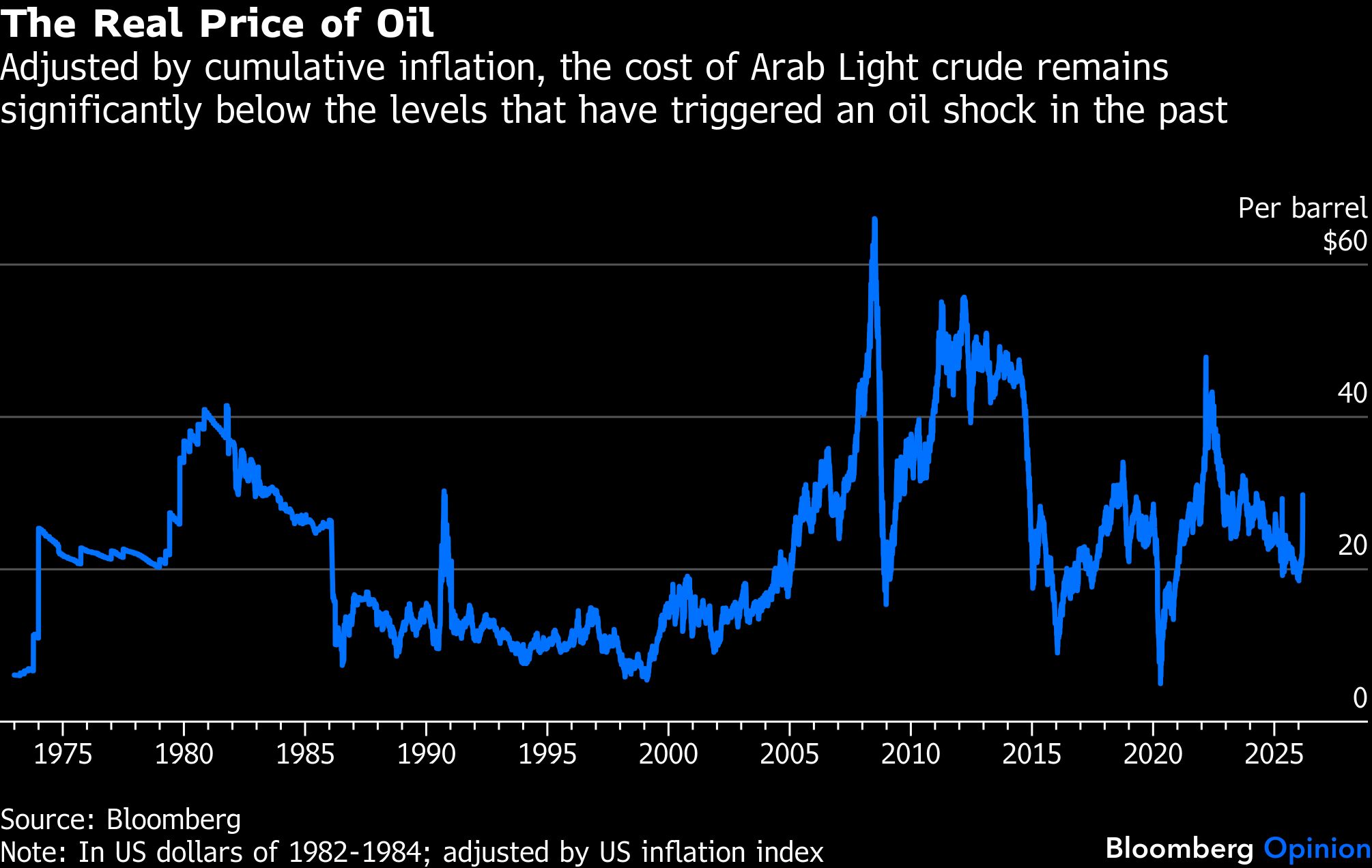
Will it work? In real terms, adjusted by the cumulative impact of inflation, oil is still well below previous spikes. The $139-a-barrel reached in March 2022 after Russia invaded Ukraine is about $157 in today’s money. The $147.50-a-barrel in July 2008 is equivalent to about $205 a barrel now. Plus the price impact has been short-lived so far, measured in days, rather than months or quarters.
For an oil spike to become a full-blown crisis, the price needs to move higher and stay there for a time. But as the days of bombings and counter-attacks turn into weeks, it will start to hurt the market. The pipeline bypasses buy time, but nothing can replace reopening the Strait of Hormuz.
And there are new dangers. Saudi Arabia and the UAE are walking a security tightrope. Diverting oil via the workaround pipelines is part of their commitment to keep energy markets supplied no matter what. But their actions clearly help Washington and may invite further military retaliation from Tehran. As more tankers head to the new loading points outside the Persian Gulf, there’s nervousness among industry officials in Riyadh and Abu Dhabi that the pipelines, pumping stations or even the ports will be attacked by drones.
Sunni Arab states in the Persian Gulf have long had tense relations with Iran, a Shia-majority country. And yet in recent years Riyadh and Abu Dhabi have sought to improve relations. Before the hostilities, they were eager for Tehran to agree to a diplomatic deal with the US through talks being mediated by Oman.
Oil is dragging them into the conflict, with unknown consequences. Increasingly, the Third Gulf War resembles some episodes of World War II. Think about the Battle of the Atlantic, where Germany tried to cut off Britain’s supply of essential commodities. Now, it’s the Battle of the Pipelines.
A message from Advisor Perspectives and VettaFi: Discover something new! Click here to register for our upcoming webcasts.
Bloomberg News provided this article. For more articles like this please visit
bloomberg.com.
Read more articles by Javier Blas