For years technology has been defined by the unstoppable growth of a handful of companies. Big Tech’s consolidation of power seemed a foregone conclusion even as Sam Altman’s OpenAI sparked an artificial intelligence boom with ChatGPT. Having promised to build AI for humanity, Altman became a proxy for Microsoft Corp., just as his rival in the race to construct utopia, Demis Hassabis, now ships product for Google.
But the last two months of market upheaval — and standoffs with the Pentagon over how this tech might be militarized — have shown a company breaking that mold. Anthropic PBC has no single Big Tech backer it can call a proxy (not yet anyway) and it has shunned the Silicon Valley “blitzscaling” mantra of shipping fast to dominate a market and patch problems on the fly. Its Chief Executive Officer Dario Amodei has said “no” to many of the things Altman rushed into.
However disingenuous Amodei may one day turn out to be about safety — particularly if his products destroy jobs — an encouraging picture is emerging of his impact on the industry. Anthropic is a serious competitor to tech’s established order and is shaking things up in an AI business that has itself been wildly disrupting entire corporate sectors, or at least their share prices. That is a healthy outcome for a tech market that was becoming far too entrenched.
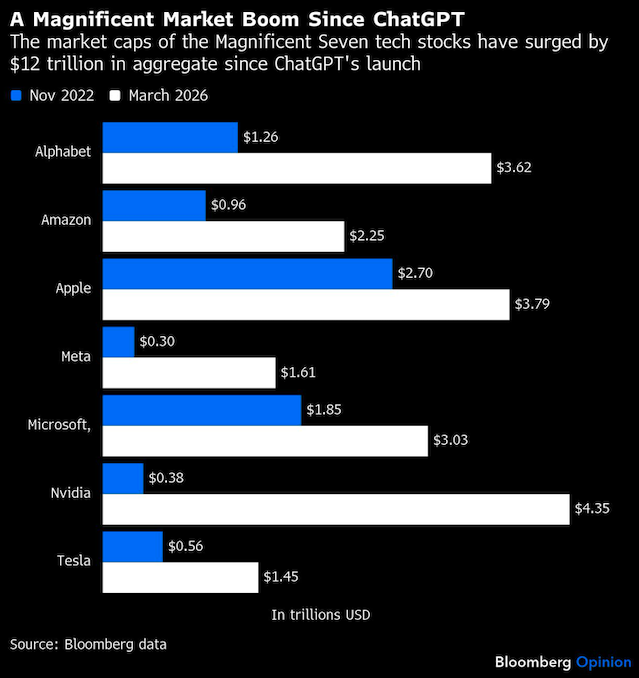
In the three years since ChatGPT sparked the generative-AI boom, the market capitalizations of the Magnificent Seven tech stocks have increased by $12 trillion, their total value (about $20 trillion) now on par with the gross domestic product of China. Some of those giants like Microsoft and Alphabet Inc. are behind today’s most popular chatbots. And while a cluster of promising startups might once have loosened their stranglehold, the upstarts have mostly been hoovered up by the big incumbents through stealth acquisitions.

Anthropic has somehow avoided that fate. The company, whose flagship chatbot Claude is beloved by software engineers and startup founders in Silicon Valley, has significant financial backing from Big Tech that has yet to translate to operational influence. Amazon is thought to hold between 15% and 20% of the company, and Alphabet’s Google has 14%.
Though Microsoft’s 27% of OpenAI is not a much bigger stake, it comes with deep product integration. Microsoft’s Azure is OpenAI’s cloud provider, and Microsoft’s Copilot chatbot is built on OpenAI’s models (on Monday Microsoft said it would incorporate Claude Cowork, too). The two companies’ commercial fates are intertwined in a way that Anthropic’s and Amazon’s are not.
Anthropic’s Amodei has also taken a more focused approach to product development. Claude, for instance, does not generate images, limiting the risks around users producing deepfakes. And, unlike OpenAI, the company has zeroed in on business customers rather than consumers, meaning it avoids paying the hefty computing costs of supporting a vast user base and is on course to generate almost $20 billion in annual revenue.
That’s a very different approach to Altman, who’s become the “Yes Man” of AI in his manner of rushing to embrace every available opportunity. OpenAI introduced a shopping feature for ChatGPT last year, and has walked back those plans in the last few weeks. Altman was opportunistic again when he struck a deal with the Pentagon, taking advantage of its fallout with the Anthropic, but later admitting that his own deal was “sloppy.”
Amodei’s commercial success is what gave such weight to his “no” to the Pentagon over guarantees to not use Claude for autonomous weapons or spying on Americans. A struggling startup wouldn’t have commanded the same attention and sparked the same public debate as one worth $380 billion.
That is one thing genuine competition can offer beyond pricing pressure: a greater chance of breaking the ideological groupthink of established players and forcing hard questions that monopolists rarely have to answer. It’s hard to see Microsoft, Google or OpenAI rebuffing the Defense Department in quite the same way.
With any luck, that principle will extend into areas like consumer safety and terms of service for customers, shaping what AI becomes and adding some friction to the “move fast, break things” strategy that has fueled the boom. Competition is essential to healthy markets and, for the present in AI, there might be enough of it to make a difference.
A message from Advisor Perspectives and VettaFi: Discover something new! Click here to register for our upcoming webcasts.
Bloomberg News provided this article. For more articles like this please visit
bloomberg.com.
Read more articles by Parmy Olson