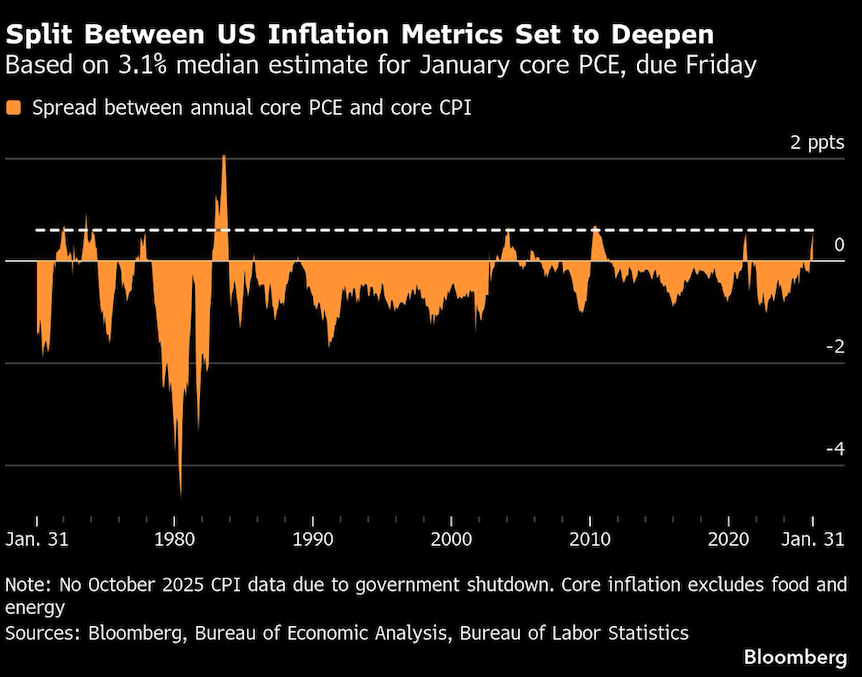
A key measure of US inflation was tame at the start of the year. But another metric is shaping up to paint a very different picture.
Wednesday’s report on the consumer price index showed core inflation, which excludes food and energy costs, was mild in both January and February — a pleasant surprise as companies tend to raise prices at the turn of the year. Yet economists expect another gauge, one preferred by the Federal Reserve and set for release on Friday, was probably rather strong in both months.
The fact that the personal consumption expenditures price index has been outpacing the CPI is already unusual. Typically it’s been the other way around, as a higher weighting on housing costs in the CPI tends to keep that measure relatively elevated.
Now the wedge appears to be deepening. Should the core PCE rise 3.1% in the year through January as economists expect, it would exceed the annual core CPI by one of the widest margins in decades.

The divergence began before the Iran war, which has sent oil prices sharply higher and renewed risks of a broader acceleration in inflation. That puts the Fed in a tough spot. While policymakers are broadly expected to leave interest rates unchanged next week, a sustained pickup in price pressures would make it difficult for officials to justify resuming rate cuts in coming months to shore up a fragile labor market.
“While CPI data remains benign, PCE inflation data have not strengthened the case for cuts especially with upside risks from oil prices,” Bank of America Corp. economists said in a note.
The PCE price index, a product of the Bureau of Economic Analysis, draws from the CPI for several price categories. In the wake of the latest CPI data, economists were quick to boost their forecast for the February core PCE price index, which is due April 9. Several projected it would rise 0.4% for a second month, with some penciling in a bigger pickup.
The division stems from how each inflation measure weights certain items. CPI, which is produced by the Bureau of Labor Statistics, places a strong emphasis on housing costs. A key metric known as rent of primary residence rose 0.1% from January, the least in five years. It also assigns a higher weight to used-car prices, which have fallen for three straight months.
On the other hand, the PCE price gauge focuses on certain goods costs much more. Economists pointed to products like computer software and jewelry, which both jumped notably in February’s CPI and exert greater influence on PCE inflation. Forecasters at Barclays Plc, Morgan Stanley and Bank of America see PCE core goods prices advancing at least 0.8% in February, 10 times the increase shown in the latest CPI report.
No matter which metric you look at, the war in Iran is expected to push inflation higher in March, which will take into account the latest surge in oil and gasoline prices. Diesel fuel prices have also jumped, which will filter through to higher transportation costs, and the disruption to fertilizer supplies from the region is expected to boost food prices.
“The longer the conflict continues, the greater the risk of it pushing overall inflation upward,” Elizabeth Renter, senior economist at NerdWallet, said in a note. “Next month, we’ll certainly see it in energy price growth, but higher gas prices can cause other categories to grow more expensive too.”
A message from Advisor Perspectives and VettaFi: Discover something new! Click here to register for our upcoming webcasts.
Bloomberg News provided this article. For more articles like this please visit
bloomberg.com.
Read more articles by Molly Smith