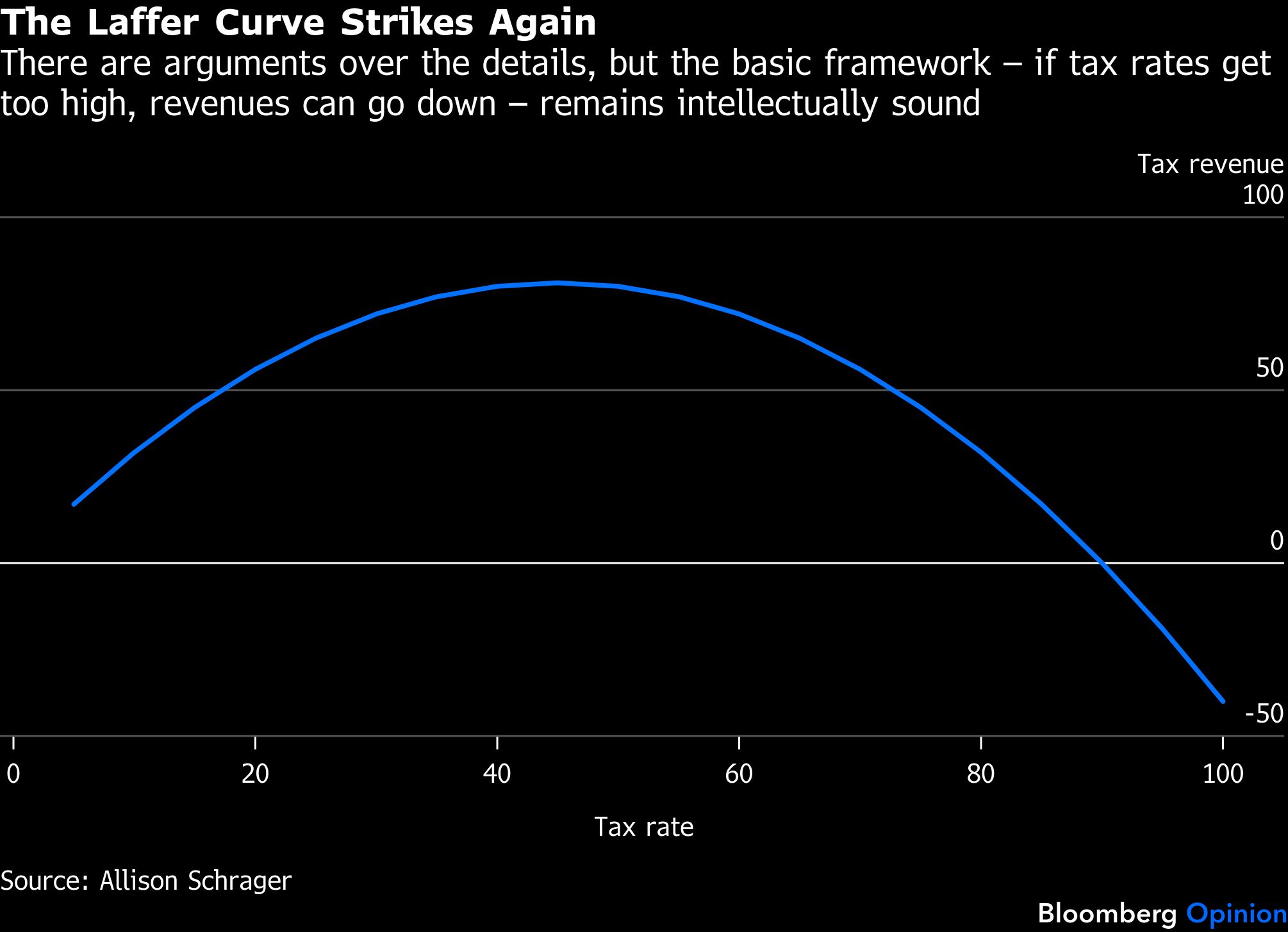
For years it was a punch line. Now the Laffer Curve — which purports to show that tax cuts can increase revenue — is making a kind of comeback. This time around, it is providing more of an intellectual than a policy framework, but that is a useful role as some states and city governments appear eager to test the proposition that no tax is too high.
Famously (or infamously?) drawn on a napkin by the economist Art Laffer in 1974, the Laffer Curve is a concave shape plotting the relationship between tax revenues and the tax rate. It shows that at a certain point, tax cuts lead to greater revenue. When the tax rate is too high, people work less, thus reducing tax revenue.
The Laffer Curve was part of the justification for the tax reform of the 1980s, which lowered rates and got rid of many deductions. But then a funny thing happened: Revenue fell after the tax cuts. There are plenty of rationales for cutting taxes, such as efficiency or fairness, but more revenue did not appear to be one of them.
Still, thoughtful skeptics admit that the Laffer Curve illustrates a valid point. Consider what would happen if people were taxed at 150%, so they had to give up not only all the money they earned but also another 50%. The answer is obvious: No one would work. The practical problem now, however, is that with the federal income tax rate topping out at 37%, the US is not close to the point where it would get revenue increases from a tax cut.

That’s true for income taxes. What about wealth taxes? The Laffer Curve could kick in much sooner for taxes on wealth, because it is relatively easy for people to change how and where they invest. State tax rates are more than federal rates because it is easier to move to another state than to another country.
Nonetheless, states and cities are eyeing very high tax rates. In California, a 5% tax on fortunes of $1 billion may get on the ballot in the fall. Yet research by Josh Rauh of the Hoover Institution estimates it would decrease tax revenues by $24.7 billion. That’s because rich people will move, and the state will lose both the prospective tax revenue from their wealth and the existing tax revenue from their income. An earlier paper estimates that California’s high income taxes have already caused some high earners to leave the state.
Now Washington State is trying a similar experiment. Washington has long been a no- earned-income-tax state, which attracted many tech businesses such as Amazon and Microsoft. Its House of Representatives just passed a 9.9% tax on income above $1 million, which may have already encouraged some wealthy residents to move. It may not reduce tax revenues immediately, but it will probably reduce property tax revenues and discourage future business creation, which could lead to slower growing tax revenue.
History suggests that once a state imposes an income tax, it does not stay contained to high earners. Losing its status as one of nine no-income-tax states — Washington taxes income from capital gains but not from wages or salary — would erode one of the state’s a comparative advantages (and it lacks California’s gorgeous weather). New York State is also considering higher taxes on higher earners, while New York City’s mayor is proposing several new taxes on the wealthy.
Supporters of high taxes say they are calling the wealthy’s bluff: Are they really prepared to leave California or Manhattan? And for years it was true, high earners in high-tax states such as New York or California did not leave for Texas or Florida. But that’s changing. Maybe that’s because blue states aren’t offering the same level of services they used to, whether it’s in schools or transportation, while quality-of-life crime such as shoplifting is up in cities like New York. Or maybe it’s because network effects aren’t as strong as they used to be; living in close proximity to the center of finance or technology isn’t so valuable as to be worth the higher taxes.
All of which means that point on the Laffer Curve where higher taxes result in lower revenue could hit a lot sooner than many states and cities realize.
A message from Advisor Perspectives and VettaFi: Discover something new! Click here to register for our upcoming webcasts.
Bloomberg News provided this article. For more articles like this please visit
bloomberg.com.
Read more articles by Allison Schrager