Looking Through the Value Rotation Illusion
Membership required
Membership is now required to use this feature. To learn more:
View Membership Benefits Advisor Perspectives welcomes guest contributions. The views presented here do not necessarily represent those of Advisor Perspectives.
In our recent article, "The Value Rotation Illusion," we explained that in the recent rotation from growth to value, passive investors are actually selling value stocks to buy expensive stocks. Confused? In this follow-up, we take the three-tier earnings valuation framework we introduced in the previous article a step further to uncover true value stocks.
First, though, it's vital to provide context for why the passive investment landscape skews stock valuations.
Passive Investing Drives the Current
A passive investment environment is often agnostic to valuations, blurring the lines between traditional investment styles like value and growth.
We frequently associate passive investors with investing in broad market indexes such as the S&P 500 or the Nasdaq. However, passive investors also buy sector- or factor-based ETFs — such as consumer staples ETFs or large-cap growth factor ETFs. The word "passive" means they are not picking individual stocks, but it doesn’t necessarily imply their investment style is passive. A growing number of passive investors are actively trading, rotating in and out of popular narratives and themes. For more on this topic, please read our recent article "Calm Market Waters Hide Fierce Undercurrents."
Over the last few months, stocks in large-value ETFs have been hot while the once-trendy mega-cap technology stocks have fallen out of favor. This rotation is clearly visible in the widening performance gap between value and growth sectors, as well as the migration of capital from tech giants into the largest value-oriented ETFs.
The first graph below shows the stark contrast in money flows between the Vanguard large-cap value (VTV) and the iShares large-cap growth (IVW) ETFs. The second graph shows a greater divergence between the State Street Energy ETF (XLE) and the State Street Technology ETF (XLK).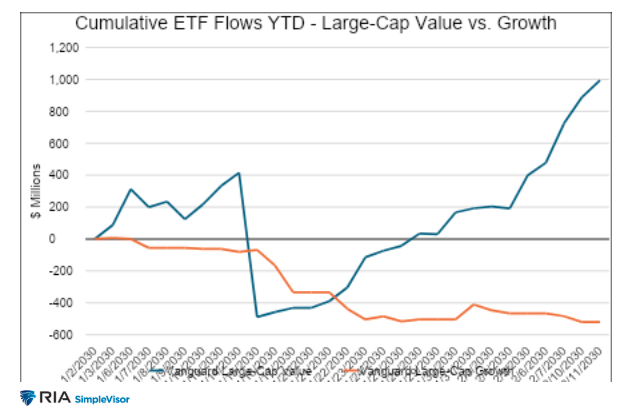

The Value Rotation Narrative
The media is making quite a to-do about the exodus from expensive growth stocks and into cheaper value stocks. Yet, as we showed in part one, investors are chasing a narrative; in many cases, they are actually selling value while under the illusion they are buying it.
The value rotation narrative suggests that higher-beta mega-cap growth stocks have run their course and are now overpriced and risky. Consequently, the logical move is to rotate into the opposite: less expensive, smaller-cap value sectors.
Regardless of whether the narrative makes sense, it is currently driving markets, sectors, and the underlying factors. While we could argue all day that many “value” ETFs do not actually offer value, it doesn’t matter. The narrative will continue to dictate trade patterns until it fades.
However, if the narrative is not factual, it will create distortions. While active investors must appreciate the narrative and its current impact on market dynamics, they must also be able to find true value stocks — for their day in the sun will eventually come.
Traditional Screens Miss Real Value
Most value investors begin their search with quantitative screens, filtering for low P/E ratios, high dividend yields, or low price-to-book multiples. These metrics are useful starting points, but they are not conclusions. In many cases, they simply identify companies that appear cheap.
Cheap valuation metrics — like those mentioned above — can signal problems rather than opportunities. For example:
- Earnings may be cyclical and near a peak.
- The business model may be deteriorating.
- Management execution may be inconsistent.
- A legal, political, or structural headwind is forming.
Many screens — especially those that don't use forward-looking estimates — cannot distinguish between undervalued and declining companies. As a result, investors often confuse statistical cheapness with genuine value.
A Forward-Looking Framework
To properly evaluate value, investors must view companies through multiple valuation lenses: past, present, and future. Each lens answers a different question: Does the company have a good earnings track record? Is it currently performing at a high level? Is it expected to grow solidly in the future?
When the three align, value opportunities are much more likely to emerge. It's not just about earnings; equally important is how the current price relates to its past, present, and potential earnings.
Past Earnings
Is the stock obviously expensive based on its earnings and cash flow over the last year or two? Metrics such as trailing P/E, free cash flow yield, and margins help answer this question.
One Year Forward Earnings
Forward estimates matter more than trailing ones, but only if they are believable. As Benjamin Graham advised, “Investors should limit analysis of the future to what can reasonably be foreseen.”
Companies with predictable financial trends, durable competitive advantages, and consistent execution deserve more confidence than those dependent on optimistic assumptions, economic scenarios, or speculative growth narratives.
Growth-Adjusted Valuations
P/E ratios and Forward P/E ratios can be expensive if expected growth is anticipated to ramp higher. That is why we also use the Price/Earning-to-Growth (PEG) ratio, which compares a company's valuation to its expected growth rate.
This step is missing from the screening process for many investors. It is also the most difficult, as small changes in growth assumptions can dramatically alter whether a company qualifies as a value stock.
Applying the Framework
We noted that companies like Walmart and Costco, which many investors consider tried-and-true value stocks, are not cheap. Using the three-tiered framework we detailed above, Walmart has a P/E of 46, a Forward P/E of 43, and a PEG ratio of 4.50. It is clearly expensive based on the three lenses.
To help true value investors look beyond expensive “value” stocks and find true value, we created a stock screen. The results shown below have low valuations, good earnings outlooks, and growth prospects that justify their prices. These are the companies that most closely resemble true value stocks in today’s market, but they are not without risk.
We screened for the following attributes:
- Market Cap: >$5 billion
- Country: USA
- P/E Ratio: <15
- Forward P/E Ratio: <15
- PEG Ratio: <1.0
- Price to Sales Ratio: <1.0
- Quick Ratio <1.0
In addition to our three lenses, we added the price-to-sales ratio to affirm value, and the quick ratio to help assess the financial liquidity of the companies. Furthermore, we removed financial stocks, because earnings-based analysis is not comparable to the analysis used for most other companies.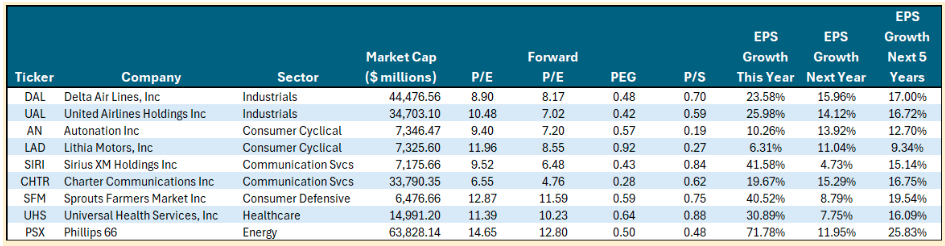
Why True Value Is Often Ignored
Markets are influenced by fundamentals but more so by psychology and incentives. Professional managers frequently prefer widely owned stocks because deviating from benchmarks introduces career risk. Furthermore, passive investment vehicles allocate capital according to index weightings that loosely fit the fund's objective. Doing so reinforces the dominance of already-popular large companies. At the same time, the financial media often amplifies compelling narratives, drawing even more capital toward the same group of stocks.
These processes often produce a feedback loop. Popular companies attract inflows, which push prices higher, which in turn attract more inflows. Less-fashionable companies experience the opposite dynamic, even when their earnings and balance sheets remain solid. Accordingly, the valuation gap between favored and ignored companies can widen significantly.
To wit, our screens show that these stocks are not big names in popular ETFs. For example, Phillips 66, the largest company on our screen, accounts for only 3.78% of the XLE energy ETF. Delta and United Airlines, the next-largest companies, account for 0.86% and 0.67% of the XLI industrials ETF, respectively. Those companies comprise an even smaller percentage of the largest large-cap value fund VTV.
The Value Trap
One of the most persistent misconceptions in investing is that cheap stocks — like those shared above — qualify as value stocks. In reality, the most dangerous type of stock is one that appears cheap but lacks earnings power or growth potential, or carries significant risks that actually justify its discounted valuation.
For example, Delta and United appear on our screen as true value stocks. However, future revenues for both companies are strongly tied to the economy and jet fuel prices. Moreover, credit card rewards programs are a significant contributor to their earnings. If we forecast a recession, their estimates for double-digit earnings growth are unreliable. We should also consider how the current surge in jet fuel prices will affect costs and whether they can pass them on to consumers. Another consideration is whether increased competition from nontraditional credit card companies will sway users away from Visa- and MasterCard-backed airline reward credit cards.
True value requires both a reasonable price and viable earnings and earnings growth. The higher your confidence in the earnings growth of a value stock, the better your odds of success.
Summary
True value investing has never been easy, but today’s passive investment environment has made it much more difficult. As a growing number of value investors buy value in name only,; ETFs labeled "value" attract these investors, even as fewer and fewer truly seek out undervalued companies. This creates a stark divergence between the fortunes of perceived-value and true-value stocks. Ultimately, such market behaviors create incredible opportunities, but we warn that patience is required to wait for these dislocations to correct.
Michael Lebowitz is a portfolio manager with RIA Advisors and author for Real Investment Advice. For more information, contact him at [email protected] or 301.466.1204.
Join RIA Advisors and elevate your career within a deeply experienced team focused on innovation. Our collaborative environment is built on a foundation of advanced technology and effective investment models, designed to enhance your ability to serve clients and grow your practice. Benefit from a supportive culture that encourages professional development and fosters a forward-thinking approach. By joining our team, you’ll be part of a group dedicated to excellence and continuous improvement, empowering you to focus on building meaningful client relationships and pursuing your business ambitions. Discover the advantages of working with our accomplished advisory team by starting your conversation today.
A message from Advisor Perspectives and VettaFi: Discover something new! Click here to register for our upcoming webcasts.
Membership required
Membership is now required to use this feature. To learn more:
View Membership BenefitsSponsored Content
Upcoming Virtual Events View All












