There’s been no love lost between builders and buyers in the entry-level housing market over the past five years. Good news for one was invariably bad news for the other. But we finally seem to be hitting a sweet spot where both sides can be cautiously optimistic.
Lennar Corp., one of largest US homebuilders, is the best company to watch for this shift because it was the most aggressive in sacrificing profitability to maintain production when the boom times of the early 2020s ended in a buyers’ strike. The message from its latest earnings update is that we are past the worst when it comes to buyer affordability and pressure on profit margins. If Lennar is right, the economic drag from housing should start to abate this year.
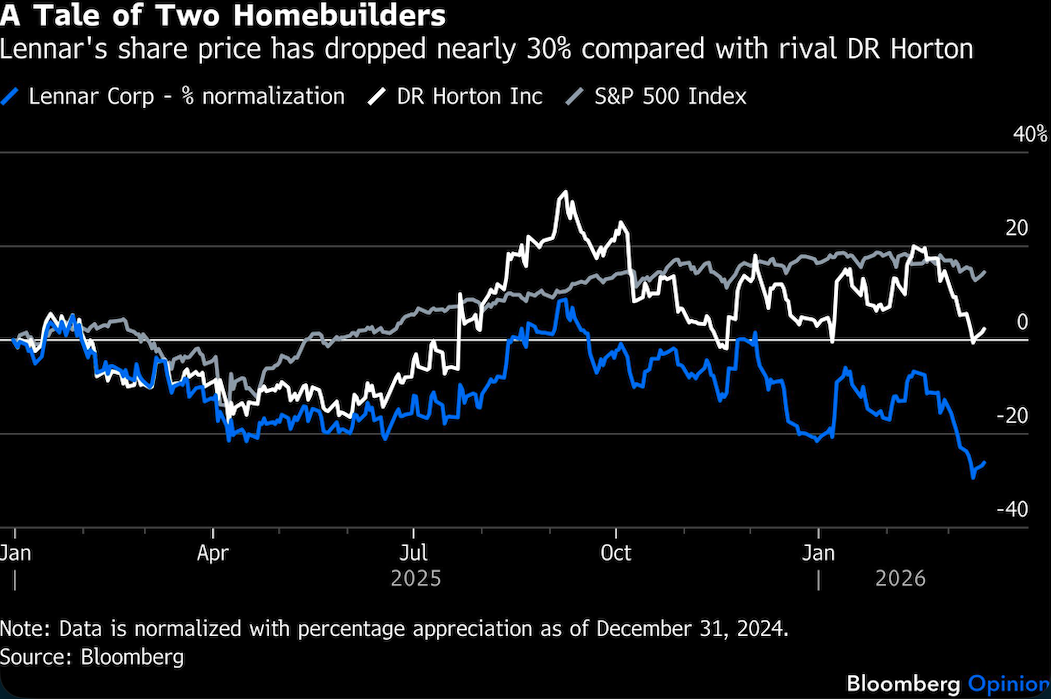
The average selling price on Lennar’s new homes has declined 22% over the past four years, driven by its decision to build smaller houses and increase incentives for buyers. The average price for new orders last quarter was lower than in the same quarter eight years ago. Investors have punished the company for its approach. Lennar’s market value has dropped nearly 30% since the start of 2025, compared with little change for rival DR Horton Inc., which builds a similar number of homes but tightly manages production to protect its profits.

The silver lining for Lennar is that having slashed prices and printed its lowest quarterly gross profit margin since 2010, it’s best positioned to see light at the end of the tunnel. The key takeaway from company executives last week was that costs are coming down while sales volumes hold. Direct construction costs have declined 7% over the past year, falling in 12 of the last 13 quarters. And after weakening for three years, Lennar’s order backlog is growing again as buyers return to a more hospitable market.
Apart from improving affordability, all homebuilders should benefit this year from a stabilization in the inventory of existing homes for sale, which serve as competition for new houses. After rapid growth over the past two years, the stock of resale houses in the key homebuilding state of Florida has fallen year over year. Nationally, there are only 5.7% more homes on the market compared with a year ago, according to Compass Inc., the largest real estate brokerage in the US. Inventory growth was running at a rate closer to 30% last year.
We’re not on the precipice of a home-building boom, but there’s reason to believe conditions are no longer getting worse. Would-be homebuyers should cheer this nascent stabilization in the entry-level market. Part of our way out of the affordability and inventory crunch in the US is building more, and that only happens if homebuilders can make the economics work — something that appeared shaky toward the end of 2025. With worker incomes continuing to grow modestly, homebuying should became gradually more accessible.
Improved operating conditions for the industry mean that policy changes that would make it easier to build starter homes have a better chance of moving the needle once implemented. Cutting red tape, speeding up permitting and relaxing zoning restrictions would allow even smaller builders, lacking Lennar’s scale and operational efficiency, to profitably build more entry-level homes.
The risk for the housing market and economy coming into the year was that rising resale housing inventory would put more pressure on homebuilder profitability, leading to fewer homes being built and more construction job cuts. That risk now seems to be easing.
Other economic risks have flared up — energy and interest rate dynamics related to the war in Iran, and uncertainty around the impact of artificial intelligence — but at least when it comes to housing, the market is signaling that buyers and builders have finally reached a truce.
A message from Advisor Perspectives and VettaFi: Discover something new! Click here to register for our upcoming webcasts.
Bloomberg News provided this article. For more articles like this please visit
bloomberg.com.
Read more articles by Conor Sen