“When we use the term stagflation, I always have to point out that that was a 1970s term,” averred Jerome Powell, the chairman of the Federal Reserve, this week.
Unemployment was in double digits and inflation was really high. That’s not the case right now. I would reserve the term stagflation for a much more serious state of circumstances.
His point was well taken. The shock to global oil supply this month has already been declared the greatest ever by the International Energy Agency, so it’s natural to draw parallels with the great shocks of the 1970s. But numerous other factors determine how serious the impact of any given hit to supply will be on the global economy. With US unemployment and inflation far lower than they were 50 years ago, it’s premature to invoke stagflation.
But there are limits. Powell prefaced those comments by pointing out that he and his colleagues had just raised their projected economic growth rate for this year by a 10th of a percent, compared to their previous forecast in December. The Fed is very unusual in seeing prospects of growth improving, even after the outbreak of hostilities in the Middle East.
Other central banks have taken a different course this week, with the Reserve Bank of Australia opting to hike rates straightaway while most others announced that the balance of probabilities had shifted toward higher rates in the near term. Christine Lagarde of the European Central Bank baldly set out a scenario where the risks of inflation and stagnation had increased:
The war in the Middle East has made the outlook significantly more uncertain, creating upside risks for inflation and downside risks for economic growth.
None of them used the word “stagflation” either, but all accepted that risks to both growth and prices had risen, and would depend on an uncertain situation in the Middle East still shrouded by the fog of war. The world has changed in the last 50 years in ways that reduce the risk of a repeat of 1970s stagflation — but don’t eliminate it.
The 1970s Oil Standard
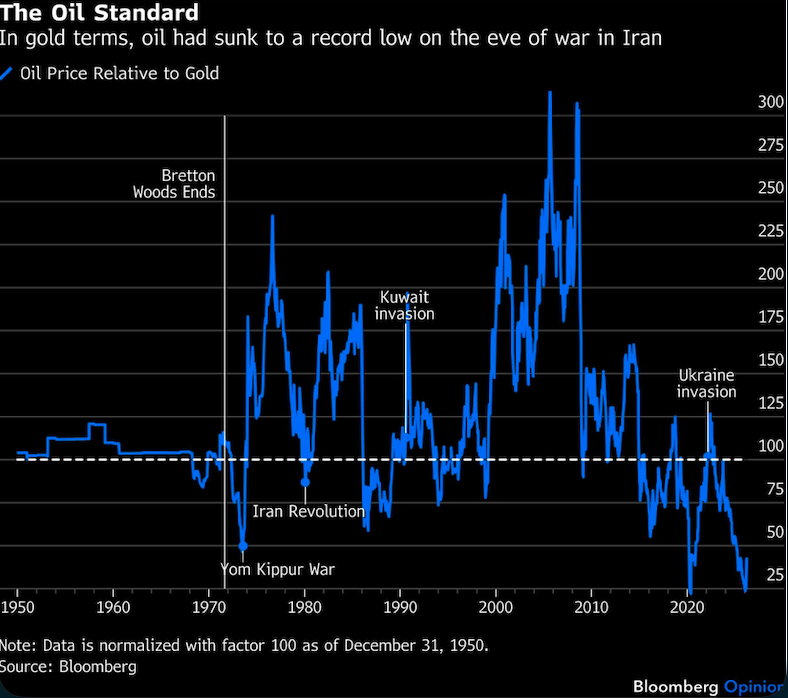
The financial fallout that followed the Yom Kippur War and the subsequent Arab oil embargo of 1973 depended on the circumstances of the time. The last ties of the international monetary system to gold had been cut by President Richard Nixon in 1971, when he decided to end the Bretton Woods peg of the dollar to gold. In the confusion that followed, the world looked for a new financial anchor and for much of the decade settled on the oil price.
Over the following two years, the price in gold of a barrel of oil dropped by two-thirds. The embargo, for all the shock that it inflicted on the world, did little more than bring oil exporters’ returns back to where they’d been in 1971. The later shock following the Iranian revolution similarly only defended the price of oil in gold terms. All it did was adjust for weakened buying power of the dollar. By the end of 1979, an ounce of gold bought 12 barrels of oil; it had been enough to buy about 11 barrels in 1971 under Bretton Woods.
Those financial upheavals drove very real economic pain for millions across the globe. Inflation reached 26% in the UK; it drove New York City to bankruptcy (and the president, in the words of an immortal headline, to tell it to drop dead). Powell is right that the current problems are not remotely comparable. But the way that the world eventually escaped stagflation is important. The Fed under Paul Volcker convinced everyone that it had sufficient credibility and independence that it could be relied on to back the dollar. There was no need for gold.
Volcker reached that stage — and the global economy settled into almost two decades of barely interrupted growth — by hiking rates repeatedly and forcing a recession in the early 1980s that was as brutal as anything that had been inflicted by the oil shocks. Nobody wants a repeat of that, but one lesson was that when oil prices slam an economy where inflation is already above target, central banks may need to be very aggressive to bring things under control again.
Further, the price of oil in gold terms has oscillated around its 1971 level in the decades since Volcker. By the end of last month, it had plumbed a new depth, dropping 75% below its level from 1970 — driven recently by gold’s surge to records as investors try to hedge inflation risks. Since the US and Israel launched their attack (which they might not have done if oil prices hadn’t seemed so tame), the oil price in gold has risen 70%. One way or another, big deviations in the oil price have a way of correcting themselves.
With inflation naggingly above forecasts and central banking independence under greater pressure than at any time since the 1970s, the conditions for a stagflationary economic wave are in place.
The Energy Cycle
However, the world is far less dependent on oil than it was 60 years ago. According to Deutsche Bank AG, total global oil consumption has risen by 1.8% per annum since 1965, while the overall economy has grown at a rate of 4.6%. Any given rise to the oil price imposes far less of a burden on the economy now than it once did, so a shock to supply must be far greater to have an economic impact to match the 1970s.
Energy intensity has reduced particularly quickly in the US. According to the analyst Ed Yardeni, total energy consumption (including all sources of power and not just oil) as a percentage of GDP has dropped by 62% since 1979. Beyond prioritizing industries that are less dependent on guzzling fossil fuels, the US has also overseen the shale gas revolution, which greatly reduced its need for foreign supply. The oil price should be far less of a driving economic force than it was half a century ago.
Financial markets recognize this, which is why the dollar has strengthened this month and American stocks have sustained far less damage than shares elsewhere. But there are still limits to how far this can be taken, as economic growth still requires energy. The technology that many, including Powell, hope will drive the next wave of growth — artificial intelligence — is proving to be energy-intense. The demands of data centers are already pushing up electricity prices and causing friction with politicians.
Energy is critical to growth, and ultimately, still impossible to disentangle from the economy and markets. Charles Gave, a founder of Gavekal Research, suggests that there is a 30-year energy cycle that is the “key driver of the global financial cycle.” The ratio of share prices to the oil price tends to be sharply mean-reverting, with periods of excessively cheap energy generally followed by rising oil prices and a bear market for stocks. That happened in the 1970s, but also in 2022 around the invasion of Ukraine.
For Gave, writing before the Iran conflict broke out, that was reason for extreme bearishness:
The next 10-15 years look as if they will be very hard for most markets. The exception is those, like China and Russia, that kept investing in energy production. As energy prices rise, it will become hard for earnings to grow structurally.
He predicted the greatest problems for the countries that had not invested in energy production, led by the euro zone.
What Should Central Banks Do?
A rising oil price is a central-banking nightmare, as it tends to raise prices (justifying higher rates) while crimping growth (which would point to easing). Predicting geopolitical events is beyond the competence of the monetary economists who run central banks, while the oil price itself is beyond the reach of their tools.
Oil shocks lay behind several of history’s most notorious central banking errors. In April 1980, Volcker’s Fed started to cut the fed funds rate. There was only one dissent.
It was a disastrous mistake that was soon corrected as inflation took hold, but ultimately required the Fed to stay tighter for longer. The sheer inconsistency of monetary policy in 1980 damaged the economy: From a peak of 20% in April, the effective fed funds rate dropped as low as 8% in August, only to close the year at 22%. That experience helps explain why central bankers aren’t keen to cut.
A generation later, the ECB contributed a mistake in the opposite direction when Brent crude rose to what is still its record high of $147 per barrel in July 2008. That prompted the the bank under Jean-Claude Trichet to vote unanimously for a rate hike, which he said was necessary for “price stability over the medium term.” He also said there was no sign that banks were tightening credit.
By the end of that year, oil would plunge to $40 amid the Global Financial Crisis.
At the press conference on the rate hike, Trichet had said that inflation was the “number-one issue” for the euro zone’s 320 million citizens and that they could “count on us.” In his defense, Google Trends shows that the level of interest in “stagflation” at the time was 50% higher than it is now. The oil price spike had contributed to an inflation scare, and fed into the disastrous confusion that would drive the crisis.
All this history gives central bankers ample reason to be cagey about responding to energy price shocks, and to have some patience. It also explains their diverging reaction this week.
But there’s nothing in the historical record to prove that stagflation will remain a phenomenon unique to the 1970s. A protracted conflict and a botched policy response could yet get there.
A message from Advisor Perspectives and VettaFi: Discover something new! Click here to register for our upcoming webcasts.
Bloomberg News provided this article. For more articles like this please visit
bloomberg.com.