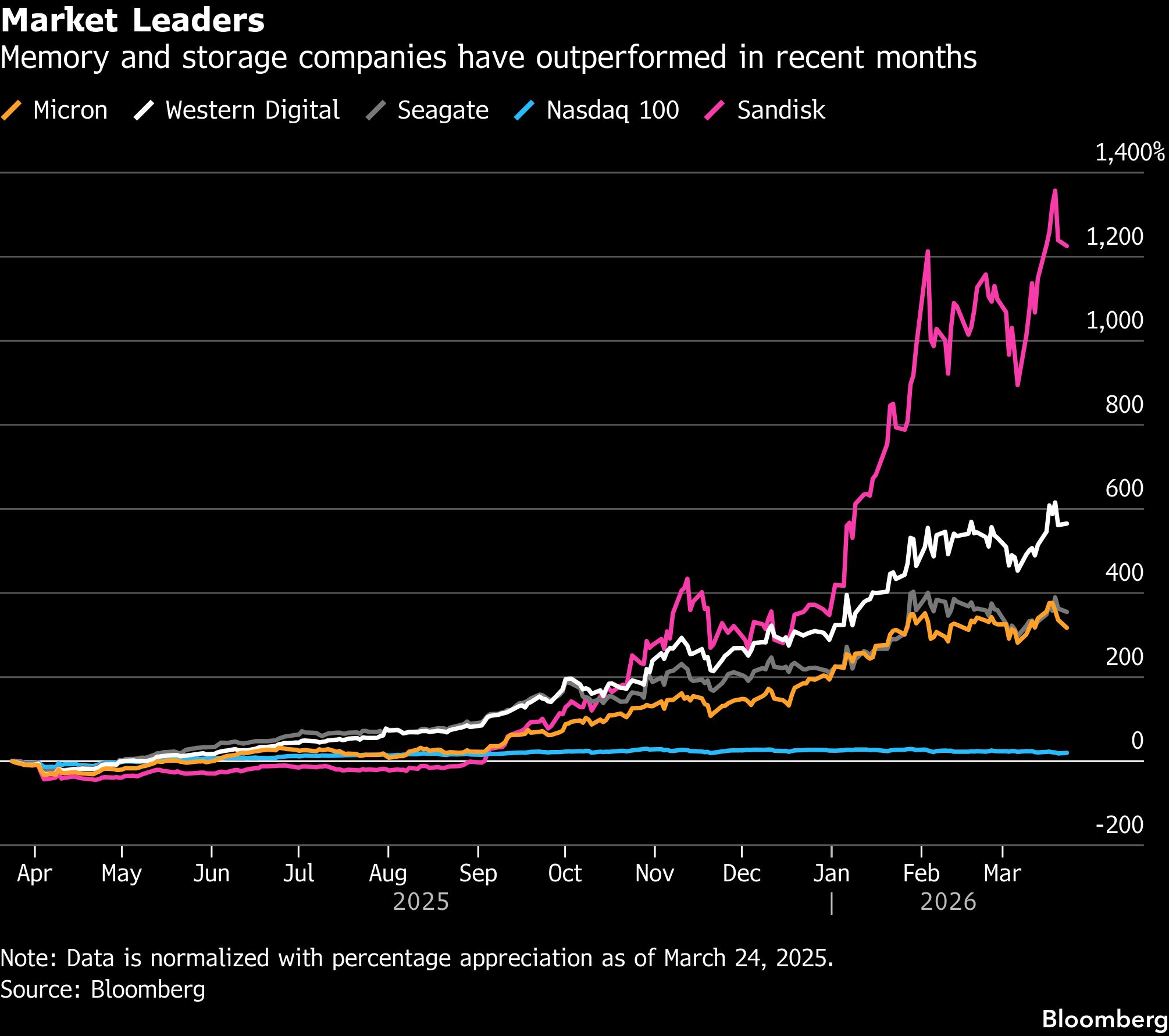
In the stock market’s volatile and uncertain start to the year, one trade has held strong: go long memory and storage.
Companies like Sandisk Corp., Western Digital Corp., and Seagate Technology Holdings Plc are among the leaders in the S&P 500 Index in 2026, even with their recent declines, as heavy spending on artificial intelligence creates insatiable demand for memory and storage components used in data centers. They were also top performers in 2025.
“Infrastructure is the place to be,” said Rob Thummel, a senior portfolio manager at Tortoise Capital, which holds shares of Western Digital, Seagate, Sandisk and Micron Technology Inc. in its Tortoise AI Infrastructure ETF.
The strength of these stocks runs counter to the Magnificent Seven technology giants, all of which are down this year, with an index of the group declining 10%. And with so many AI hyperscalers needing memory and storage products, the companies now have tremendous pricing power, suggesting that the old playbook surrounding the cyclical nature of the business may need to be reconsidered.

In particular, the stocks fit into the so-called heavy assets, low obsolescence, or HALO, trade that’s caught Wall Street’s attention, Thummel said.
“The sell side of that has been megacap tech, those haven’t done as well,” he said. “Obviously, the buy side of that has been infrastructure and memory storage and data storage.”
The thesis got some validation last week when memory chipmaker Micron Technology Inc., another one of the year’s best performers, gave a blowout forecast that underlined the ways spending on AI has made this cycle bigger and potentially longer lasting than past booms. This dynamic helps explain the group’s favored status even as investors turn skeptical about the companies spending aggressively on AI, those that could be disrupted by the technology and even long-time winners like Nvidia Corp.
“You’re simply seeing a different level of upside in memory, along with massive pricing power, so while safe may not be the right word, these companies seem easier to underwrite than other parts of the AI trade,” said Jamie Zakalik, a senior research analyst who covers semiconductor companies at Neuberger Berman.
Sandisk is by far the leading gainer in the S&P 500 this year and last, soaring more than 1,850% since starting trading in February 2025. Western Digital and Seagate are in the top 20. And Micron, which has shed 12% since its earnings last week raised concerns about its own aggressive spending plans, is still up 42% in 2026, putting it among the 25 best performers.
By comparison, the S&P 500 is down 3.9% this year, the tech-heavy Nasdaq 100 Index has lost 4.2% and the Philadelphia Stock Exchange Semiconductor Index has gained just 9.7%.
Of course, increases in memory prices are driven by supply shortages. Failures to balance supply and demand have been at the heart of the industry’s cyclical history as booming prices lead to increased production, which can cause prices to plummet when demand softens.
“The supply is still trying to play catch up,” said Ann Miletti, head of equity investments at Allspring Global Investments. “Over time that will get resolved. I think it’s more of a timing issue than it is anything else.”
Still, investors see further upside for the stocks as hyperscalers keep spending to build new data centers.
“There are a lot of reasons to be positive about memory right now,” Zakalik said. “AI is a very different market, with very different memory needs than traditional hardware. There’s an argument to be made that demand will be more structural, so maybe this time is different.”
Just ask Nvidia Chief Executive Officer Jensen Huang. Last week, he said his company is expecting more than $1 trillion in AI chip sales over the next few years, an indication that escalating spending on AI will continue to create high demand. That’s encouraging for investors buying memory names.
“I still do see upside as long as we continue to see this hyperscaler spending and new AI applications,” Tortoise Capital’s Thummel said. Huang “talks about what’s needed, and memory’s one of those things.”
Tech Chart of the Day
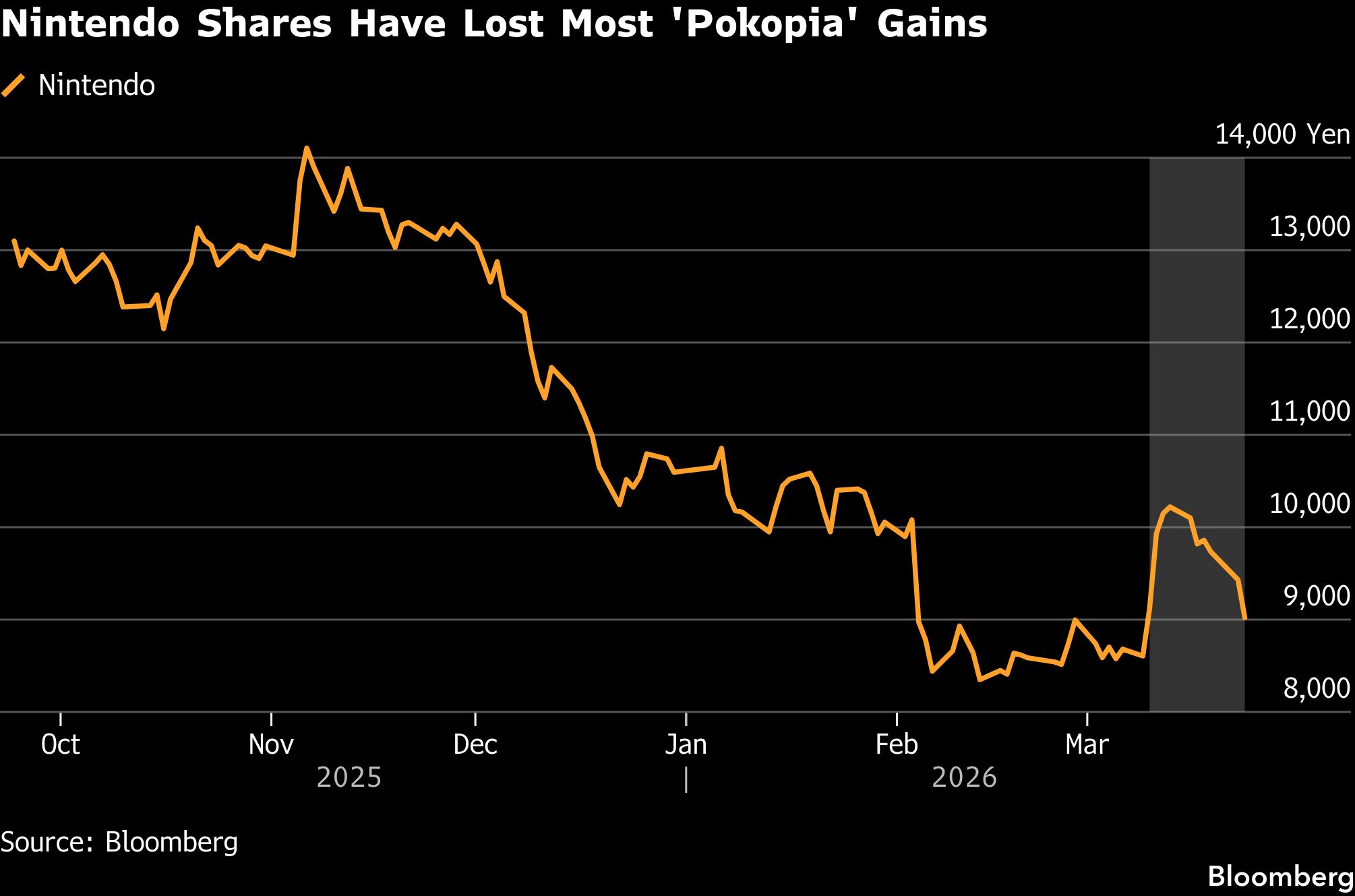
Nintendo Co. is cutting back the production of Switch 2 after demand for the $450 gaming console trailed the company’s expectations during the year-end holiday season, particularly in the US.
A message from Advisor Perspectives and VettaFi: Discover something new! Click here to register for our upcoming webcasts.
Bloomberg News provided this article. For more articles like this please visit
bloomberg.com.
Read more articles by Ryan Vlastelica and Carmen Reinicke