Every twist in the Iran conflict — every ceasefire bet, every missile strike, every shift in tanker traffic — shows up almost instantly in a $65 million exchange-traded fund that most investors have never heard of.
The Breakwave Tanker Shipping ETF plunged roughly 13% on market open Wednesday after Iran said it would allow safe passage through the strait. Within hours, it snapped back — surging after Iran’s Revolutionary Guard halted tanker traffic through the Strait of Hormuz once again in response to Israeli strikes on Lebanon.
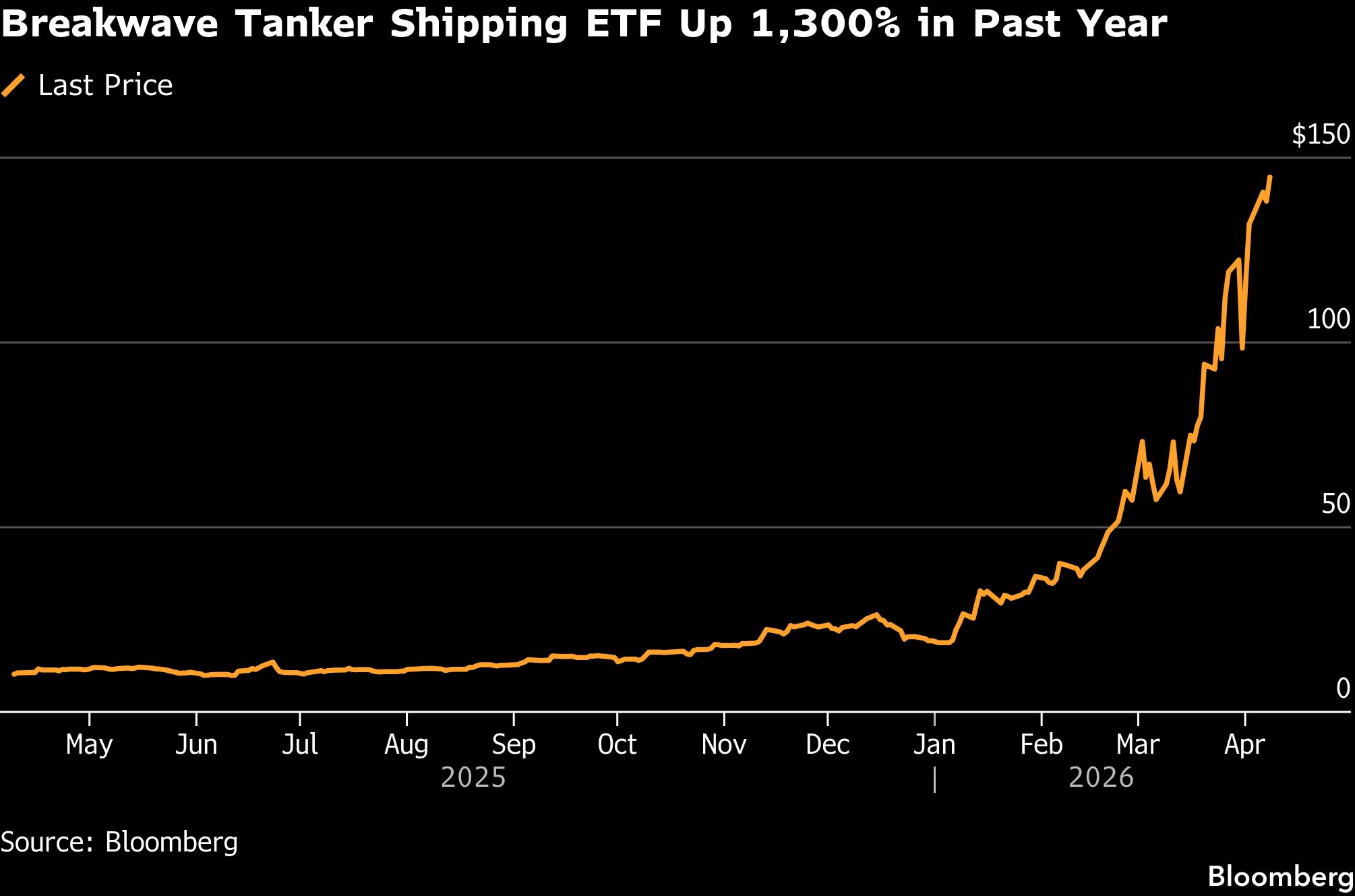
The fund’s wild session captured, in a few hours of trading, the distance between a ceasefire on paper and the reality of a war that is far from over. BWET, as the fund is known, has surged roughly 1,300% over the past year — from around $10 a share to nearly $150 — making it the best-performing US-listed ETF so far in 2026. It started the year with barely $2 million in assets. But what makes it notable isn’t just the return, but the fact that the fund has become a minute-by-minute market verdict on whether the world’s most critical energy chokepoint is open for business.
Back in January, before the war, Citrini Research flagged precisely this setup — arguing that the real opportunity in oil was not just crude itself but the ships that carry it, citing an aging fleet and tightening sanctions on so-called ghost vessels. BWET was the largest weight in Citrini’s tanker basket. Three months later, that thesis has played out more violently than anyone expected.
BWET holds freight futures tied to the daily cost of chartering very large crude carriers — the massive tankers that move oil through the Persian Gulf. About 90% of the portfolio tracks the cost of shipping crude from the Middle East to China.
“There is no risk mitigation,” said John Kartsonas, founding and managing partner at Breakwave Advisors LLC, which created the fund. “If rates decline, the fund will also decline.”
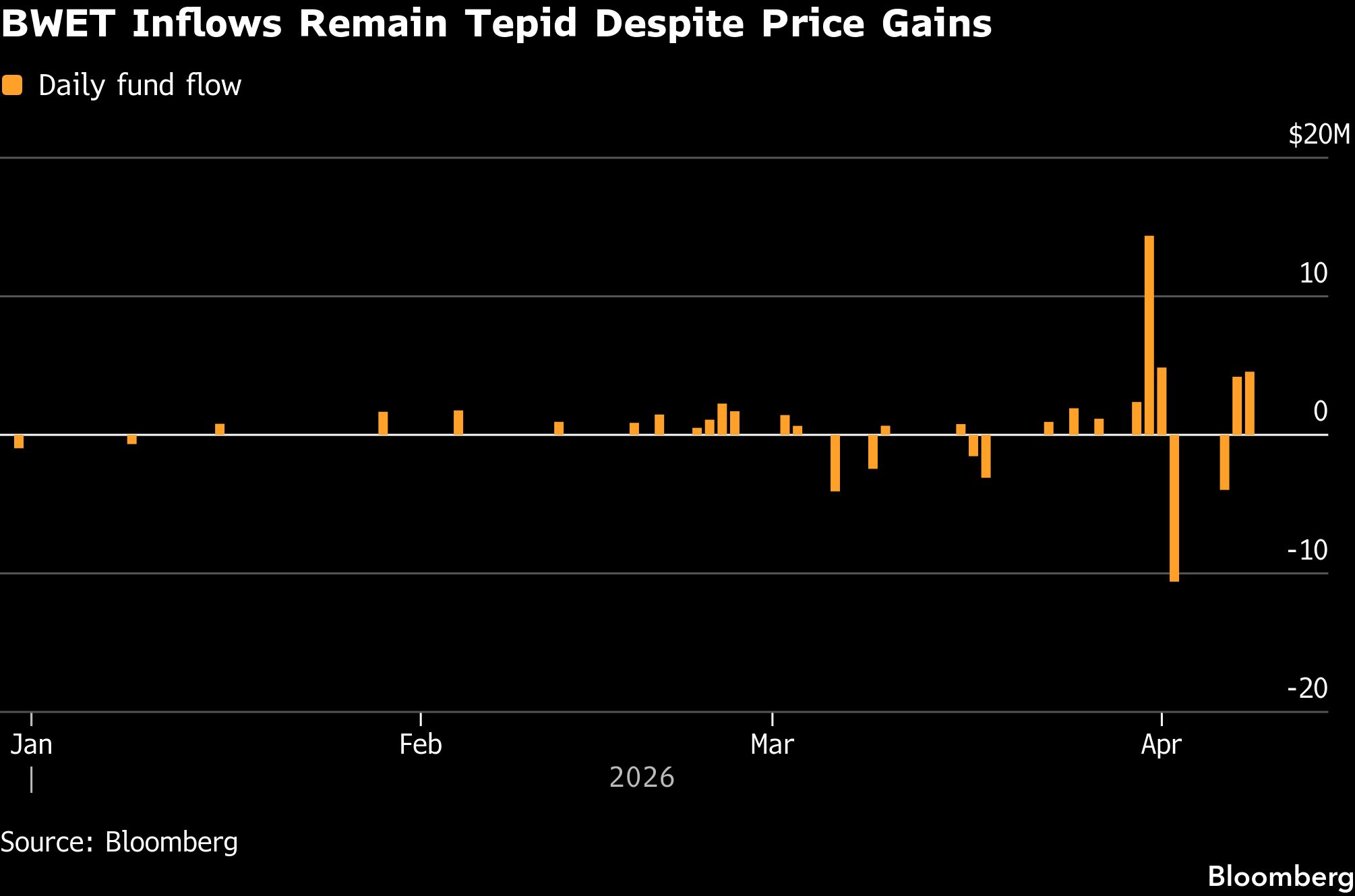
Yet for all its visibility, few investors are buying it. Despite gains that dwarf every other US-listed fund this year, BWET has attracted only about $25 million in net inflows — a rounding error next to the roughly $720 million that has poured into the United States Brent Oil Fund, for instance, which has returned a fraction as much.
A 3.5% expense ratio and a complex tax structure may have helped keep all but the most determined speculators away. Kartsonas said the headline fee could drop if assets increase, and that the fund’s use of futures leaves most assets in cash earning interest, offsetting costs.
Todd Sohn, chief ETF strategist at Strategas Securities, says there are likely a few reasons the ETF hasn’t seen more inflows. “The arbitrage opportunity has largely played out and the fund is already up multiples this year, so the risk-reward from here may not be compelling,” he said. “On top of that, it’s a pretty niche exposure; oil is one thing, but tanker freight is a more specialized bet, which can keep broader investor flows at bay.”
The rally was fueled by a sharp repricing in shipping costs after Iran effectively closed the Strait of Hormuz in early March, following US and Israeli strikes that killed Supreme Leader Ali Khamenei and triggered retaliatory attacks across the Gulf. The closure forced Asian buyers to source crude from outside the Persian Gulf, driving up demand — and prices — for the vessels that carry it. The going rate for very large crude carriers loading in the Gulf currently stands at over half a million dollars a day, roughly five times pre-war levels.
The shipping market was tight even before the first missile was fired. Sinokor Group, a Seoul-based firm, had amassed a large share of tanker capacity, pushing up costs as charterers scrambled for vessels amid concerns over concentrated ownership. Sanctions on Russia and Iran were simultaneously shrinking the pool of compliant ships. And years of underinvestment had left the global fleet aging and constrained.
That structural tightness is why some analysts believe the fund’s gains won’t fully unwind even if peace holds. Trade routes have grown more complex, buyers are sourcing crude from farther afield, and demand for shipping capacity is rising independent of the conflict.
“The story right now is war and disruption, but this could transition to a fundamental story,” Kartsonas said, pointing to concentrated ownership and steady global demand.
The conflict’s aftershocks may also outlast the fighting. Even a full reopening of the strait would not erase the higher insurance costs, the rerouted supply chains, or the logistical chaos at ports across the Indian Ocean and the Gulf.
“Even with alternative routings, there is huge schedule disruption at ports like Mundra, Nhava Sheva, and Khor Fakkan — and that is not going to go away overnight,” said Destine Ozuygur, a senior analyst at freight analytics platform Xeneta.
A message from Advisor Perspectives and VettaFi: Discover something new! Click here to register for our upcoming webcasts.
Bloomberg News provided this article. For more articles like this please visit
bloomberg.com.