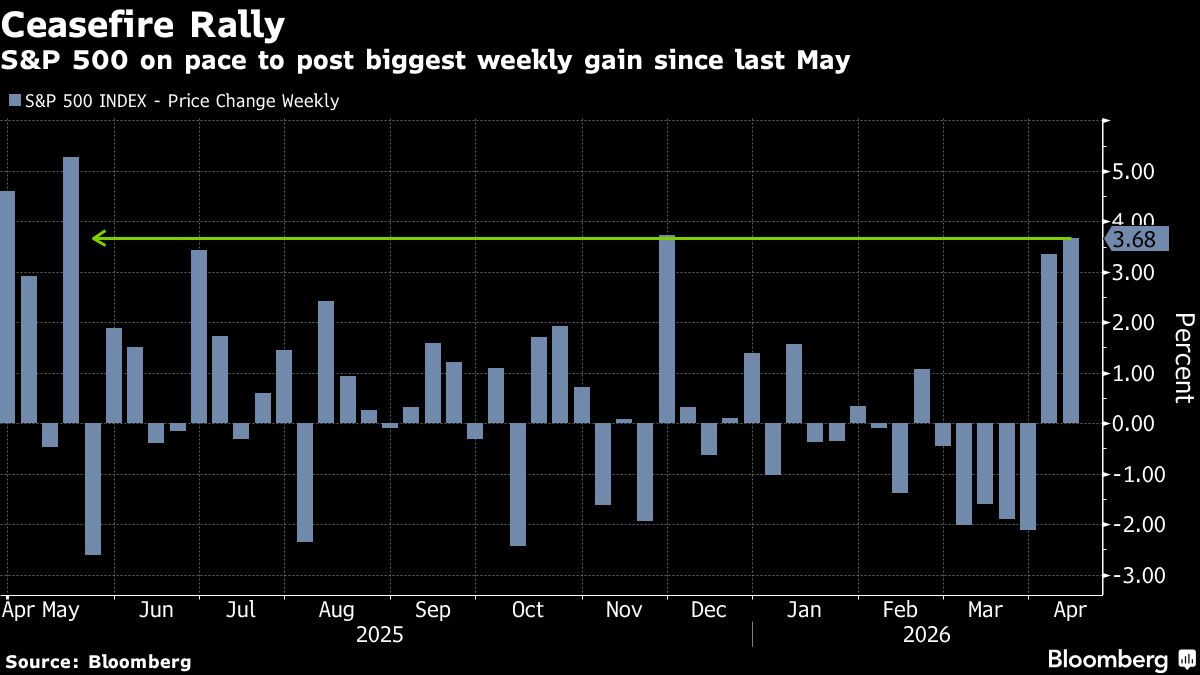
US equity futures stalled after a seven-day rally as investors weighed whether a fragile truce between Washington and Tehran can hold, and oil headed for its biggest weekly loss in nine months.
Contracts on the S&P 500 were little changed at 8:03 a.m. in New York, leaving the underlying index on track for its largest weekly gain in nearly a year. Nasdaq 100 futures also traded flat, with the tech-heavy benchmark on its longest winning streak since September.
Markets have been buoyed by a two-week ceasefire agreement announced Tuesday, which sparked a surge in equities and a pullback in oil. Traders are now looking for signs that the temporary truce can evolve into a more durable de-escalation. President Donald Trump said he remained “optimistic” about the outlook, even as he warned Tehran against imposing fees in the Strait of Hormuz.
“Today, geopolitics will remain the dominant force on markets, but as long as the face-to-face meeting Saturday morning isn’t cancelled, geopolitics shouldn’t weigh on markets too much,” wrote Tom Essaye, president and founder of the Sevens Report.

The S&P 500’s winning streak now faces a key test as investors look to upcoming inflation data before attention shifts to US-Iran talks scheduled in Islamabad this weekend. March’s CPI, the first since the Iran war began, is expected to show the fastest monthly increase in headline CPI in almost four years, driven by gasoline prices.
While the recent tone in markets is cautiously optimism around further diplomatic progress, tensions continue to cap risk appetite. A bout of equities volatility fueled by surging energy prices amid the Iran war is eroding confidence among some of the market’s most reliable bulls: retail traders.
Individual traders are moving away from aggressively buying dips and toward skipping pullbacks, selling into rallies and positioning more defensively, according to Arun Jain, a strategist at JPMorgan.
Still, the US stock market is expected to get a boost from so-called systematic investors, which tend to follow price trends rather than fundamentals. Commodity Trading Advisors, or CTAs, are currently short about $30 billion of S&P 500 futures. At current market levels, Goldman Sachs Group Inc.’s trading desk model suggests they could buy roughly $34 billion over the next week, as they cover bearish bets and flip back to net long positions.
Under the surface, market leadership is also shifting. Value stocks posted their second-strongest quarterly outperformance versus growth shares in more than three decades, a trend that strategists say could extend further.
In corporate news, Taiwan Semiconductor Manufacturing Co. reported a 35% increase in quarterly revenue, suggesting global AI chip demand remained intact during the first weeks of war in the Middle East. In China, AI firm Sharetronic Data Technology Co. reportedly acquired systems containing restricted high-end Nvidia chips, highlighting ongoing supply chain workarounds. Lumentum Holdings Inc. said demand from the biggest US technology firms for its optical components is accelerating, and likely to fill order books through 2028.
In the consumer space, Nike Inc. shares edge lower in premarket trading on Friday, as Piper Sandler downgraded to neutral from overweight on concerns that athleisure is becoming too saturated across the industry. Shake Shack Inc. gained as Mizuho Securities raised the recommendation on Class A to outperform from neutral, saying the valuation looks attractive with catalysts ahead.
A message from Advisor Perspectives and VettaFi: Discover something new! Click here to register for our upcoming webcasts.
Bloomberg News provided this article. For more articles like this please visit
bloomberg.com.
Read more articles by Natalia Kniazhevich