The Apple AI Strategy: Discipline Over Hype
Membership required
Membership is now required to use this feature. To learn more:
View Membership Benefits Advisor Perspectives welcomes guest contributions. The views presented here do not necessarily represent those of Advisor Perspectives.
While tech giants race to invest billions into AI, executives at Apple are quietly sitting on their hands and a mountain of cash. Given the massive growth in AI investments, as shown in the graphs below, executives of leading companies at the forefront of AI development must be ecstatic about the prospect of AI significantly boosting their bottom lines.
The puzzling question, however, is why Apple isn't following suit. Or is it taking a different approach to winning the AI arms race?
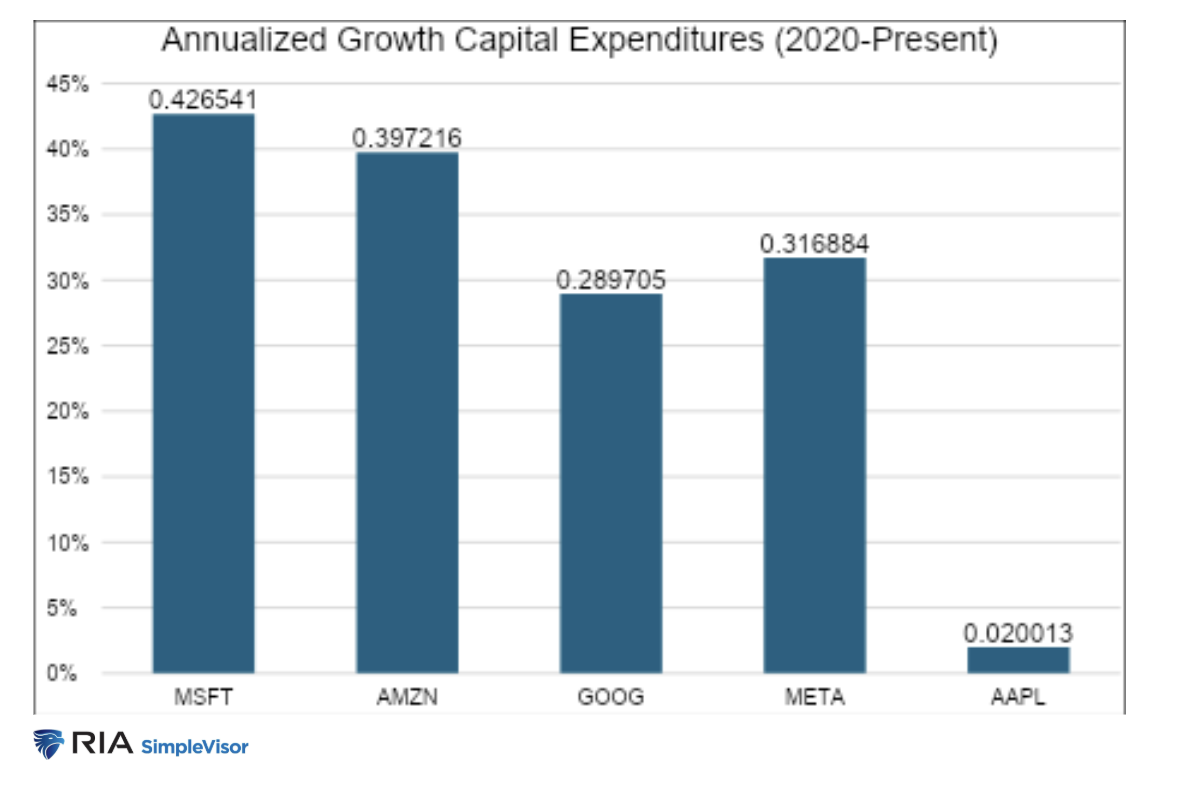
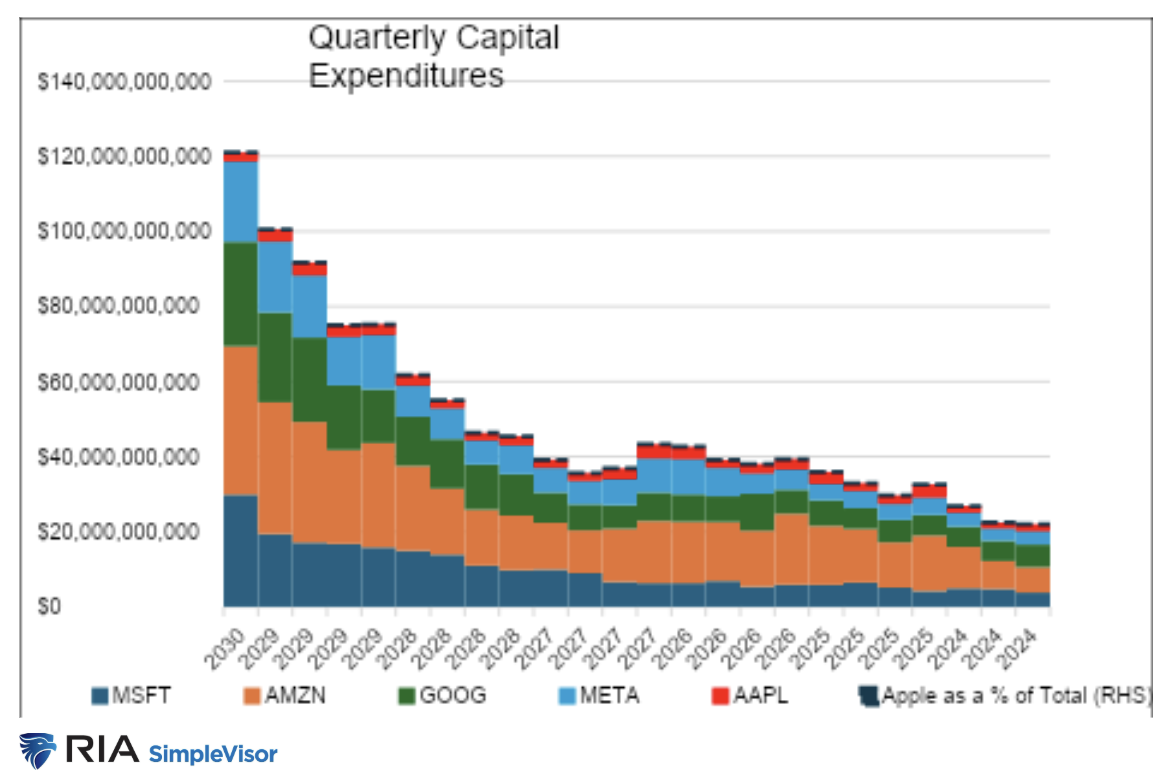
Apple Avoids the AI Spending Boom
Apple is one of the world’s most profitable companies. Over the last four quarters, it reported over $400 billion in annual revenue and nearly $100 billion of free cash flow. Furthermore, the company holds $65 billion in cash and cash equivalents and $77 billion in marketable securities.
The bottom line is that Apple can easily self-fund AI innovation on a massive scale, as its competitors are doing. Yet it hasn’t. Rather than mimicking its peers, Apple appears content to let the AI landscape mature before committing significant capital.
Restraint seems like complacency or even negligence. However, Apple has a long and extremely successful history of deploying capital at the right time — when the profit outlook is clear, the technology is established, and the customer value proposition is well-defined.
This approach may be frustrating for Apple shareholders in the short term, but history — and the chart below comparing Apple to the S&P 500 — suggests it has played out extremely well.
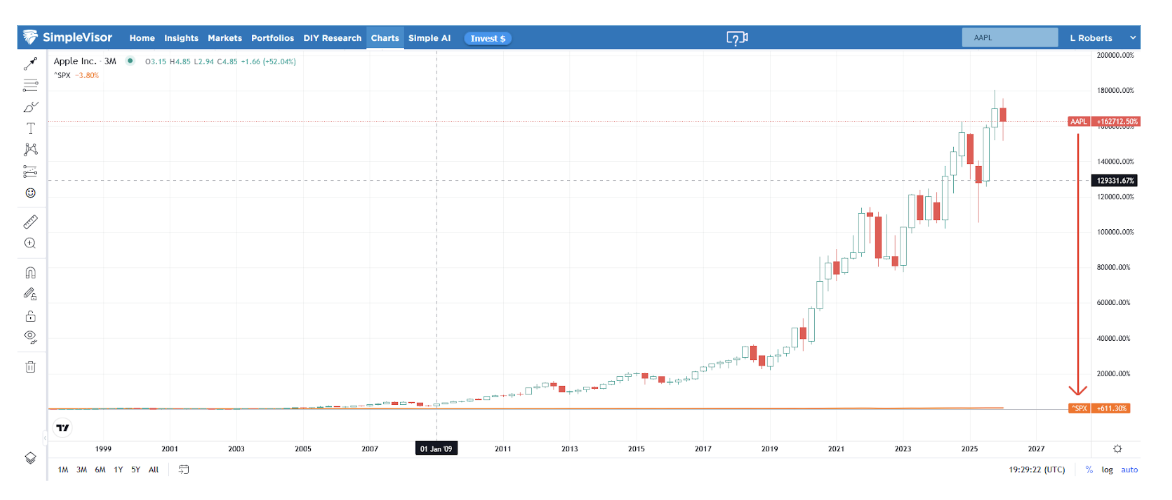
Apple’s Historical Playbook
Apple has rarely been first to introduce a new product. It was not the first personal computer company, the first smartphone maker, or the first to launch wireless earbuds, smartwatches, or VR headsets. In nearly every case, Apple waited while other companies experimented and helped define the product and the market.
Apple waited to understand what consumers wanted in a product. Only after the uses of a new product became obvious and consumer demand was proven did Apple step in with well-designed products that emphasized reliability, usability, and profitability. Its goal has always been not to be the biggest producer of a product but to be the best. In most cases, it has lived up to that lofty goal.
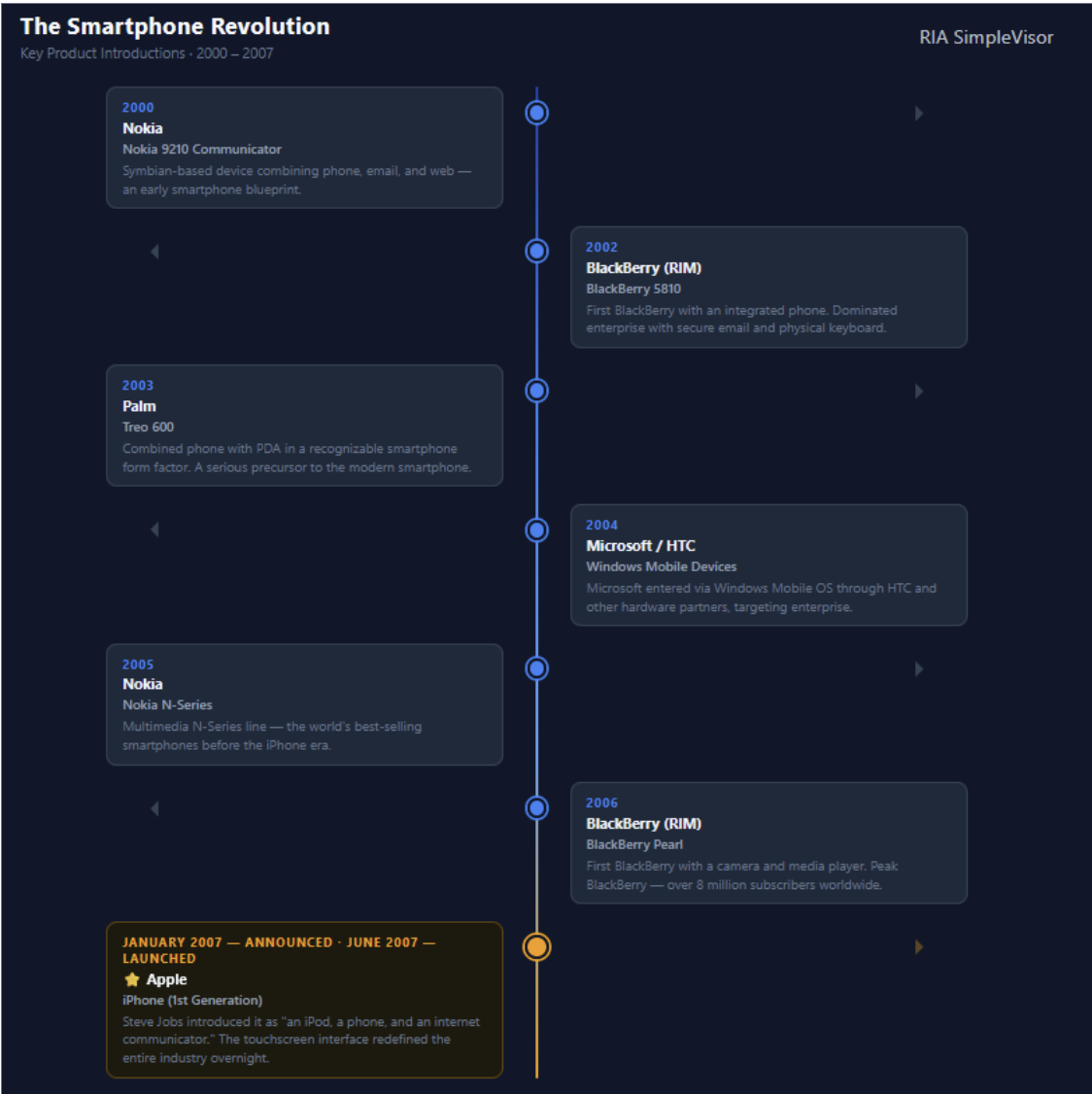
The timeline below shows the various smartphones that preceded Apple’s iPhone. Given the smartphone landscape today and the fate of the products that preceded the iPhone, it's fair to say that Apple’s patience was well rewarded.
Discipline Will Win the AI Game
Today’s generative AI ecosystem is still in its experimental phase. Training costs are enormous, inference costs remain high, and business models are largely unproven. Many AI products are impressive, but have produced limited revenue.
Instead of competing with the likes of Microsoft, Meta, and Google, Apple appears to be integrating AI incrementally. It is embedding AI into existing hardware, operating systems, and services rather than creating standalone, capital-intensive platforms. This allows its products to stay competitive without fundamentally altering its cost structure.
This approach takes Apple out of the AI limelight, which has at times weighed on the stock price.
Waiting for Clarity
There are good reasons to wait for AI to better define itself before Apple spends hundreds of billions on strategies that may not prove profitable. For example:
- Monetization: While AI can clearly improve productivity and user engagement, it remains unclear how much consumers are willing to pay for it directly.
- Legal/regulatory: Data privacy, intellectual property disputes, model accountability, and regulatory limitations are evolving areas of law and public policy. Apple, whose brand is closely tied to trust and privacy, could lose more than most companies from missteps in these areas.
- Capital flexibility: By not locking itself into massive investments today, Apple retains the capital flexibility to invest rapidly once AI technology better defines itself and the economics become more apparent.
The Long View
For the impatient investor or trader, Apple’s approach feels underwhelming, especially amongst the daily headlines proclaiming AI innovation and trillion-dollar opportunities. But, for investors with patience, history suggests that Apple’s greatest successes have come not from being first, but from entering markets when technology, consumer readiness, and profitability align.
In our article, "AI Bubble: History Says Caution Is Warranted," we discussed how many game-changing innovations, such as AI, are often accompanied by a financial bubble. Furthermore, for understanding Apple's AI strategy, it has historically been far from certain that the front-runners, initially touted as the biggest beneficiaries of the innovation, will be the long-term winners.
To wit: In 1999, few, if any, investors had ever heard of Google. The term for an internet search, “Googling,” was not yet a thing. Today, Google has a 90% share of the search engine volume, and many of its early competitors no longer exist.
Is Apple taking a page out of Google’s playbook and waiting in the weeds for the AI industry to mature? Is Apple the next Google?
Summary
In the early stages of a technology buildout, infrastructure tends to capture the most value. This time appears similar, with the chipmaker Nvidia posting extraordinary returns and investors fawning over the big data center players like Microsoft, Amazon, Meta, and Google. However, over time, value typically migrates toward the technology's application. Understanding where we are in that migration from infrastructure to application is important.
In our opening section, we asked if Apple executives share the same enthusiasm for AI as their chief competitors. The answer is that Apple executives understand something their peers do not — the race rarely goes to whoever is first out of the gate.
Michael Lebowitz is a portfolio manager with RIA Advisors and author for Real Investment Advice. For more information, contact him at [email protected] or 301.466.1204.
Join RIA Advisors and elevate your career within a deeply experienced team focused on innovation. Our collaborative environment is built on a foundation of advanced technology and effective investment models, designed to enhance your ability to serve clients and grow your practice. Benefit from a supportive culture that encourages professional development and fosters a forward-thinking approach. By joining our team, you’ll be part of a group dedicated to excellence and continuous improvement, empowering you to focus on building meaningful client relationships and pursuing your business ambitions. Discover the advantages of working with our accomplished advisory team by starting your conversation today.
A message from Advisor Perspectives and VettaFi: Discover something new! Click here to register for our upcoming webcasts.
Membership required
Membership is now required to use this feature. To learn more:
View Membership BenefitsSponsored Content
Upcoming Virtual Events View All












