A dramatic shift is underway in US equity markets. Stocks hit an all-time high Wednesday as Middle East peace hopes tamped down geopolitical anxiety, and derivatives traders who had pulled back from bullish bets are now racing to position for further gains in technology shares.
Wall Street is bracing for another runup after a bout of selling left hedge funds underexposed ahead of an incoming wave of earnings and shifting sentiment in derivatives. Bullish positioning is showing up in the tech-laden Nasdaq 100, now in the middle of its longest winning streak since 2019, as traders ready to chase a further climb through the options markets.
“The S&P 500, Nasdaq 100 and the Magnificent Seven call skew was depressed and upside was underpriced to begin the month,” said Chris Murphy, co-head of derivatives strategy at Susquehanna International Group. “But as equities have gone on an epic rally and underexposed investors have been forced to chase and reach for upside.”

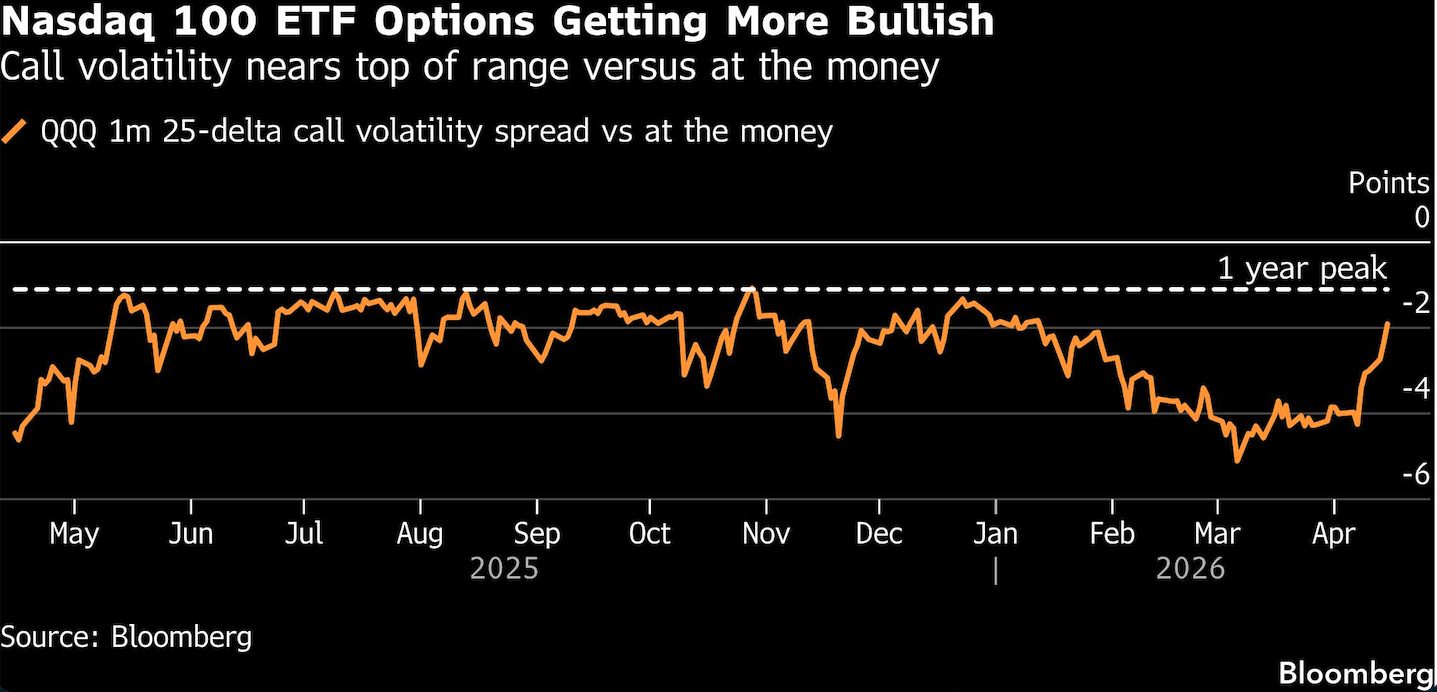
At least one measure is signaling traders’ desire for contracts that bet on near-term upside. Implied volatility for a 25-delta call option on the largest exchange-traded fund tracking the Nasdaq 100 is the highest since mid-January compared with contracts at the current market level.
The S&P 500’s race to record after record skidded to a halt when the US and Israel launched a coordinated attack against Iran six weeks ago, driving options traders to pull back from wagers on more gains. That backdrop shifted abruptly in recent days, with US stocks posting their strongest weekly gain since November last week and extending the advance to an all-time high on Wednesday amid optimism that diplomatic progress will ease conflict risks.
The Nasdaq 100 has climbed for 11 consecutive days. Should the momentum continue on Thursday, that would be gauge’s longest streak of gains since 2017.
Still, broader positioning remains light, suggesting there is still capacity for investors to add risk. Hedge funds, for instance, have been reducing their holdings on US technology shares at the fastest pace in more than five years.
Exposure to US stocks across trend-following systematic funds fell to the level last seen in the summer of 2025. But as stocks resumed their climb and volatility declined, those funds started adding positions. Traders don’t want to be caught off-guard by another prolonged advance.
Investors are “scrambling” for the “under-owned right tail” according to Nomura’s cross asset desk strategist Charlie McElligott.
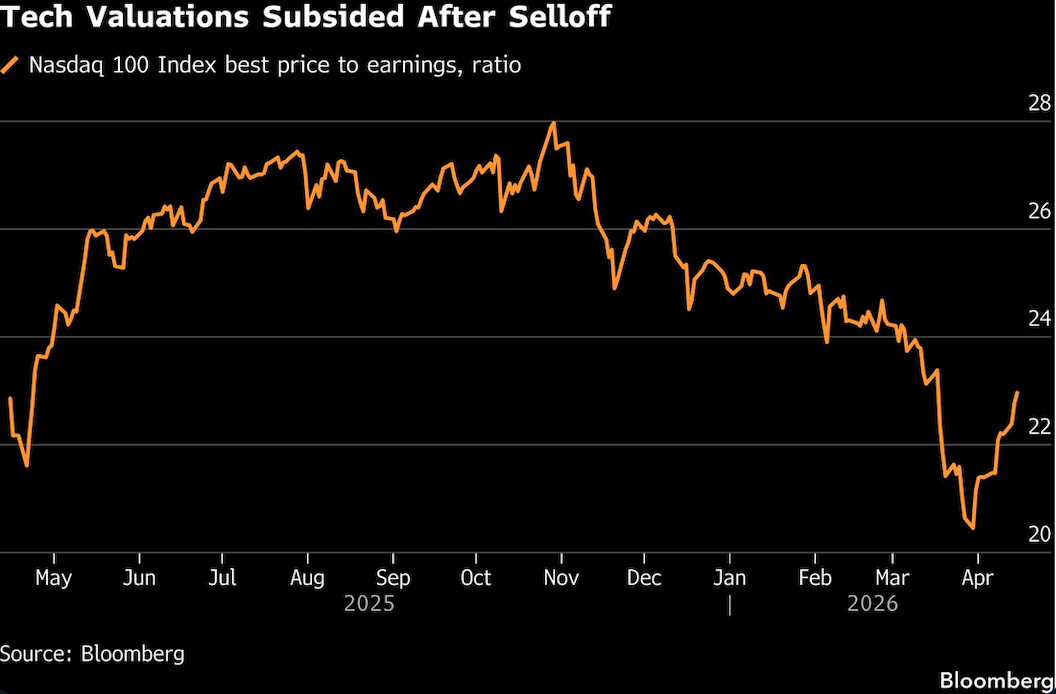
At the same time, valuations for megacap tech have become more compelling relative to the broader market. The premium for the Magnificent Seven versus the rest of the S&P 500 has narrowed to near eight-year lows.
“The Mag 7 screens attractive to the remaining 493 companies, which is a thesis that’s starting to come up frequently in client conversations into EPS season,” Goldman Sachs Group Inc. traders wrote in a note to clients on Wednesday.
Valuations across the technology sector have compressed meaningfully. Both the S&P 500 Information Technology sector and the Nasdaq 100 are now trading below their 10-year average forward multiples, offering what some investors view as a more constructive entry point into large-cap growth stocks.
The key question now is how far the rebound in US stocks can extend if geopolitical risks continue to fade. According to Goldman Sachs’ trading desk, client conversations point to a consensus range of 7,200 to 7,300 for the S&P 500 over the coming month. The benchmark closed at 7,023 on Wednesday.
A message from Advisor Perspectives and VettaFi: Discover something new! Click here to register for our upcoming webcasts.
Bloomberg News provided this article. For more articles like this please visit
bloomberg.com.
Read more articles by Natalia Kniazhevich