I came across a statistic the other day that goes against the intuition of practically everyone in the US who has a job: Americans are working less than they did in the 1950s and ’60s. How is this possible, when we all feel chained to our desks or our phones?
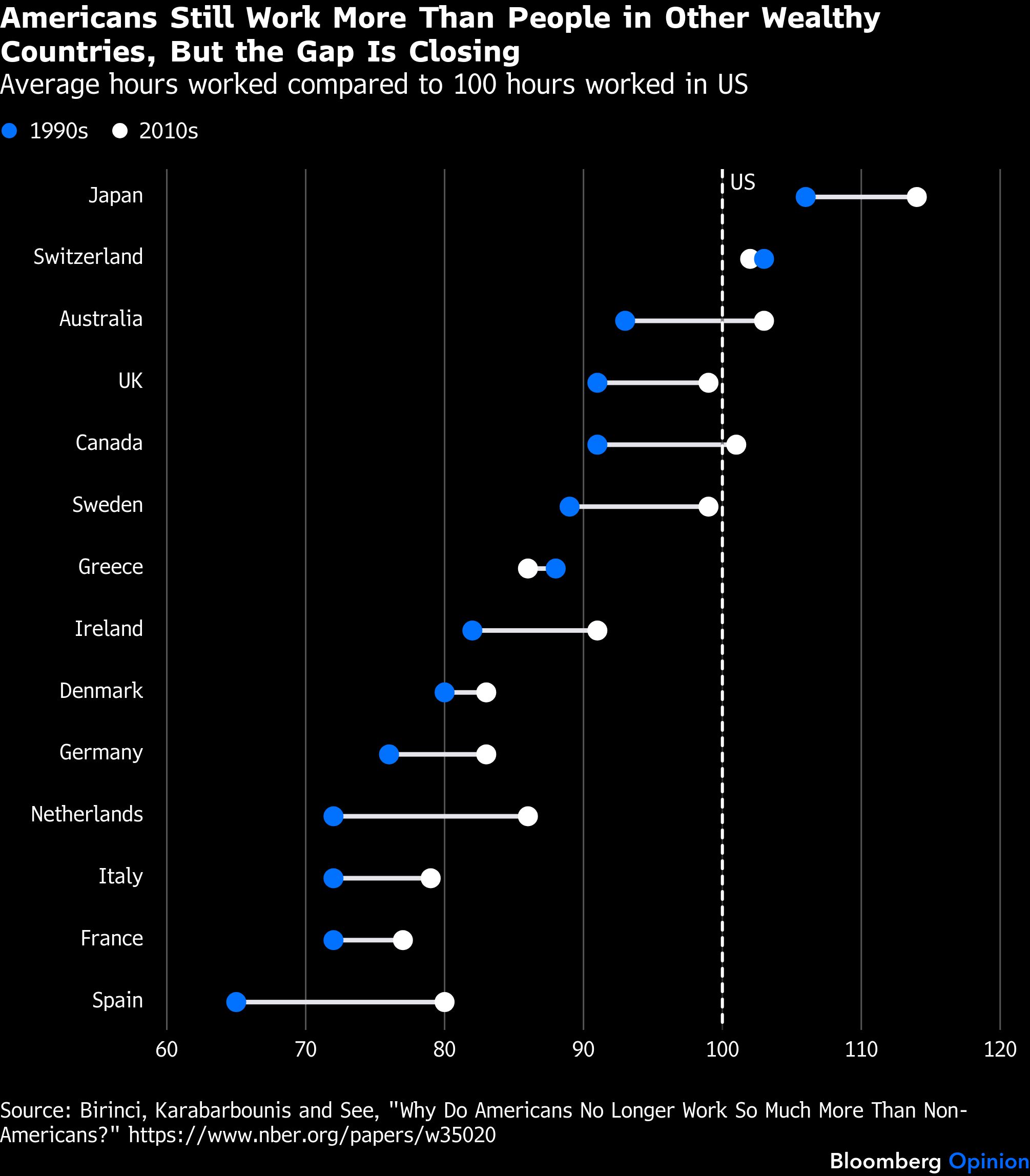
Yes, we still work more than almost anyone else — especially the Europeans, with their long vacations and 35-hour work weeks — but the gap is closing. Not only are Americans working fewer hours per week, but people in other wealthy nations are working more. At this rate, we’ll soon be working as hard as the French.
Je plaisante! As it turns out, this phenomenon may be best explained by the decline of men in the workforce rather than a general rise in American indolence. Still, the implications for the US economy, and the federal budget, are profound.
Right after World War II, it was the Europeans who worked harder than everyone else. But as they rebuilt their economies and constructed huge welfare states, their working hours fell. They now work much less than the rest of the world. Americans’ working hours also declined in the 1950s, but started to increase in the 1960s and accelerate in the 1980s and 90s before leveling out and then falling in the 2010s. Meanwhile, Europeans started working more in the 2010s. The gap between the US and other rich countries has been cut in half.
A new paper explores why this might be. It suggests that one reason might be the expansion of Medicaid in the US: In 1970, the program covered about 20 million people, or roughly 10% of the population; by 2020, those figures were 100 million and 30%. Medicaid can be a disincentive to work, because if someone on Medicaid takes a job or just works more hours, they could lose their health benefits or have to pay more for them. Some research estimates that Medicaid income limits can act as a 100% tax on work.
At any rate, this decline in working hours in is turning into a problem. Some older Americans are shut out of the labor market because of age discrimination or lack of suitable jobs. Meanwhile, some part-time workers can’t find full-time, reliable work. What’s unclear is whether these trends are getting worse, or will get better in coming decades as technology offers people more ways to work for themselves.
A more concrete concern is that this phenomenon of working less is concentrated among men and lower-income Americans. It used to be that those with higher incomes worked very little, but in the 20th century that changed: Now higher earners work more hours than people who earn less. As for the gender gap, according the American Time Use Survey, working hours for men and women who have jobs has been fairly stable since 2003. The drop in overall working hours comes mostly from people who don’t work, especially men. It’s clear that a lot of this trend is driven by men leaving the work force.
Fewer men are in the labor force in Europe, too. But that’s because of earlier retirement and longer life expectancy. In 2020, only 8% of European men age 25 to 54 were out of the labor force, compared to 11% in the US. Youth unemployment tends to be higher in Europe, but at least there is a trend of working more, while the US is going in the wrong direction.
It is worth noting that Americans still work more than Europeans. On average, other rich countries work 92 hours for every 100 Americans do. And if the American welfare state has become more generous, in most of Europe it is even more generous. It’s possible to structure benefits in a way that encourages work, of course. But the larger point is that none of this is sustainable.
Both America and Europe have aging populations that will be increasingly expensive to care for. And if people are working less, that means there will be less tax revenue to pay for those benefits. Europe has taken a step in the right direction, but it still has much further to go. Meanwhile, between growing its welfare state and shrinking its working hours, the US may be accelerating its reckoning, too.
A message from Advisor Perspectives and VettaFi: Discover something new! Click here to register for our upcoming webcasts.
Bloomberg News provided this article. For more articles like this please visit
bloomberg.com.