am Altman, the chief executive officer of OpenAI, said at a finance conference in October 2023 that he and his “CEO friends” were running a betting pool on when the first one-person billion-dollar company would be created thanks to artificial intelligence.
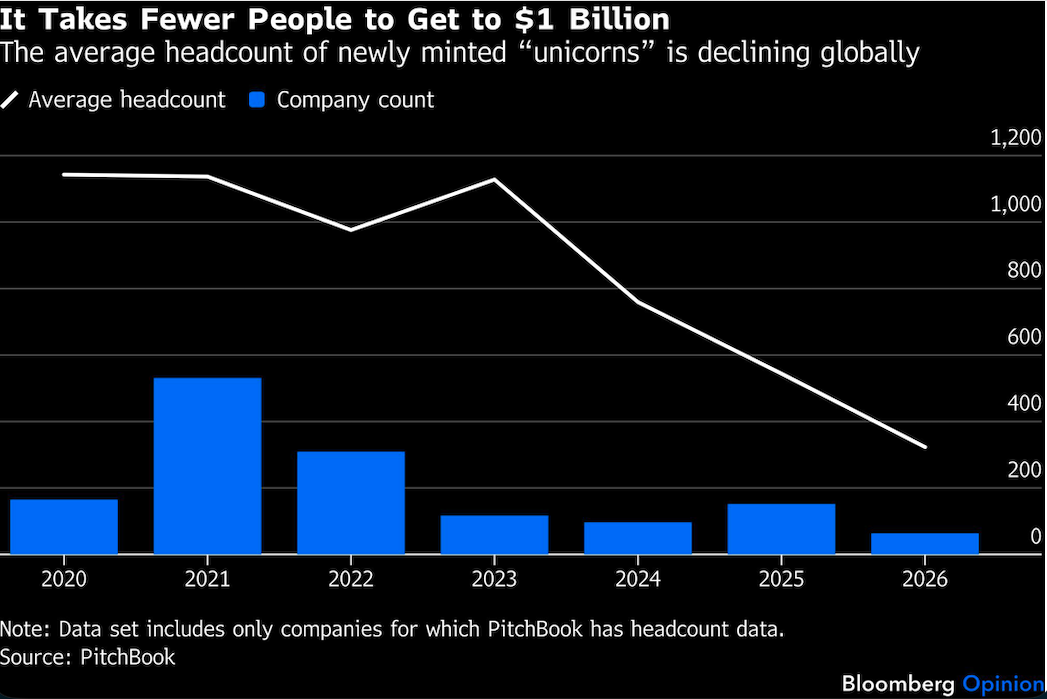
He didn’t divulge their identities nor their precise predictions. But if anyone’s bet fell within two years of that day, they lost. Those with a longer time horizon might still like the odds of it happening sooner rather than later. The trajectory is clear: Unicorn headcounts are shrinking, according to new data from PitchBook.
Yet whether this can be attributed to the vaunted productivity gains of AI is a more complex question. The sales pitch is this: AI’s great promise, as far as startups are concerned, is that it should enable more to be achieved with fewer people. Each software engineer can crank out more code than previously possible, while other operational roles might be replaced, or at least augmented, with chatbots or similar technologies.
While AI may be bringing some of those promised boosts, the drastic drop in employee numbers for today’s crop of unicorns appears to have more to do with the shifting dynamics in venture capital in the post-pandemic years, now supercharged by fevered hype for anything and everything AI.
Globally, the average number of employees at companies that became unicorns has dropped from 1,128 in 2023 — the first full year of ChatGPT’s existence — to 544 in 2025 and 323 so far in 2026. Counting just the US, average headcount for new unicorns in 2026 stands at just 172.
(These numbers are based on companies for which PitchBook has headcount data, typically from company disclosures or press reports. In 2026, that has included 64 companies that became unicorns. The total number of unicorns minted globally this year, according to PitchBook’s data, is 102.)

As the world began to emerge from the pandemic, and large tech companies started to shed thousands of employees, the buzzword among venture capital firms for a fleeting moment was “frugal.” Backers had become tired of the days when companies like Uber Technologies Inc. would burn through billions of dollars in pursuit of rapid growth with little regard for near- or even medium-term profitability. Now companies were expected to have healthier balance sheets and reduced headcount. According to one tally, more than 160,000 tech workers were laid off in 2022 and 260,000 the next year.
The AI boom put overall frugality on the backburner, but the desire for leaner headcounts has endured. That’s one factor. But most crucially to the shrinking unicorn trend is the big VC funds’ eagerness to get in earlier on any company that shows promise of becoming something like the next OpenAI.
“You have these mega funds that have $5 billion, investing at seed,” said Kyle Stanford, PitchBook’s director of research for US venture capital. “They’re able to be a little more elastic on what price they pay. If they need to pay extra or put valuation up another 15%, 20% just to get that deal done — they’re going to do it.”
This has led to remarkable valuations for minuscule teams. The standout example is Safe Superintelligence, the AI startup co-founded by OpenAI co-founder and former chief scientist Ilya Sutskever. It was valued at $32 billion at its last funding round in April 2025 when it had just 16 employees. Its headcount is still “less than 40,” the company said.
Investors’ appetite to back companies created by breakaway former employees of top AI labs is insatiable. Last July, OpenAI’s former chief technology officer, Mira Murati, raised $2 billion — a record for a seed round — for her new company, Thinking Machines Lab, valuing it at $12 billion despite not having released any product. In 2026’s crop of AI unicorns, Redwood City-based Humans&, built by a team of former Anthropic and xAI talent (among others), was valued at $4.48 billion just four months after its founding.
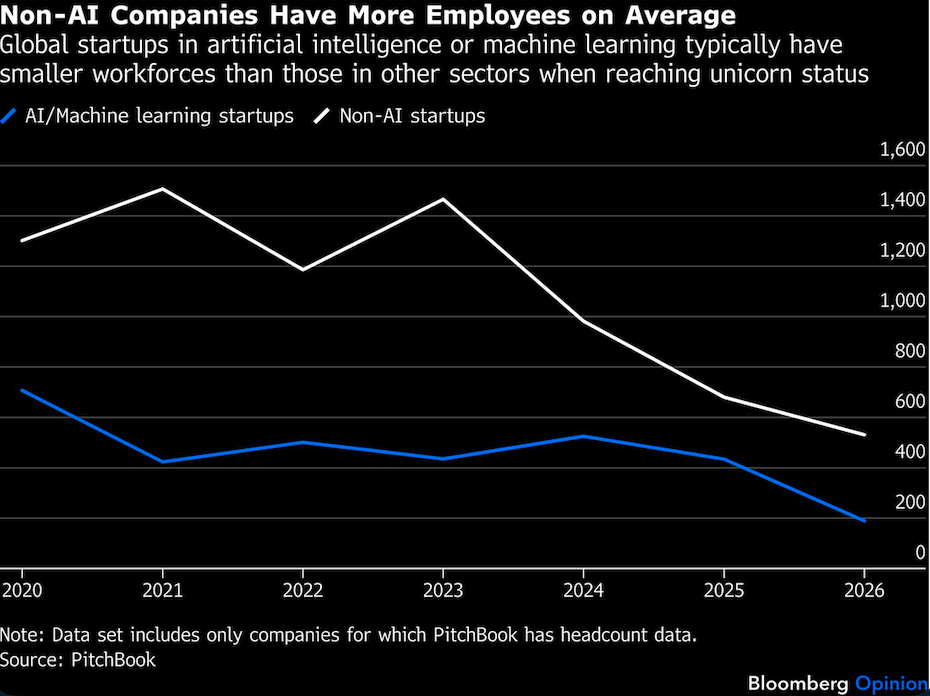
The FOMO-fueled clamor for AI companies might be one explanation for why newly crowned unicorns that are not AI companies typically have more employees. PitchBook had headcount data for 25 new non-AI/machine learning unicorns globally so far this year. They had an average headcount of 531, compared with 189 for the 39 new AI unicorns.
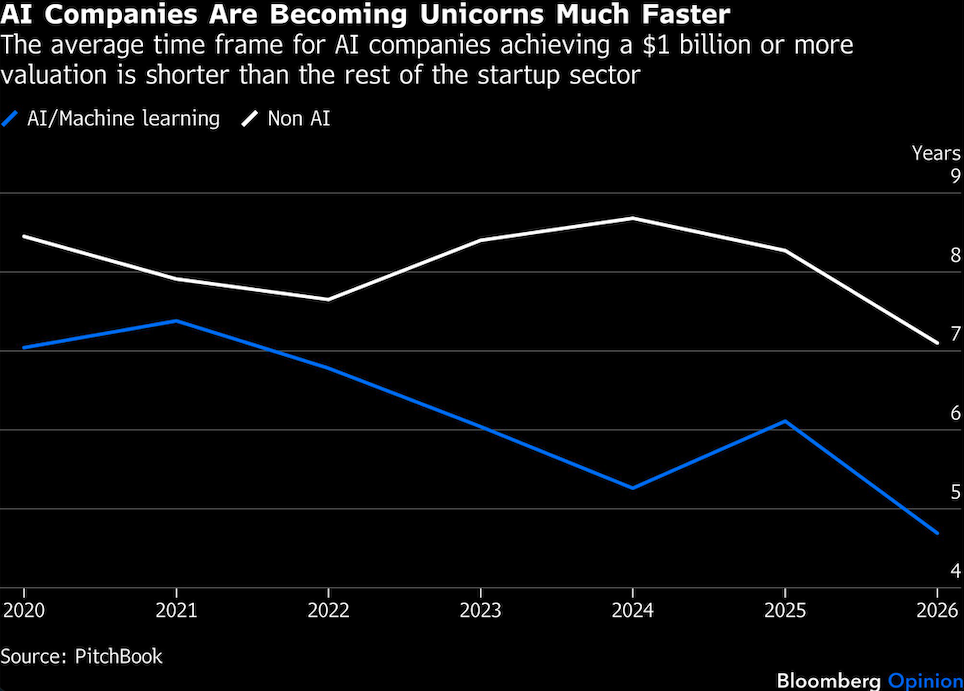
AI companies are also becoming unicorns significantly sooner than non-AI-focused startups. The average age for AI unicorns minted so far in 2026 is around four years and eight months; the median is three years and two months. For non-AI startups that have become unicorns so far this year, both the average and median age was more than seven years.
The plug for AI is that it streamlines every kind of company, not just buzzy AI startups gambled on by venture capitalists, eyes bulging with imagined riches. As it stands, if a single plucky entrepreneur becomes the first to officially claim a solo unicorn, he or she will likely get there more on reputation and hype than on the immediate value of what has actually been built. The world of startups has always been that way, of course, but what is clear is the road from zero to a billion-dollar valuation has been shortened.
Altman didn’t share how soon he thinks a solo unicorn might emerge. His fiercest rival, Dario Amodei of Anthropic, said last May that there was a high probability a solo unicorn would emerge this year.
Perhaps it has already happened. OpenClaw, the open-source AI agent, captured the imagination of Silicon Valley and well beyond when it was launched in November. The bot’s developer, Vienna-based Peter Steinberger, was promptly taken on by OpenAI for an undisclosed but likely very handsome salary. As part of the move, Steinberger pledged to keep OpenClaw open source, creating a foundation for its ownership. “Yes, I could totally see how OpenClaw could become a huge company,” Steinberger wrote about the move. “And no, it’s not really exciting for me.”
Had he chosen a different direction, we might now be calling him the first solo unicorn founder — and someone in Altman’s group chat would have won a bet.
A message from Advisor Perspectives and VettaFi: Discover something new! Click here to register for our upcoming webcasts.
Bloomberg News provided this article. For more articles like this please visit
bloomberg.com.
Read more articles by Dave Lee