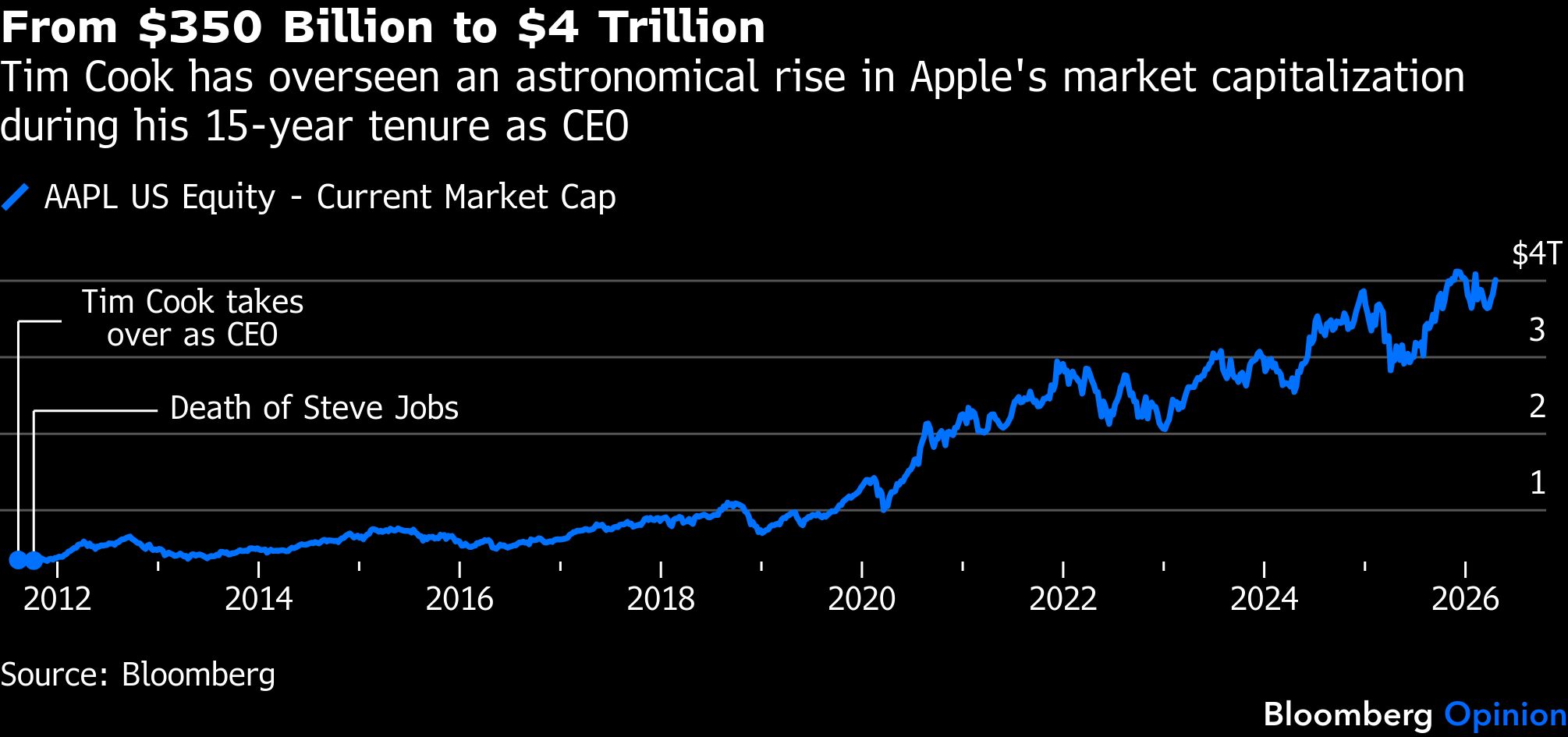
In announcing on Monday that John Ternus would be succeeding Tim Cook as chief executive officer of Apple Inc. this year, the company’s board made it clear: We’re a hardware company and we’re going with the hardware guy.
It’s a mission statement that bears repeating in 2026, the year of Apple’s 50th anniversary and now one that the company and its legions of fans hope will feature a smooth leadership transition. Ternus, who joined Apple in 2001 and rose through the ranks to become senior vice president of hardware engineering in 2021, will take over a company in fine strength but facing looming questions about how it shifts to the new computing paradigm of AI.
Ternus will inherit one of the biggest gambles in recent Silicon Valley history. Unlike the other top technology companies, Apple has chosen not to set aside more than a hundred billion extra dollars to build out data centers or hire rockstar AI researchers on inflated salaries. Instead, it has focused on ensuring it remains the gateway to these new services, betting on the enduring quality (and profitability) of its devices.
Some have said this positioning has left Apple vulnerable. Others see it as trademark Cook restraint, the consequences of which will now fall to his successor. Ternus’ promotion is a doubling-down on Cook’s strategy, but it’s a strategy that will need to be built upon urgently.
Apple may not need to establish itself as a maker of frontier AI models — with the colossal spending that would entail — but it can’t risk having its devices look outdated, either. The firm’s AI efforts have been hobbled by a lack of focus and personnel changes. AI features that were announced with considerable fanfare ended up delayed because engineers couldn’t make them work reliably. Apple had to turn to Google for help improving its lackluster AI assistant, Siri.
Ternus’ job will be to make sure that these are only temporary setbacks and that the next decade is, as IDC analyst Francisco Jeronimo puts it, spent building a “strong AI platform and ecosystem strategy before competitors consolidate their positions.”
Ternus and his subordinates may be looking around to see what might come from initiatives designed to unseat Apple’s dominance, such as OpenAI’s partnership with former Apple design boss Jony Ive to create an as yet undefined AI device. Meta Platforms Inc. also fancies its chances with smart glasses. Thanks to Cook, Apple can face these still minor threats with a decades-long head start on what it takes to manufacture billions of units at an unparalleled high quality. A more formidable foe might be innovations from Samsung or Huawei, though Apple’s software supremacy has held firm so far.
Ternus’ experience with the AirPods and Apple Watch lines stands him in good stead for an era of more “ambient” computing where screens play less of a role. The key will be in how he can reinvigorate iOS — the company’s operating system for mobile devices — and retool it for AI. “Needless to say,” Ternus told his current team in a memo on Monday, “I still plan to be very hands-on.”