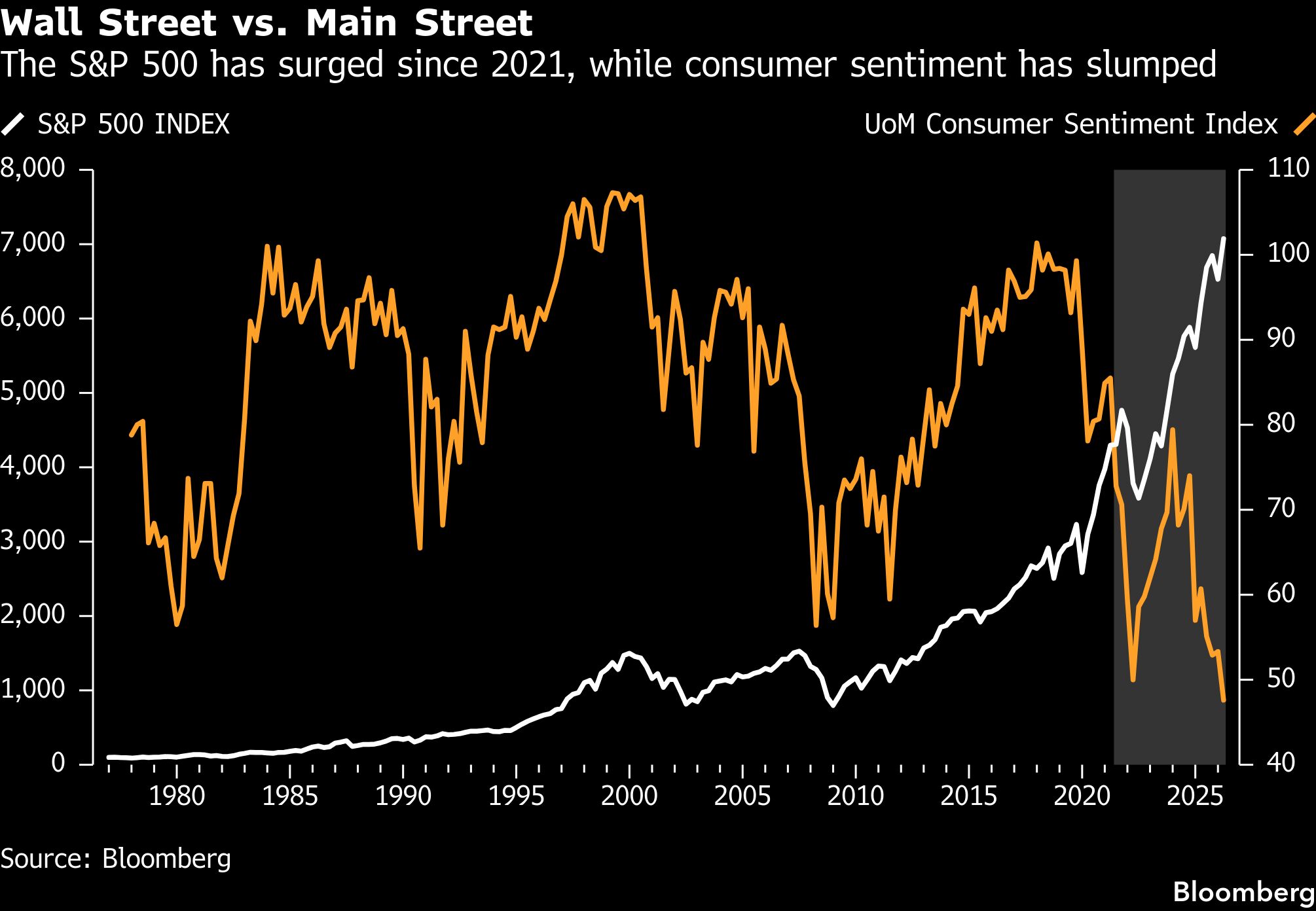
Stocks are trading near a record high, signaling Wall Street is learning to cope with lingering geopolitical risks. Main Street is struggling to catch up.
Consumer sentiment is languishing at all-time lows, with Americans increasingly worried about mounting inflation driven by hostilities in the Middle East. Earlier this month, a preliminary read on the University of Michigan’s consumer sentiment index for April slumped to a record-low 47.6, down from 53.3 in March. The final figures will be released on Friday.
Strong corporate earnings, the revival of the artificial intelligence trade and an otherwise resilient economy have buoyed the stock market even as Americans’ outlook has started to sour. Chief among consumers’ concerns are prices at the gas pump as the closure of the Strait of Hormuz drives up costs.
The divide has reached a critical juncture where investors need to question how much further sentiment can worsen before it starts to erode the S&P 500 Index’s earnings power.
“The consumer remains the bedrock of the US economy, so any deterioration there is ultimately a risk to equities,” said Noah Weisberger, chief US equity strategist at BCA Research.

The US is in a “slowing-but-still-growing” phase, where it’s not a clear recession and reacceleration is still possible, according to Weisberger.
“The market is being supported by resilient earnings and investment-led growth, especially AI- and capex-related spending, while consumers are still contending with a lukewarm labor market and, at least in terms of confidence if not yet spending, higher gasoline prices and headline inflation,” said Weisberger. “Weak confidence also predates the Iran conflict, so this is not purely an oil story.”
Meanwhile, a separate survey from the Federal Reserve Bank of New York showed consumers’ views on their financial situation was deteriorating with more than a quarter of households — the highest proportion since last May — expecting to be worse off.
“The K-shaped recovery continues to divide consumers of different income and spending levels,” said Brent Ciliano, chief investment officer at First Citizens Bank. Ciliano added that higher-income consumers are benefiting from broad financial asset appreciation while those on lower incomes struggle to keep pace with inflation.
Earlier: Warsh Says Fed Needs New Framework for Addressing Inflation
Yet Wall Street continues to pile into the stock market ignoring the early warning signs. The S&P 500 gained 0.7% at 9:42 a.m. on Wednesday, gaining for the sixth time in eight trading days. To Chris Zaccarelli, chief investment officer at Northlight Asset Management, the stock market moves on corporate profits rather than surveys.
“Even if consumers express their unhappiness with the current state of affairs, but have the wherewithal to keep spending, then corporate profits will keep rising and the stock market will rise along with it,” Zaccarelli said.
And there are signs consumers are still spending. Earlier this month, Delta Air Lines Inc. said bookings were strong across premium and corporate travel. Meanwhile, cruise-ship operator Carnival Corp. highlighted robust demand, even with elevated pricing.
But at discount retailers that cater to lower-income shoppers the pressures facing the average American household are more apparent.
Walmart Inc.’s full-year earnings guidance missed estimates when it reported in February. The world’s largest retailer, best known for its discount prices, attributed the more cautious view to the unpredictable state of trade, subdued consumer sentiment and labor market conditions.
Discount chain Dollar General Corp. also gave a more tepid outlook in light of the choppy consumer backdrop and rising gas prices. And home improvement retailer Home Depot Inc. recently noted that economic uncertainty is weighing on consumers’ willingness to take on bigger projects.
It also stretches to real estate firms. D.R. Horton Inc. said in its earnings that new home demand was being impacted by “affordability constraints and cautious consumer sentiment.”
Individual traders are also growing wary. The cohort is now driving the largest share of bearish put-option activity since May 2022, according to strategists at Barclays Plc. This, they said, points to “renewed inflation-driven caution” similar to 2022 when fears the Fed’s rate hikes would push the economy into a recession.
Investors can get a better sense of if consumers are still spending when Procter & Gamble Co. as well as Coca-Cola Co. and Visa Inc. report in coming days.
“Equity markets continue to benefit from historically strong corporate fundamentals,” said Ciliano. “If this fundamentally driven momentum remains intact, so will the upward trajectory in equity market prices.”
A message from Advisor Perspectives and VettaFi: Discover something new! Click here to register for our upcoming webcasts.
Bloomberg News provided this article. For more articles like this please visit
bloomberg.com.
Read more articles by Joel Leon, Peyton Forte