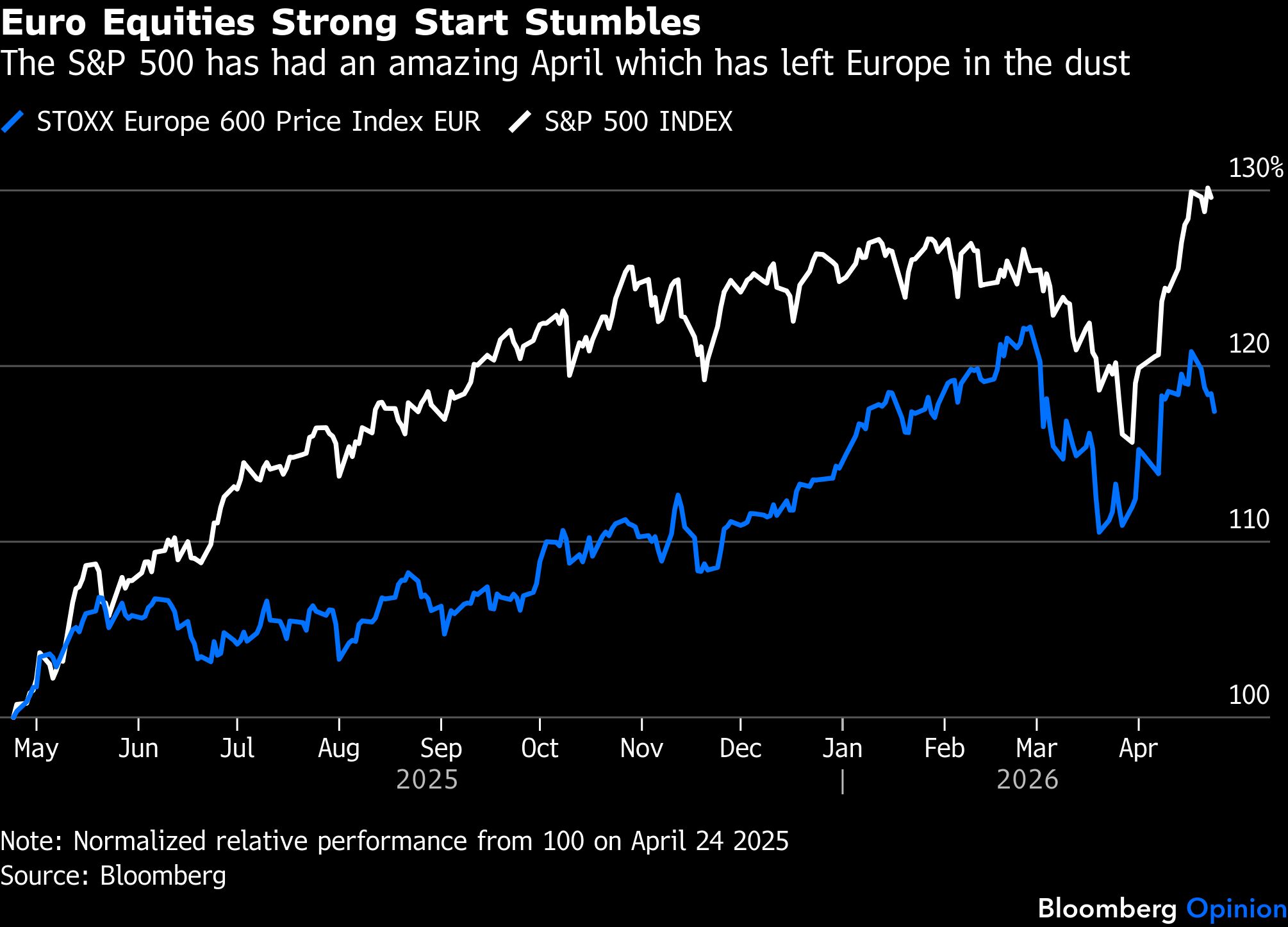
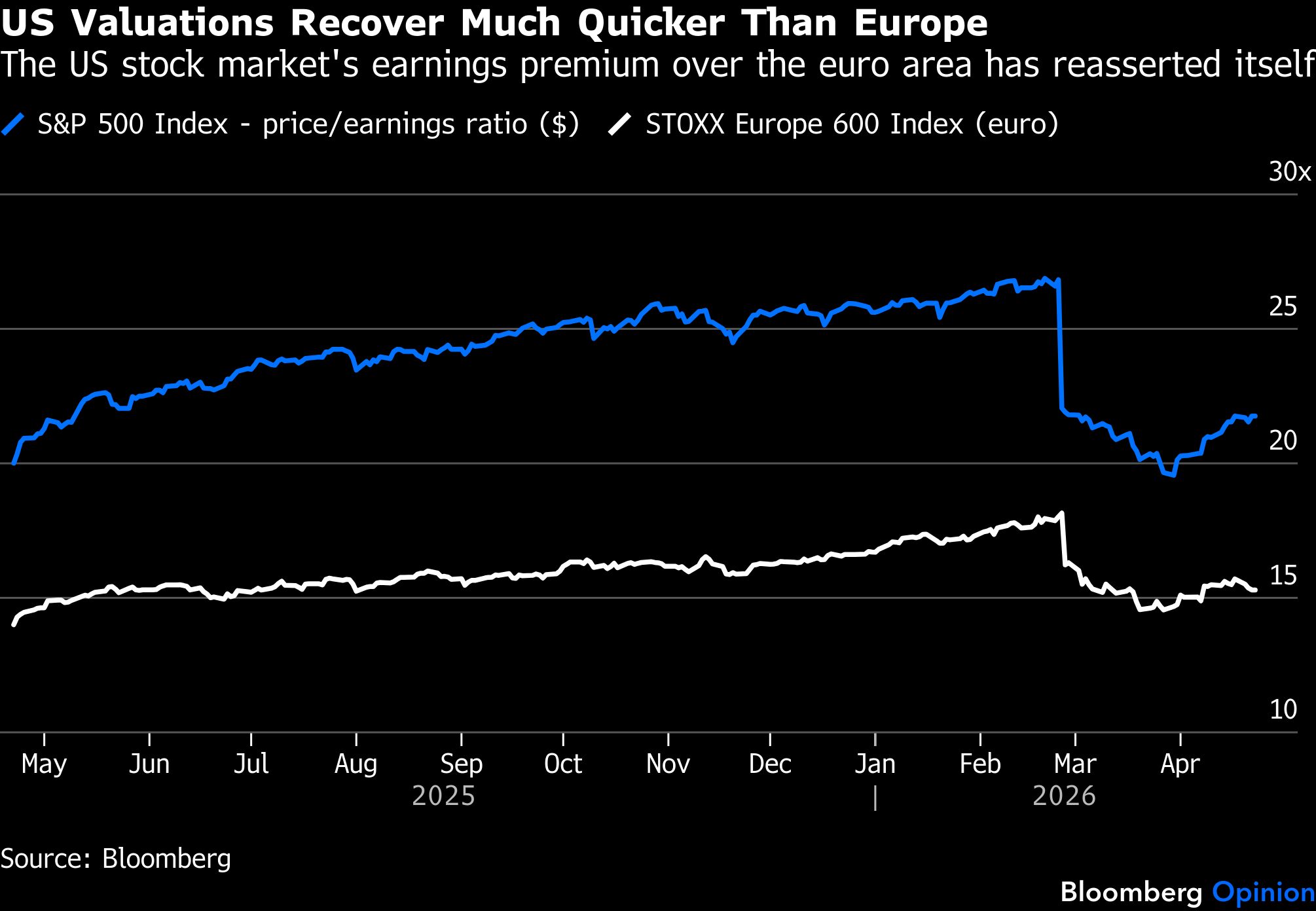
European stocks started the year much stronger than their US peers but the tantalizing prospect of the euro area clawing back some of its persistent gap in earnings growth, and the higher company valuations that come with it, looks to have slipped through its grasp again.
Europe’s proximity to both the Iran and Ukraine wars means its equity market can’t catch a break. A first look at April’s economic data shows the impact of the Gulf conflict is showing up starkly. International investors have too many incentives to look elsewhere.
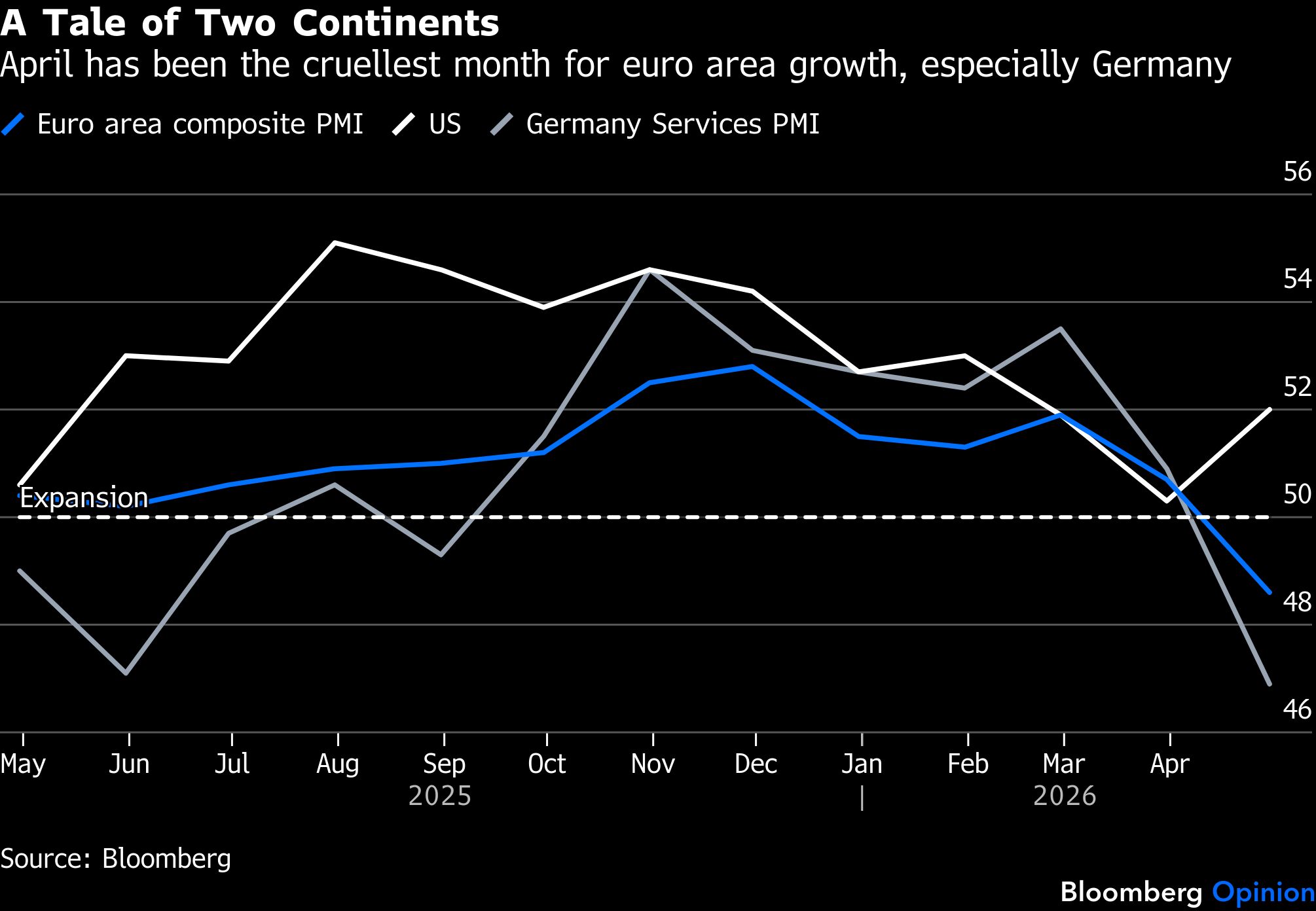
The euro-area economy is again on the cusp of recession, as a blockade of the Strait of Hormuz — a vital waterway for oil from the Gulf — leaves it more vulnerable to soaring energy prices. Euro-area purchasing managers’ indexes, a measure of business activity, were uniformly poor in April, removing vestiges of hope that the economic from the Iran war will be glancing. The composite measure fell more than forecast to 48.6, a 17-month low. Worse, a measure of raw material input prices jumped to 76.9 from 68.9 in March and selling prices rose to 68.4 from 65.3. This is evidence of the recent energy-price impact.
Germany was the worst hit, with a four percentage-point drop in its services sector PMI to 46.9, well below the 50 line that separates growth from contraction. Manufacturing has held up better but this may be driven by stockpiling of inventories in anticipation of expected supply bottlenecks. At least there’s some realism from the German government, which has halved its 2026 growth estimate to 0.5%.
This contrasts bleakly with the composite PMI gauge in the US rising more than expected to 52 in April from 50.3 in March, with both manufacturing and services stronger. The broader performance of the local economy isn’t the only lodestar that equity investors follow but it makes it tough for a region to do well if it’s wading through economic mud with little prospect of firmer ground.
Euro-area equity markets have adjusted accordingly. A Bloomberg survey of 17 analysts’ forecasts shows they expect the Stoxx Europe 600 Index to end 2026 just 2% higher than today. Although corporate earnings reported so far have risen by an average of 4% — a notable improvement from the fourth quarter’s contraction — investors had been expecting much better before the US and Israel’s protracted military standoff with Tehran.
There’s been a welter of downward revisions to earnings forecasts related to war impacts. Ludovic Subran, chief investment officer at Allianz SE, told Bloomberg News he was “more worried about a recession than stagflation.”
Citigroup Inc. analysts, who recommend that investors should be underweight euro-area stocks versus their US and UK counterparts, argue that European equities are still pricing in earnings upgrades, which are a “high bar to achieve in the current environment.”
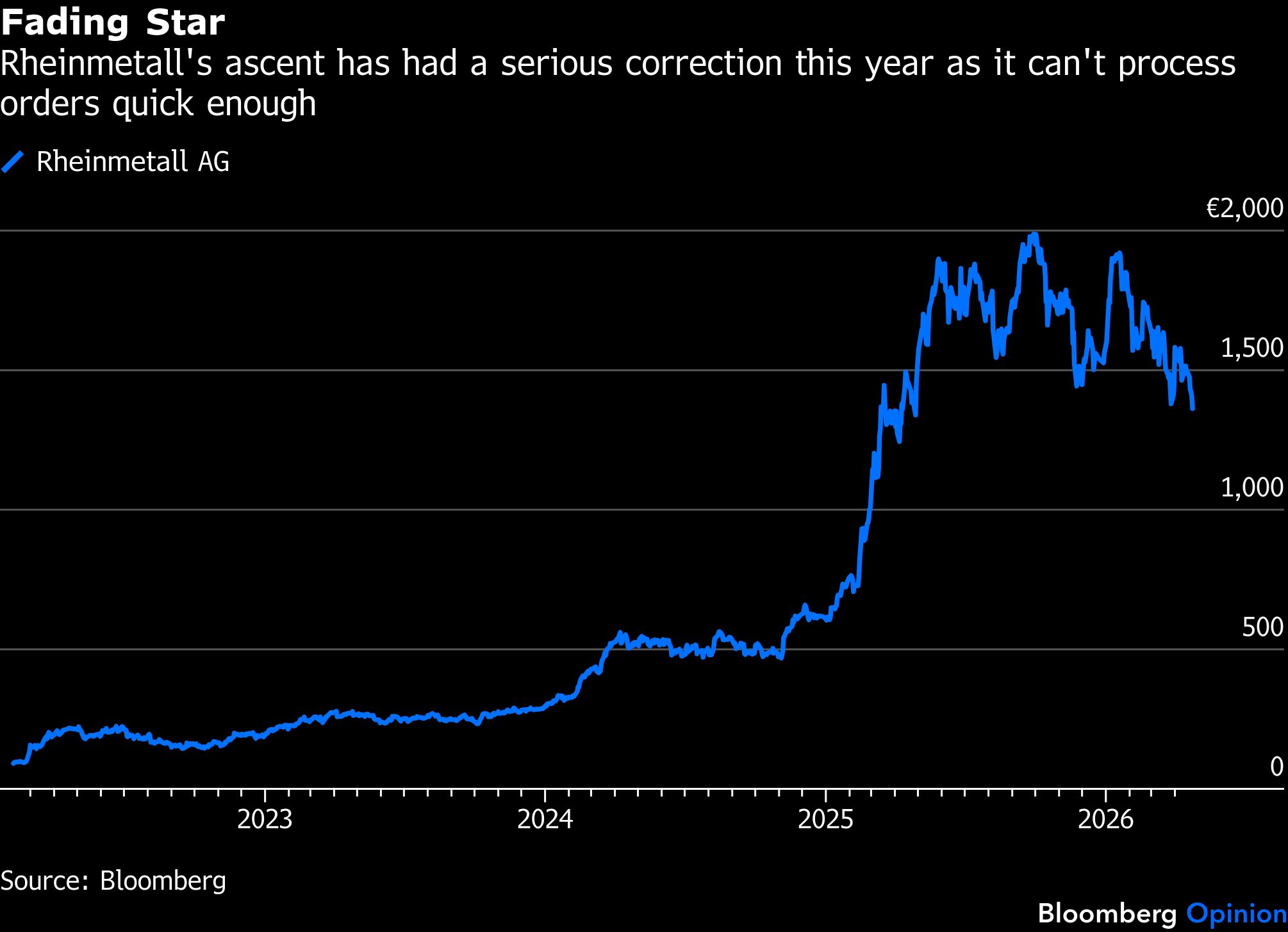
Banks and defense stocks were the big gainers early this year. But the euro Stoxx 50 index of leading banks is nearly 10% off its early February high. Shares in German stock-market darling Rheinmetall AG, seen as a big winner from Europe’s rearmament, had risen 20-fold since Russia invaded Ukraine. But its luster has rubbed off as it has failed to live up to high investor expectations, falling 30% since then. Its record order backlog can’t be delivered quickly enough to justify its sky-high valuation.
There is less rationale to search for hidden gems in the old economies of Europe, especially with the effects of the Hormuz oil shock hitting them much harder than the energy independent US. With more than half of revenue for large-cap euro area companies originating within the bloc or Asia, where growth and energy markets are similarly afflicted, European companies are only really seeing healthy income increases in the US. That doesn’t help in any argument to invest more in the continent’s businesses.
The outperformance of the US economy compared with Europe is showing up in first-quarter corporate earnings, with 85% of American companies beating expectations, their strongest quarter in two years. The finance and tech sectors have led with an average 8% earnings uplift, twice the pace of the euro area.
The artificial-intelligence revolution is still the main game in town, with demand for silicon chips driving the Philadelphia Semiconductor Index up 40% in April. That’s spilling over into record highs not just for the S&P 500, but for the Japanese Nikkei 225, Taiwanese Taiex and Korean KOSPI indexes also. With tech a smaller part of Europe’s industrial landscape, it’s pretty tough to compete for attention with the gold rush elsewhere.
There had been hopes of economic stimulus to bolster some of the euro area’s manufacturing prowess. The European Union has a raft of loan programs to help nation states lift their defense spending. Typically, though, EU members have dragged their heels on drawing down interest-bearing debt and the effect so far has been muted, with the extra cash often being spent on regular budget items. Germany alone has nearly €1 trillion ($1.17 trillion) of infrastructure and military spending earmarked. A catch is that the infrastructure spending extends over 12 years. There isn’t enough happening in the immediate future to propel growth.
The German IFO institute reckons as much as 95% of the country’s proposed new infrastructure spending is being siphoned off to plug budget holes. In fairness, Berlin’s finance ministry has pushed back, reckoning that investment spending rose 17% last year to €87 billion. That’s still peanuts.
This month, International Monetary Fund economists posted a dispiriting historical blog on how little defense spending has a multiplying effect on economic growth. Hopes are fading that the European military splurge will achieve proper scale, avoid duplication between EU members and won’t just be spent on more readily available US weaponry.
Still, the EU’s strength is its ability to pull together in a crisis. The freeing up of a €90 billion Ukraine support package is a step forward. A resolution of either of the conflicts on its doorstep, with a concomitant drop in energy prices, would be disproportionately beneficial to euro equities, in the same way that they are suffering most now. Germany has just published its first military strategy in 70 years and vowed to take on “responsibility for Europe.”
But the hard reality is that 2026’s brief moment in the sun for euro-area equities has clouded over once again.
A message from Advisor Perspectives and VettaFi: Discover something new! Click here to register for our upcoming webcasts.
Bloomberg News provided this article. For more articles like this please visit
bloomberg.com.